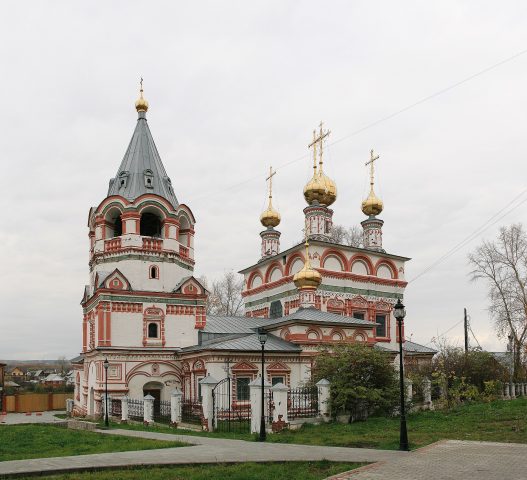
Perched on the high bank of the Kama River, Trinity Cathedral in Solikamsk feels like a place where time moves differently. It doesn’t dominate the skyline with dazzling colors or ornate details, but rather blends into the town’s quiet rhythm, as if it has always been here—watching over the streets, the river, and the slow passage of centuries. Solikamsk itself was once far more than a quiet provincial town; it was a powerhouse of salt production and trade, and the cathedral stands as a reminder of that era, its sturdy walls having weathered fires, wars, and shifting regimes without losing their quiet dignity.
The cathedral’s story begins in the 17th century, when Solikamsk was at its peak. Salt barons, flush with wealth, funded the construction of churches to leave their mark on the city, and Trinity Cathedral was no exception. The first wooden church on this site appeared early in the century, but by 1684, it had been replaced by a stone structure. Built in the tradition of northern Russian architecture, the cathedral was designed to endure: thick walls, small windows, and heavy vaults gave it a fortress-like solidity. It survived multiple fires, each time rising again, its original form largely intact.
What makes Trinity Cathedral striking is the way it balances strength and grace. From the outside, it appears almost austere, its massive structure softened by delicate window frames and the soaring spire of its bell tower. Inside, the space once gleamed with the work of master craftsmen—iconostases painted in the style of the Stroganov school, gilded carvings, and intricate royal doors. Much of that splendor is gone now, but the fragments that remain offer a glimpse of the cathedral’s former grandeur.
The bell tower is perhaps the most iconic part of the cathedral. More than just an architectural feature, it serves as a landmark for the town, its slender silhouette visible from afar. In clear weather, the view from the top stretches across the Kama River and the surrounding forests, though few venture up the steep, worn staircase these days. Even from the ground, the tower commands attention, a silent testament to Solikamsk’s past as both a commercial and spiritual hub.
Like many churches in Russia, Trinity Cathedral suffered during the Soviet era. It was closed, repurposed as a warehouse, a workshop, even a gym. Icons vanished, frescoes were painted over, and the interior was stripped of its finery. Yet the building endured. Restoration began in the late 20th century, and today the cathedral is active again, though it has not been fully returned to its former glory. Inside, the scent of wood and wax lingers, and traces of old murals peek through the walls. The iconostasis, though simpler than it once was, still carries a sense of timelessness.
Trinity Cathedral is more than an architectural monument; it’s a living piece of Solikamsk’s history. It has witnessed the town’s rise and fall, the changing of rulers and eras, yet it remains steadfast, a quiet guardian of the past. Visitors come not just to pray but to feel the weight of history in its walls. The light filters through narrow windows, and in the stillness, it’s easy to imagine the voices of those who once knelt here in prayer.
Solikamsk isn’t a place that draws crowds of tourists, and that’s part of its charm. There’s no rush here, no need to hurry from one attraction to the next. The streets are quiet, the pace unhurried, and Trinity Cathedral fits perfectly into this atmosphere. It doesn’t shout its history; it lets you discover it slowly, in the details—the worn stone steps, the faint outlines of old frescoes, the way the light falls across the floor. There’s no pretense here, just the quiet authenticity of a place that has seen centuries unfold. That, perhaps, is why it lingers in the memory long after you’ve left.