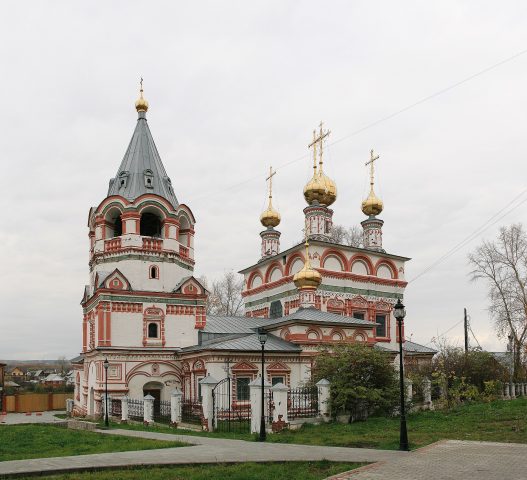
The Voivode’s House in Solikamsk is one of those rare places where the past doesn’t just linger—it feels alive. Built in the late 17th century, this sturdy two-story stone mansion once served as the residence of the local voivode, the tsar’s appointed governor who ruled the city and its surrounding lands. The building has changed little over the centuries. Its thick walls, tall windows framed by intricate wooden trim, and steeply pitched roof are all characteristic of the period. Step inside, and the sheer scale of the place becomes apparent—ceilings so high they seem to defy gravity, walls nearly a meter thick, and an atmosphere that carries the weight of history.
Solikamsk was no ordinary town in its heyday. From the 16th century onward, it thrived as one of Russia’s most important salt-producing centers, a commodity so valuable it was often called "white gold." The city’s wealth attracted the attention of the tsar’s administration, and the voivodes sent here were far more than mere bureaucrats. They were the ultimate authority—overseeing tax collection, dispensing justice, and maintaining order in a region where fortunes were made and lost on the salt trade. The Voivode’s House was built to reflect that power: solid, unshakable, and designed to endure. It was the heart of the city’s political and economic life, where merchants haggled over shipments, messengers delivered royal decrees, and disputes were settled in its grand halls.
The architecture of the house blends traditional Russian medieval styles with local Ural influences. Stone was a rare commodity in the area, so it had to be brought in from afar, adding to the building’s sense of permanence. The facade is understated yet striking, with carved window frames, subtle cornices, and small niches that break up the expanse of stone. Inside, the original features remain intact: vaulted ceilings, heavy wooden doors with wrought-iron hinges, and massive brick stoves that once heated the rooms. The basement, where supplies were stored, still has narrow slit windows—remnants of a time when even a governor’s residence needed to be defensible.
After the voivode system was abolished in the 18th century, the house passed through various hands. It served as government offices, then a district school, and later became a residential building. Fortunately, these changes did little to alter its original character. During the Soviet era, it housed a museum, and while the exhibits inside may have shifted over time, the building itself remained the star attraction. Today, the Voivode’s House is part of the Solikamsk Local History Museum, and visitors can explore its rooms only as part of a guided tour. But even from the outside, the house speaks volumes—of the clatter of messengers’ boots on the cobblestones, the scratch of quills in the chancellery, and the weighty decisions made within its walls.
Solikamsk is often called an open-air museum, and for good reason. The city is dotted with reminders of its past: wooden churches, merchant mansions, and old saltworks. Yet the Voivode’s House stands out, not just as an architectural relic but as a living connection between eras. In the 17th century, it was a seat of power; in the 18th, a center of education; in the 19th, a home for ordinary families. Now, it preserves the stories of everyone who has walked through its doors.
A visit to the Voivode’s House is worth it for the atmosphere alone. The interior stays cool even in summer, and the silence is so profound it feels like time moves differently here. Guides share tales of the voivodes’ daily lives—how they entertained guests, drafted laws, and settled disputes. At times, it’s easy to imagine the echoes of the past: the clatter of hooves on the street outside, the murmur of merchants in the marketplace, the rustle of papers in the chancellery.
From the outside, the building appears austere, almost stern, but that’s part of its charm. It doesn’t demand attention; it simply endures, having outlasted centuries of change. The surrounding streets, with their narrow lanes and low fences, are just as steeped in history. The Voivode’s House isn’t just a landmark—it’s a tangible piece of the past, one that invites you to step inside and experience history firsthand. That’s what makes it unforgettable.