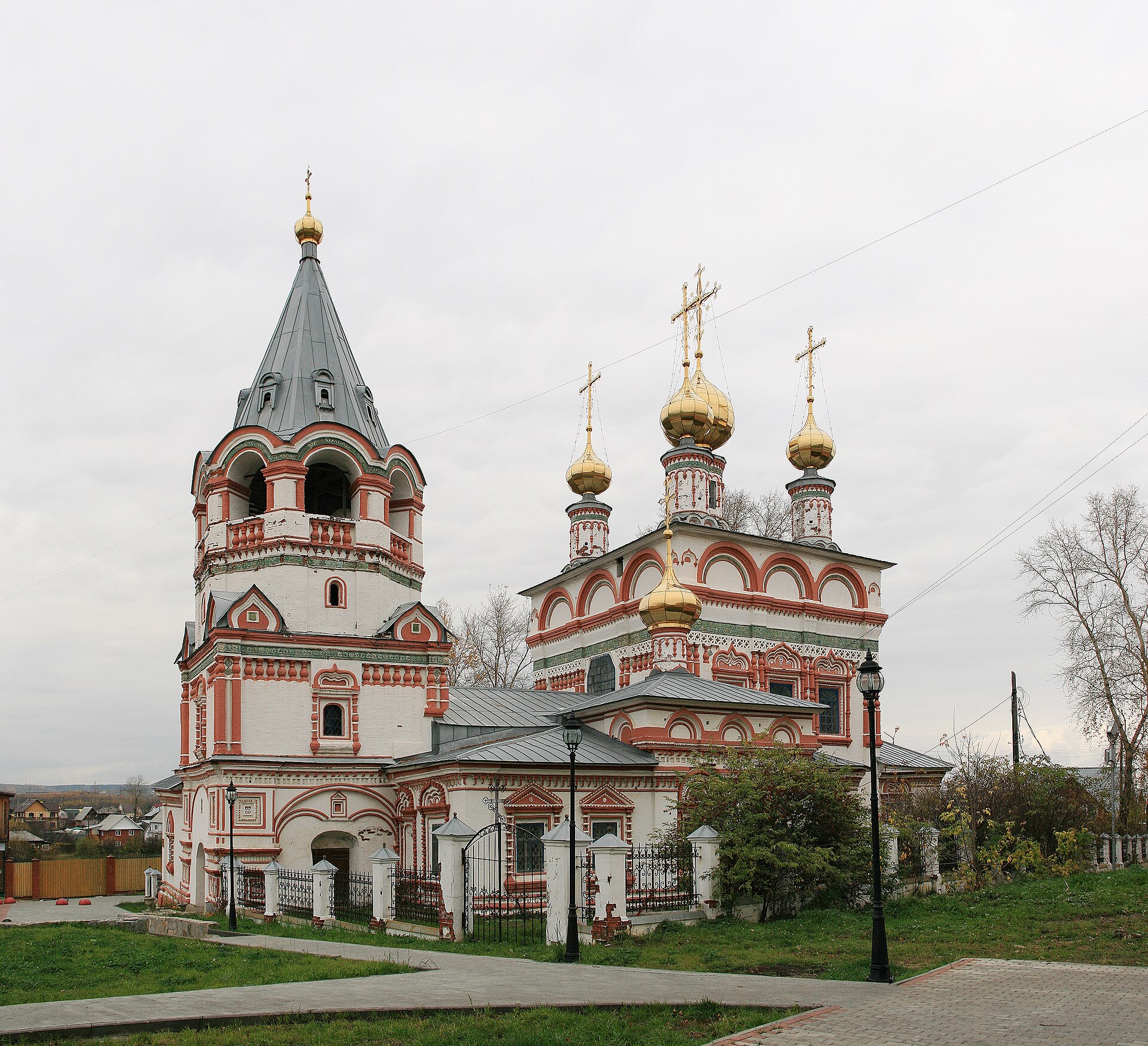
The Church of the Epiphany in Solikamsk is one of those rare places where time seems to slow down, as if the weight of history itself has settled into its walls. Built in the early 18th century, it stands on the banks of the Usolka River, a quiet witness to the centuries of change that have shaped this old Ural town. Solikamsk was once one of the wealthiest cities in the region, its fortune built on salt mining, and the church reflects that legacy—not just in its architecture, but in the atmosphere that lingers here, as if the very air carries echoes of the past.
The church was constructed during a period when Russian architecture was transitioning from the austere forms of the pre-Petrine era to the more ornate and decorative styles that followed. The Church of the Epiphany embodies this shift perfectly. Its two-story structure, topped with a tall bell tower and a steep, shingled spire, manages to feel both grand and intimate at once. The white stone details, the intricate window frames, and the playful brickwork give the building a sense of lightness, despite its solid construction. The southern facade is particularly striking, adorned with kokoshniks—semicircular decorative gables that were common in northern Russian architecture but take on a distinct local character here, softened by the Ural landscape.
Inside, the church has lost much of its original furnishings, but what remains offers a glimpse into its former splendor. The high vaulted ceilings, the spacious hall with its choir loft, and the faded murals on the walls once glowed in the light of countless candles and oil lamps. Now, the space is quiet, but if you listen closely, you can almost hear the creak of floorboards, the murmur of prayers, the distant peal of bells ringing over the town. The church has survived fires and restorations, each time rebuilt with care to preserve its historical spirit.
Solikamsk has always been a place where different lives and cultures intersected. Merchants and industrialists, exiles and pilgrims—all passed through here, and the Church of the Epiphany served as more than just a place of worship. It was a hub of community life, where trade disputes were settled, deals were struck, and townspeople gathered to share news. In the 18th century, when the city thrived on salt production, the church was one of the wealthiest in the region. Its icons were framed in precious metals, its chalices were silver, and its vestments were woven from rich brocades—all symbols of the prosperity that salt brought to the area.
Over time, Solikamsk’s role changed. Salt mining declined, and the city grew quieter, though it never lost its historical significance. The Church of the Epiphany remains one of the few reminders of its former grandeur. Today, it is both an active place of worship and a federal architectural monument. Visitors come not only to pray but also to explore the history of the Urals, Russian culture, and traditional craftsmanship. There’s no tourist hustle here, no crowds—just a chance to step into the past and feel its presence.
The church is especially beautiful in winter, when snow blankets its roof and bell tower, accentuating the clean lines of its design. In summer, surrounded by greenery and blooming gardens, it blends seamlessly into the landscape, as if it grew from the earth itself. The Usolka River, flowing slowly nearby, adds to the sense of timelessness. Watching its unhurried waters, it’s easy to imagine the barges that once carried salt downstream, or the merchants and travelers who paused by the church on their journeys.
More than just a building, the Church of the Epiphany is a living piece of history woven into the fabric of Solikamsk. It tells the story of how the city evolved, how Russian architecture developed, and how people lived through different eras. There’s nothing flashy or artificial about it—just a quiet authenticity that draws those who seek something real. In a world that often feels increasingly uniform, places like this remind us that every corner of the earth has its own soul, its own story to tell.