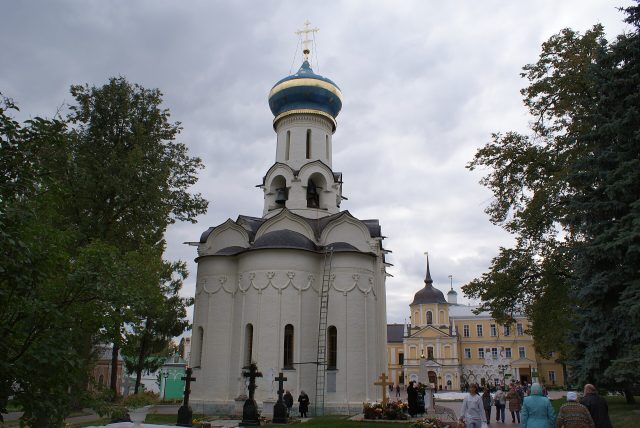
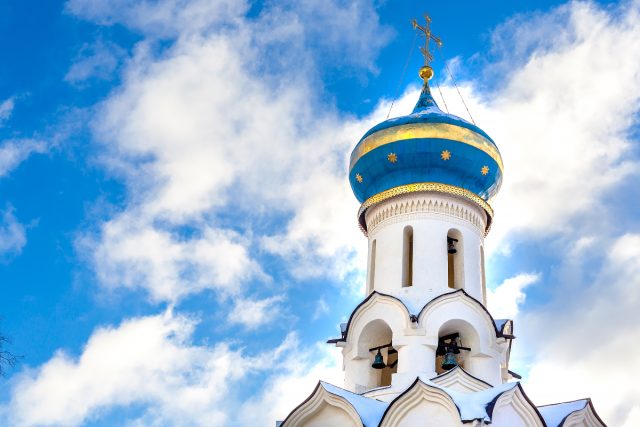
The Trinity Lavra of St. Sergius is a place where time seems to slow down, where the weight of centuries lingers in the air. Perched on a hill above the Konchura River in Sergiyev Posad, this monastery has stood for over six hundred years as the spiritual heart of the Russian Orthodox Church. Its walls have witnessed the rise and fall of empires, the turmoil of wars, and the quiet resilience of faith. More than just an architectural ensemble, the Lavra is a living chronicle—every stone, every fresco, every toll of its bells carries the echoes of the past.
Founded in the 14th century by St. Sergius of Radonezh, one of Russia’s most revered saints, the monastery began as a humble wooden church and a handful of cells where the first monks lived in ascetic devotion. Sergius chose this spot deliberately: surrounded by dense forests, it was secluded yet lay along a vital route connecting Moscow to the north. Over time, a settlement grew around the monastery, and the once-modest hermitage evolved into a major religious and cultural center. It’s hard to imagine now, but this place was once wilderness, where monks lived in dugouts and survived on what the land provided.
The Lavra’s architectural identity took shape over centuries. The earliest structures were wooden, but by the 15th century, stone construction began in earnest. The oldest surviving building is the Trinity Cathedral, erected in 1422 on the site of the original wooden church. Its white-stone walls, austere lines, and golden domes became a model for Russian church architecture. Inside, the relics of St. Sergius rest beneath the cathedral’s vaulted ceilings, drawing pilgrims from across the country. The frescoes by Andrei Rublev and Daniil Chyorny, which adorn the walls, are not merely masterpieces of art—they are sacred artifacts, preserving the spiritual legacy of the monastery.
By the 16th century, the Lavra had acquired its iconic fortified walls and towers, giving it the appearance of an impregnable stronghold. This was no accident—the monastery had often been a target for invaders. During the Time of Troubles, it withstood a siege by Polish-Lithuanian forces, and in 1812, preparations were made to defend it against Napoleon’s advancing army. Even today, the walls—some up to six meters thick—stand imposing, though their defensive purpose has long faded. Behind them lies a world unto itself: churches, bell towers, refectories, monastic cells, and outbuildings, each with its own story.
One of the most striking structures within the Lavra is the Assumption Cathedral, built in the 16th century as a tribute to its namesake in the Moscow Kremlin. Its five domes, soaring arches, and lavish interior evoke a sense of grandeur and solemnity. Here, the tomb of Tsar Boris Godunov and his family serves as a rare reminder of Russia’s turbulent Time of Troubles. Nearby, the 18th-century bell tower rises over eighty meters into the sky, making it one of the tallest in Russia. From its observation deck, the view stretches across the Lavra and the red-roofed town of Sergiyev Posad, nestled among rolling green hills.
Beyond its spiritual significance, the Lavra has long been a center of learning. In the 17th century, it became home to Russia’s first theological academy, training clergy and scholars. Today, the Moscow Theological Academy continues this tradition, educating future theologians. The monastery’s library holds ancient manuscripts and books, some copied by hand in the Middle Ages. For many visitors, a trip to the Lavra is as much a cultural experience as a religious one—exhibitions of icon painting, the resonant peal of bells, and grand liturgical services on feast days all offer glimpses into Russia’s spiritual and artistic heritage.
The atmosphere of the Lavra is unlike anywhere else. Even on the hottest summer days, a cool stillness pervades the grounds, broken only by the rustle of leaves and the distant call of birds. Wandering its paths, one stumbles upon quiet courtyards, old wells, and blooming gardens, each corner revealing something new. On feast days, the monastery transforms: thousands of candles illuminate the churches, the scent of incense fills the air, and the sound of bells carries far beyond the walls. Yet even on ordinary days, the Lavra is never empty. Pilgrims, tourists, and locals come to venerate the relics of St. Sergius, light a candle, or simply find a moment of peace.
Sergiyev Posad and the Lavra are inseparable. The town grew up around the monastery, its history intertwined with that of the holy site. Today, it remains a place of pilgrimage and a popular destination for travelers from Moscow and beyond. The old town, with its wooden houses, museums, and souvenir shops selling icons and matryoshka dolls, offers a glimpse into traditional Russian craftsmanship. But the real draw is the intangible sense of continuity—the feeling that here, time moves differently, and the past is never far away. Whether you come for faith, history, or simply curiosity, the Lavra leaves an impression that lingers long after you’ve left its walls.