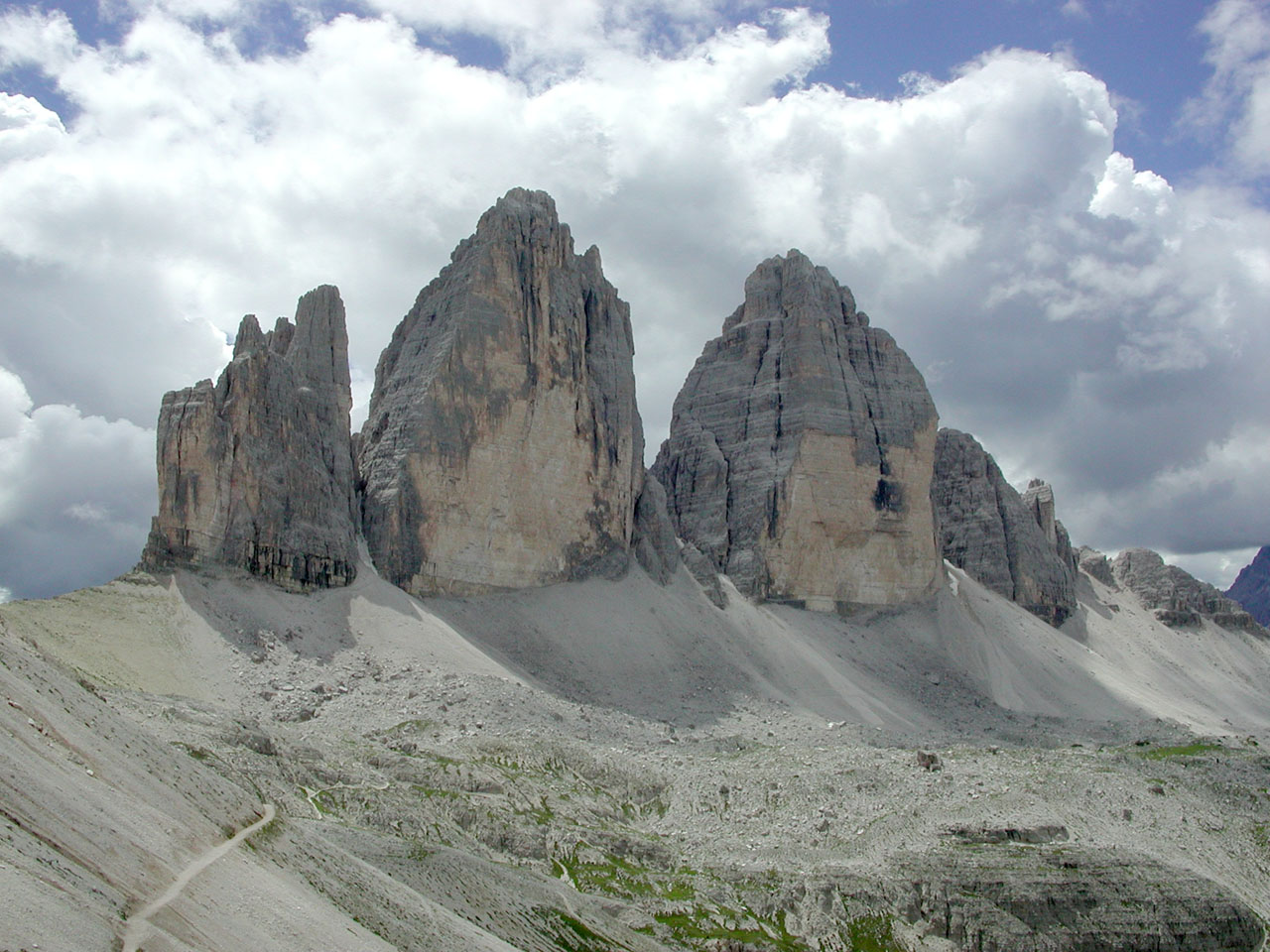
The Tre Cime di Lavaredo are one of those rare places in the Dolomites that feel as though they were shaped by something greater than time or geology. These three jagged peaks rise above the Auronzo valley like sentinels, their sharp silhouettes instantly recognizable even from a distance. Though they appear almost identical at first glance, each has its own distinct character. The central peak, the tallest at just under three thousand meters, anchors the formation, while the two flanking summits complete a shape that has become a symbol of the entire mountain range. Their name simply means the Three Peaks of Lavaredo, but the simplicity of the title belies the drama of the landscape they dominate.
The history of the Tre Cime is inseparable from the story of mountaineering itself. In the late 19th century, these peaks became a proving ground for early climbers, their sheer faces and unpredictable weather testing the limits of skill and endurance. The first recorded ascent of the highest summit took place in 1869, and since then, the routes to the top have been woven into the lore of the Alps. During World War I, the area became a battleground, with Italian and Austro-Hungarian forces clashing along the ridges. Remnants of trenches and fortifications still cling to the slopes, a quiet reminder of how even the most remote places can become stages for human conflict.
Today, the Tre Cime are best known as a destination for hikers. The most popular approach begins at Rifugio Auronzo, a mountain hut perched at around 2,300 meters. From there, a well-marked trail leads toward the base of the peaks, a journey of about an hour and a half at a steady but manageable pace. The path is not particularly steep, but the constant ascent demands a certain level of fitness. The reward, however, is immediate—the first glimpse of the Tre Cime emerging from the curve of the trail, followed by the gradual reveal of the surrounding cliffs and, eventually, the sweeping view of the Misurina valley and its mirror-like lake below.
What makes the Tre Cime so compelling is their ability to change with the light. At dawn, the limestone glows a soft pink, shifting to gold as the sun climbs higher. By midday, the peaks are a brilliant white, almost too bright to look at directly. As evening approaches, they take on deeper hues—purples, blues, and the faintest traces of violet. On overcast days, the summits seem to dissolve into the clouds, giving the impression that they are floating above the earth. In winter, snow softens their edges, but the grandeur remains undiminished.
The area around the Tre Cime has developed just enough to make a visit comfortable without spoiling the sense of isolation. Rifugio Auronzo offers a place to rest, with simple meals like polenta with cheese or hearty stews that taste even better after a long walk. A handful of other huts along the route provide similar hospitality during the summer months. Staying overnight is worth considering, if only for the chance to experience the peaks at sunrise, when the trails are empty and the only sounds are the wind and the distant call of birds.
For those who prefer not to hike, there are other ways to see the Tre Cime. From Lake Antelao, the peaks appear even more imposing, their sheer faces reflected in the still water. A cable car ride to the nearby town of San Candido offers another perspective, with guided excursions available for those who want to get closer without tackling the full trail. No matter how you approach them, the Tre Cime leave a lasting impression—one of scale, silence, and the quiet power of the natural world.
It’s important to remember that the Tre Cime are part of the Dolomiti Bellunesi National Park, a UNESCO-protected area with strict conservation rules. Visitors are asked to stay on marked paths, avoid lighting fires, and carry out any waste. These measures help preserve the delicate ecosystem, where rare alpine plants cling to the rocks and wildlife like chamois, marmots, and golden eagles still thrive. A careful eye might spot colorful lichens on the stones or hear the sharp whistle of a marmot warning its colony of approaching footsteps.
There is something uncompromising about the Tre Cime, a starkness that is part of their appeal. They are not a place of soft edges or gentle beauty, but of raw, unfiltered grandeur. There are no palm trees or crowded beaches here, no hum of traffic or chatter of crowds. Instead, there is space—wide, open, and humbling. Perhaps that’s why photographs of the Tre Cime so often become symbols of travel itself. They remind us that the world is vast, that some of its most extraordinary sights require effort to reach, and that true beauty is often found where the land is wild and untamed.