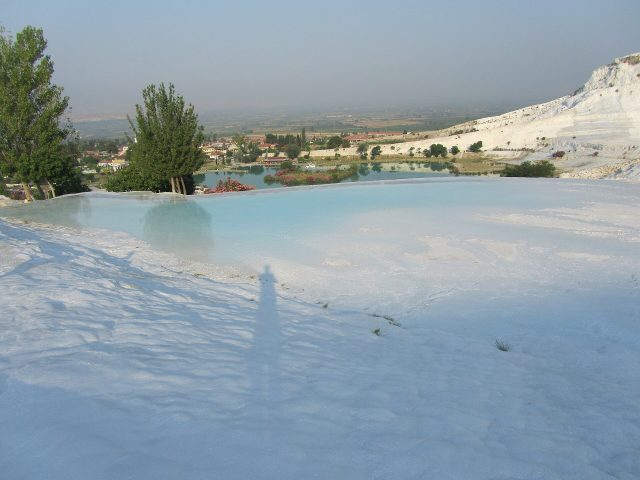
The white terraces of Pamukkale spill down the hillside like a frozen waterfall. They’re travertine—limestone layers left by thermal springs over thousands of years. The water, heavy with calcium and carbon dioxide, flows down the slope, depositing minerals that harden into soft, chalky formations. The contrast between the stark white stone and the green hills around it is sharp, especially in the Anatolian sun.
Above the terraces lie the ruins of Hierapolis, an ancient city founded in the 2nd century BCE. People once came here for the healing waters, and the Romans and Byzantines built temples, baths, and a theater. Now, the stone streets and the amphitheater—still intact—overlook the same valley they did two thousand years ago.
The terraces depend on the springs, which bubble up at 35°C with high mineral content. For years, visitors walked and bathed on them, but damage led to restrictions. Today, only designated areas like Cleopatra’s Pool allow swimming. There, you can float among ancient columns that fell into the water during an earthquake.
Early mornings here are quiet. Mist clings to the terraces, and the water looks almost clear. By midday, crowds arrive, but you can still find a spot to watch the water trickle down, slowly adding new layers. At sunset, the stone glows gold, and the ruins cast long shadows.
Pamukkale doesn’t feel like a tourist trap. There’s no resort noise—just the sound of water and wind. Walking the terraces isn’t just about seeing a natural wonder; it’s about stepping into history. The soft stone underfoot reminds you how slowly the world changes, and how easily it can be harmed.
It’s strange to find such a place so far from the sea, in the middle of Anatolia. But that’s part of its charm. No beaches, no crowds—just stillness and the feeling of being somewhere out of time. Locals treat the terraces with care, knowing they’re more than a landmark. Many work as guides or run small guesthouses, passing down stories that have lasted for generations.
Legends say the terraces are the tears of giants or the bathing place of Cleopatra. Science explains it differently, but the magic remains. This is a place to slow down—not just to relax, but to notice what’s already here. No luxury needed, just time.
If you visit, don’t hurry. Spend a day in Hierapolis, walking through the necropolis with its rows of sarcophagi. Or sit at the edge of the terraces and watch the light shift on the water. You don’t need a guide to feel it—the texture of the stone, the rustle of leaves, the mineral scent in the air. It stays with you.
Pamukkale can’t be captured in photos or words. You have to stand on the terraces yourself, feeling the weight of centuries underfoot. Nature doesn’t need human hands to create something unforgettable. Sometimes, the best experiences come from watching something that has lasted for thousands of years—and will keep going long after we’re gone.