Delphi is one of those rare places where history isn’t just remembered—it’s felt. The weight of the past lingers in the air, in the worn stones underfoot, in the way the light falls across the ruins of what was once the center of the ancient world. Among the scattered remains of the sanctuary, one structure stands apart: the Tholos, a circular marvel of marble that still carries an air of quiet mystery. Its perfect proportions and graceful curves make it unmistakable, even from a distance. Three steps lead up to a ring of columns, their slender forms supporting what was once a conical roof, and every angle seems deliberately designed to catch the sunlight just so.
Built in the 4th century BCE, the Tholos appeared at a time when Delphi was no longer at its political peak but remained the spiritual heart of Greece. Its purpose has never been definitively settled. Some scholars argue it was a temple dedicated to Athena Pronaia, the guardian of the sanctuary, while others suggest it may have served as a treasury or a place for ritual purification. Nearby once flowed the Kassotis spring, whose waters were used in sacred rites, lending some credence to the idea that the building had a ceremonial function. Then again, in the ancient world, the lines between the sacred and the practical were often blurred—perhaps the Tholos was meant to serve multiple roles at once.
What makes the Tholos remarkable, even among Delphi’s many architectural treasures, is its design. The outer ring consists of twenty Doric columns, their sturdy fluting giving way to an inner circle of ten Corinthian half-columns, their capitals carved with delicate acanthus leaves. This blending of styles was unusual for the time, lending the structure an unexpected lightness. The marble was quarried locally, from the slopes of Mount Parnassus, and its pale hue contrasts sharply with the surrounding greenery and rocky terrain. The columns weren’t carved from single blocks but assembled from stacked drums, held together by metal pins that have long since corroded away—yet the building still stands, a testament to the skill of its builders.
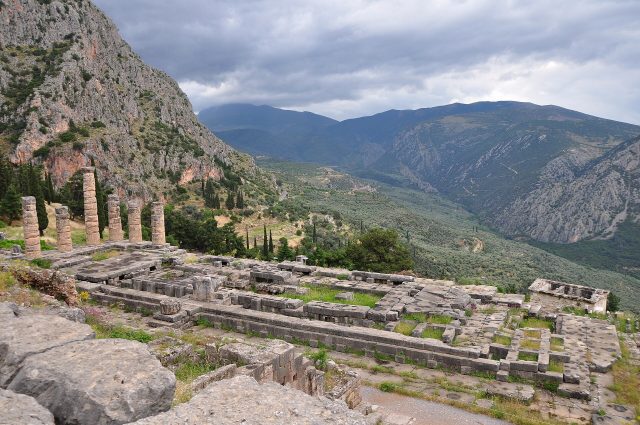
Today, only fragments of the Tholos remain, but even in ruin, it commands attention. Just three columns have been partially restored, yet that’s enough to imagine the building in its original splendor. Standing beside it, it’s impossible not to wonder about the countless people who passed through here over the centuries—pilgrims, kings, philosophers, all drawn to Delphi’s reputation as the navel of the world. The Tholos likely greeted them as they approached the sanctuary, a striking introduction to a place where mortals sought the wisdom of the gods.
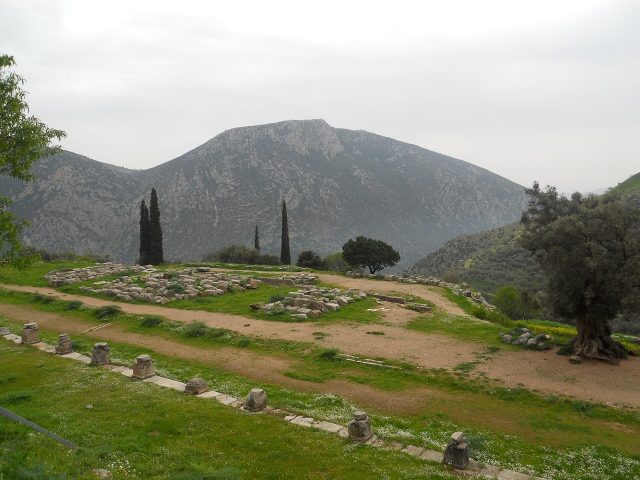
The Tholos doesn’t exist in isolation. Around it lie the remnants of other structures that once defined Delphi’s sacred landscape: treasuries where city-states stored offerings to the gods, altars, statues, a theater, and a stadium. Yet the Tholos holds its own, not just for its unusual shape but for the way it interacts with the land. Perched on a small terrace, it overlooks a valley that was once filled with the rustling of a sacred grove, with the mountains rising beyond. On clear days, the view stretches for miles, and it’s easy to see how this setting might have inspired its creators to design something so perfectly balanced.
Visiting Delphi today is like stepping into a story that’s still unfolding. The modern town is quiet, its streets winding past olive groves and cypress trees, but the ruins carry a presence that’s hard to shake. The scent of wild thyme lingers in the air, mingling with the resinous tang of pine, and the only sounds are the wind through the trees and the occasional call of a bird. The Tholos isn’t just a relic—it’s a bridge to an era when people believed the gods spoke through oracles, when art and faith were inseparable. It’s a reminder of how fleeting power can be, but also of how enduring the ideas carved into stone can become.
Time has worn away much of Delphi’s former glory, but the Tholos endures, even in its broken state. It stands as a symbol of the harmony the ancient Greeks sought in their architecture, their religion, and their lives. There’s something almost alive about it, as if the voices of the past still echo in its marble. That might be why this place has drawn people for millennia—not just for its ruins, but for the sense of something greater, something sacred that lingers here. The Tholos doesn’t just mark a spot on a map; it marks a moment when the human and the divine felt closer than they do now.