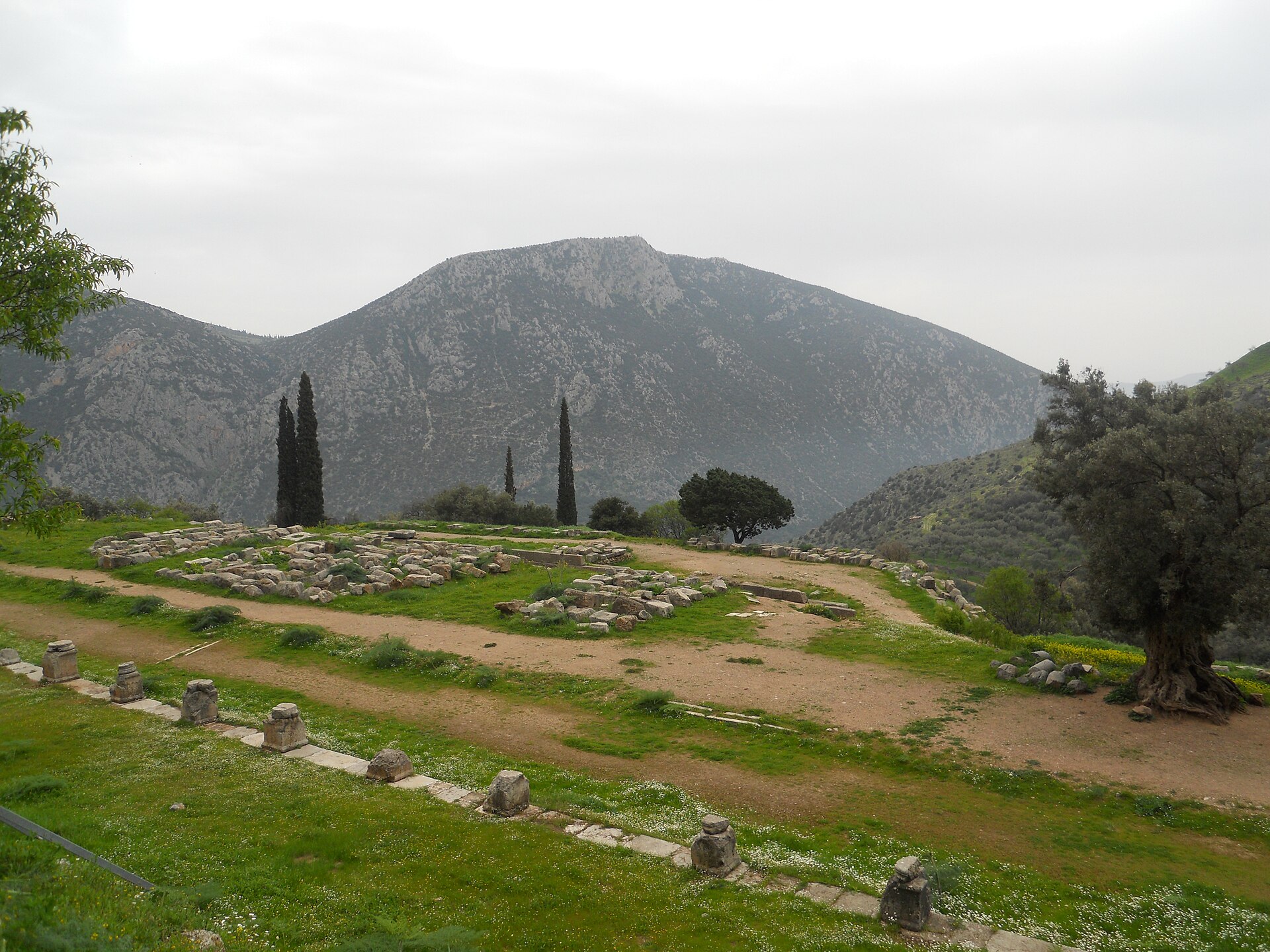
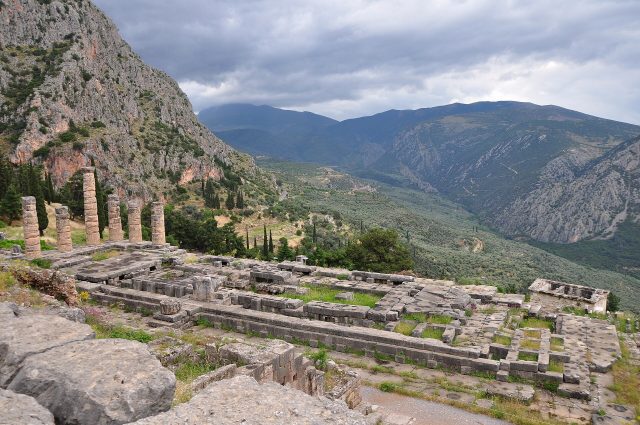
The Sanctuary of Athena Pronaia in Delphi is one of those rare places where history feels almost tangible. Tucked away from the main archaeological site, just off the path leading to the famous Temple of Apollo, it carries an atmosphere all its own. Unlike the crowded central ruins, this spot remains quiet, allowing visitors to linger among the stones without the usual rush. Here, the details that often go unnoticed elsewhere—weathered carvings, the play of light on ancient walls—reveal themselves slowly, as if inviting you to step into another time.
The name Pronaia translates to "the one before the temple," a fitting description for a sanctuary that once served as a threshold to Delphi’s most sacred space. While Apollo’s oracle drew the largest crowds, Athena was worshipped here with equal reverence. The temple built in her honor dates back to the Archaic period, and though only its foundations remain, it’s not difficult to imagine its original form—a modest Doric peripteros, surrounded by columns, smaller than the grand structures nearby but no less significant. Its simplicity reflects the early days of Greek temple architecture, when form and function were still finding their balance.
Nearby stands the so-called Treasury of the Massaliots, a small but remarkably well-preserved building that once held offerings from Massalia, a Greek colony in what is now southern France. The treasury’s metopes, though worn by time, still hint at the scenes they once depicted—mythological tales carved in stone, a testament to the skill of ancient artisans. The building itself is a reminder of Delphi’s far-reaching influence. Pilgrims and envoys from across the Greek world traveled here, bearing gifts and seeking the oracle’s wisdom, and the treasury was one of many such structures that lined the sacred way, each representing a city or colony’s devotion.
The most enigmatic structure in the sanctuary is the tholos, a circular building whose purpose remains debated. Some scholars suggest it was a temple dedicated to another deity, perhaps Artemis, while others believe it served as a treasury or even a place for ritual feasts. Built in the 4th century BC, its elegant proportions and refined Doric columns—three of which have been partially restored—give a sense of its original grace. Perched on a slight rise, the tholos offers a sweeping view of the valley below, where the sacred grove of Apollo once thrived. Standing there, it’s easy to picture the landscape as it was millennia ago, alive with the murmur of leaves and the distant echo of prayers.
The sanctuary is deeply woven into Delphi’s myths and history. According to legend, this was the site of Apollo’s battle with Python, the serpent he slew to claim the oracle. Athena, the goddess of wisdom and strategy, later became its protector, her presence complementing Apollo’s divine authority. In antiquity, the sanctuary was more than a religious site—it was a place where politics and faith intersected. Representatives from Greek city-states gathered here to negotiate alliances, declare wars, and forge trade agreements, all under the watchful gaze of the gods.
Today, the ruins of Athena Pronaia are unassuming, but that very modesty makes them compelling. The stones, cracked and darkened by centuries of wind and rain, carry the weight of time in a way that polished monuments often do not. They don’t need grand explanations; their silence speaks volumes. Olive trees, their silver leaves rustling in the breeze, grow among the ruins, their presence a quiet constant in a landscape that has otherwise changed beyond recognition. The air here feels different—lighter, somehow, as if the past is still lingering just beneath the surface.
Visiting the sanctuary is less about seeing and more about feeling. It’s a place that invites reflection, not just on the architecture or the myths, but on how human beliefs have evolved over the centuries. In antiquity, this was a space charged with sacred meaning, where the divine felt close enough to touch. Today, we approach it with a historian’s curiosity, yet the atmosphere still carries something of that old reverence. Perhaps that’s why Delphi continues to draw those who seek more than just a glimpse of the past—it offers a connection to something deeper, something enduring.
The best time to visit is early morning or late afternoon, when the sun casts a gentle light over the stones and the heat of the day has eased. The silence is almost palpable then, broken only by the occasional call of a bird or the distant bleating of sheep grazing on the hillsides. If you’re lucky, you might see a shepherd guiding his flock along the same paths that have been trodden for thousands of years—a scene that could have been lifted straight from Homer’s epics. In moments like these, Delphi stops being just an open-air museum and becomes something alive, a place where the past and present coexist in quiet harmony.