Perched on the rugged cliffs of Cornwall’s north coast, Tintagel Visitor Centre is where history and myth collide with the raw beauty of the Atlantic. This isn’t a place for flashy exhibits or theme-park attractions—it’s a gateway to a landscape steeped in stories, where every rock and gust of wind seems to whisper of the past. The centre itself is modest, a modern structure designed to blend into the wild surroundings rather than dominate them. Inside, the focus is on context: how this windswept headland has been shaped by time, from its earliest days as a fortified settlement to its later associations with Arthurian legend.
The ruins of Tintagel Castle, just a short walk from the centre, are what draw most visitors. Built in the 13th century by Richard, Earl of Cornwall, the castle was more a statement of power than a practical stronghold. But long before Richard’s time, this site was already significant. Archaeological finds—fragments of pottery, coins, and remnants of buildings—suggest that Tintagel was a thriving hub of trade and culture in the early medieval period, possibly even a royal residence. The real history of the place is fascinating enough, yet it’s the legends that have cemented its place in the imagination.
The most enduring of those legends ties Tintagel to King Arthur. In the 12th century, the chronicler Geoffrey of Monmouth wrote that Arthur was conceived here, the result of a magical deception orchestrated by Merlin. According to the tale, Uther Pendragon, disguised by Merlin’s sorcery, seduced Igraine, the wife of the Duke of Cornwall, within the castle walls. Historians have long dismissed this as fiction, but the story has taken on a life of its own. The visitor centre doesn’t try to debunk the myth—instead, it offers a way to navigate the blurred line between fact and folklore, leaving room for visitors to decide what they want to believe.
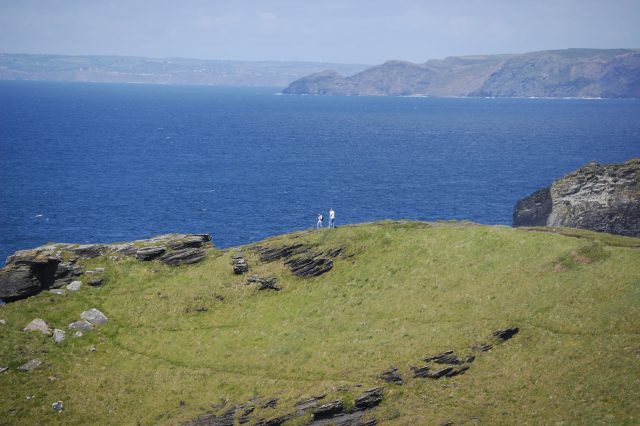
The walk from the centre to the castle is part of the experience. The path winds through grassy slopes where sheep graze, then narrows as it approaches the thin strip of land connecting the headland to the mainland. Here, the full force of the Atlantic becomes impossible to ignore. On stormy days, the waves crash against the cliffs with a ferocity that makes it easy to see why this place was chosen for a fortress—it’s defensible, yes, but also exposed to the elements in a way that feels almost deliberate. The modern bridge leading to the ruins replaces an older, more precarious staircase, making the crossing safer without diminishing its drama.
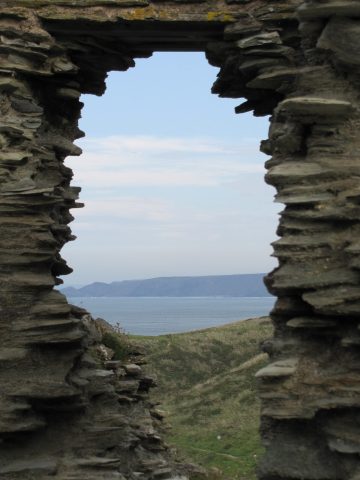
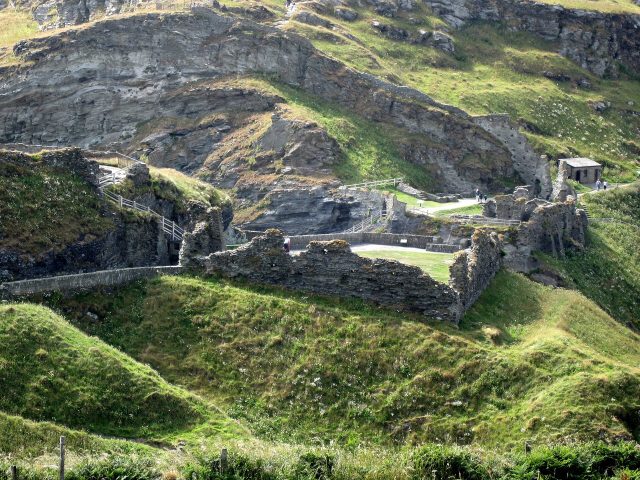
The castle itself is little more than scattered fragments of walls and foundations, but that’s part of its appeal. There’s no grand structure left to admire, just stones that hint at what once was. Wandering among them, it’s tempting to imagine the bustle of medieval life or the figures of Arthurian legend moving through these same spaces. The highest point offers the best views—out across the bay, where the ocean stretches endlessly, and the cliffs drop sharply into the water. On a clear day, the horizon feels close enough to touch, and the sense of timelessness is almost tangible.
The visitor centre also explores how Tintagel’s reputation has evolved over the centuries. In the 19th century, when romanticism and a fascination with the medieval past were at their peak, the site became a magnet for artists and writers. Poets were drawn to its wild beauty, while archaeologists sought to uncover its secrets. Today, Tintagel remains a place of both tourism and ongoing research. Excavations continue each season, often revealing new details that reshape our understanding of the site’s history. It’s a reminder that the past is never truly settled—it’s always being reinterpreted.
For first-time visitors, the centre serves as a useful starting point. There are maps to orient yourself, updates on current excavations, and a café where you can sit with a drink and watch the waves. But the real value lies in the way it prepares you for what’s beyond the doors—the chance to step into a landscape where history and myth feel equally real. This isn’t a place for those in a hurry. It’s for those willing to pause, to listen to the wind, and to let the stories sink in, even if just for a moment.
Tintagel is more than just ruins and legends, though. The surrounding area is rich with wildlife—seabirds nest on the cliffs, and seals are often spotted in the waters below. On calmer days, visitors can descend to the beaches, where the sand is mixed with pebbles and the tide leaves behind intricate patterns of seaweed and shells. It’s a landscape that humbles as much as it inspires, a reminder that nature has always been the most enduring presence here.
A visit to Tintagel is less about ticking off a tourist attraction and more about stepping into a different kind of time. You could spend hours exploring the ruins, walking the coastal paths, or simply sitting on a rock, listening to the ocean. Or you could do none of those things and still leave with the sense that you’ve touched something ancient. What makes Tintagel special isn’t just its history or its legends—it’s the way it lingers in the mind long after you’ve left, as if the place itself has a way of holding onto those who pass through.