In the jungles of northern Guatemala, howler monkeys call from the canopy and leaves rustle underfoot. Dos Pilas waits. This was no ordinary Maya city. For a brief, violent period, it defied Tikal—its former ruler—and reshaped the region’s power struggles. The ruins now stand silent, but the stones remember battles, betrayals, and kings who gambled everything on ambition.
Founded in the 7th century as a Tikal outpost, Dos Pilas quickly outgrew its origins. By the 640s, its rulers declared independence, sparking a war that would fracture the Maya world. Hieroglyphic inscriptions here leave no room for doubt: one stele shows a king standing over a bound captive, a prisoner of war. Another recounts a siege that lasted months. The city’s story is written in blood and glyphs.
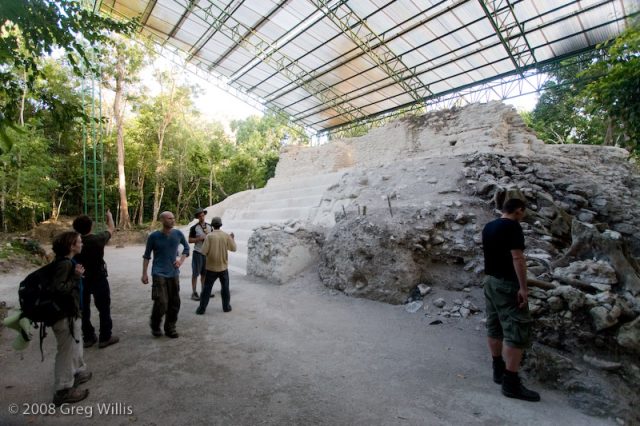
Structure L5-49, the city’s tallest pyramid, still dominates the treeline. Its steps lead to a summit where rituals once unfolded—where smoke from burning copal curled into the sky. From the top, the jungle stretches endlessly, reclaiming what it lost. Nearby, the remains of palaces and ball courts lie half-swallowed by roots. The most vivid traces of the past are the stelae: carved slabs depicting kings in jaguar pelts, warriors with obsidian blades, and glyphs that mark the rise and fall of dynasties.
Below the ruins, a labyrinth of tunnels and caves cuts through the earth. Some are natural; others were widened by human hands. These were sacred spaces, where priests left offerings—broken pots, animal bones, even human remains. The air here is thick, the walls damp. In the flicker of a flashlight, you can almost see the torchlight of ancient ceremonies.
The jungle has reclaimed Dos Pilas.
Trees split stone. Vines strangle walls. Howler monkeys roar from the branches, their calls echoing like distant thunder. Toucans dart through the foliage in flashes of blue and yellow. The ruins are not a museum exhibit; they are part of the living forest. No crowds gather here, no vendors sell souvenirs. The only witnesses are the occasional jaguar tracks pressed into the mud—a reminder that this land was never truly tamed.
Visiting Dos Pilas is not a passive experience. There are no glass cases, no signs explaining every detail. You touch the grooves of a glyph, trace the outline of a king’s headdress, stand where rulers once stood. The site is still being excavated. Each season, archaeologists uncover new fragments: a hidden chamber, a shard of pottery, an inscription that rewrites history. The past here is not fixed; it is still being uncovered, one shovel at a time.
The journey to Dos Pilas is rough. The road from Santa Elena de la Cruz winds through dense forest, a track that demands a sturdy vehicle. There are no signs, no tourist buses. Those who come do so because they want more than a photo. They come for the silence, for the weight of history pressing against their skin. Local guides—many descended from the Maya—share stories that go beyond dates and battles. They speak of gods who demanded blood, of prophecies carved into stone, of a world where the living and the dead were never far apart.
Dos Pilas demands something from its visitors. It demands respect. These ruins are not a backdrop; they are the fragile remains of a civilization that once thrived here. The stones are worn, the carvings fading. Every footstep risks erasing a little more of the past. There are no barriers, no ropes to keep you back. You can climb the pyramids, touch the stelae, walk where kings once walked. But that freedom comes with responsibility.
This is not a place to rush through. It is a place to listen—to the wind in the trees, to the stories in the stones, to the quiet voice of history that lingers in the air. If you take the time, Dos Pilas offers something rare: a moment outside of time.