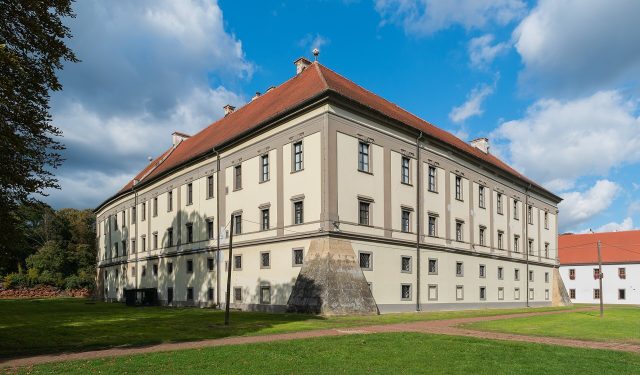
Čakovec doesn’t show itself immediately. The town moves at the pace of provincial life, unlike the Adriatic coast where every stone is part of a postcard. Yet beneath its surface, the past lingers—not behind glass, but in places still in use. The Međimurje Theatre is one of them. Over a century old, it has seen the region change, holding more than just performances. It keeps the memory of Međimurje, once its own world with its own language and stories.
The theatre came to Čakovec in 1904. At the time, the town was prosperous, the administrative heart of a region under Austro-Hungarian rule. Local landowners and merchants wanted to raise its status. They built the theatre, though the architect’s name is forgotten. His work remains in the high ceilings, the large windows, the facade mixing neoclassical lines with local touches. It was meant to impress, but not overwhelm—a statement of cultural ambition.
The building is modest from the outside. Stucco details, worn by time, still frame the entrance. Above it, the Međimurje coat of arms is barely visible. Inside, the original layout remains: an auditorium with a balcony, a small stage, a foyer where people once gathered before shows. The design shows its purpose—it was a social place, not just for entertainment.
The theatre has changed with the times. Between the wars, when Međimurje joined Yugoslavia, it hosted classics, operettas, and operas. Villagers from nearby areas came, turning a night at the theatre into an event. After World War II, the state took over, and the repertoire shifted. Even then, it was one of the few places in the region for professional performances.
Today, the theatre is a cultural center. It hosts festivals, concerts, and exhibitions. Local and visiting artists perform, from contemporary drama to experimental works. But the old feel remains—each show still feels like a small celebration, a moment for the community.
The Međimurje Theatre has stood through empires, kingdoms, socialism, and independent Croatia. It has survived wars, political changes, and economic struggles. It endures because the people who built it still use it. It’s not a monument—it’s a space where past and present meet.
Visitors might not expect it. Čakovec doesn’t have famous landmarks, and that’s why places like this matter. No crowds, no selfie sticks—just a quiet auditorium where, in the dim light, you can almost hear the past. The first notes of an operetta. The applause after a premiere. The theatre doesn’t tell its history. It lets you find it, if you listen.