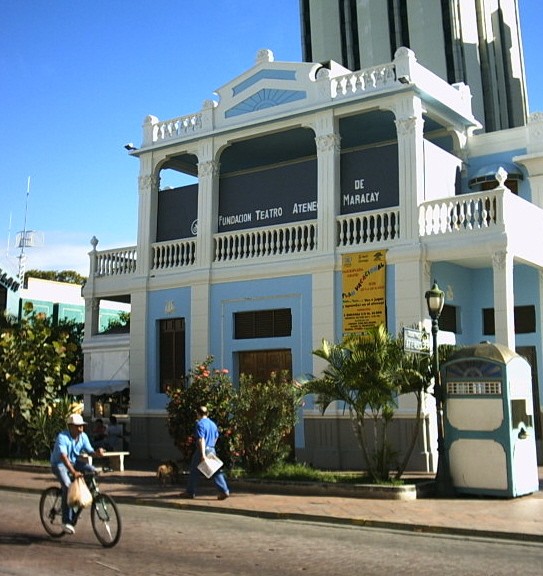
Maracay’s Ateneo Theatre is the kind of place that quietly becomes part of a city’s rhythm, not through grand gestures but by simply being there, year after year, for the people who need it. Tucked into the heart of the city, it doesn’t resemble the ornate opera houses or gilded concert halls that demand attention. Instead, it feels like a natural extension of the streets around it—unassuming, yet impossible to ignore if you know where to look. The building itself is modest, with clean lines and large windows that let in the soft Venezuelan light, as if inviting passersby to step inside and see what’s happening.
Built in the mid-20th century, when Maracay was flourishing as a cultural hub, the theatre emerged during a time of optimism. The city, known for its gentle climate and tree-lined avenues, was carving out its identity, and the Ateneo became one of its quiet landmarks. The architecture is straightforward, almost understated, with none of the pomp that often accompanies performance spaces. Inside, the design is practical, focused on making sure the audience feels close to the action, whether it’s a play, a concert, or a poetry reading. There’s no distance between the stage and the seats, no sense of separation—just a shared experience.
From the beginning, the Ateneo was meant to be more than just a theatre. It was conceived as a cultural crossroads, a place where different art forms could intersect. Over the decades, it has hosted exhibitions by local painters, lectures by writers, and debates about literature and music. For many young artists in Maracay, their first public performance happened on this stage. The theatre has a way of making even the most nervous debut feel like a natural part of its story, as if every new voice is just another layer added to its history.
Today, the Ateneo remains a vital part of the city’s cultural life, though like many institutions in Venezuela, it faces its share of challenges. The schedule still includes everything from classic plays to contemporary performances, along with music spanning genres and occasional festivals. What stands out is how deeply rooted the theatre is in the local community. Many of the works performed here are by Venezuelan artists, and the audience is just as likely to be a group of students as it is a family or a retiree. There’s no pretension, no expectation of who belongs—just an open door.
One of the most striking things about the Ateneo is how unpretentious it is. There are no dress codes, no exorbitant ticket prices, no velvet ropes separating the audience from the art. It’s the kind of place where you might see someone in a worn-out T-shirt sitting next to someone in a slightly nicer shirt, both equally absorbed in what’s happening on stage. That lack of formality doesn’t make the performances any less meaningful—if anything, it makes them feel more immediate, more real. The theatre has always been about connection, not spectacle.
In recent years, the Ateneo has had to adapt to the realities of life in Venezuela. Economic struggles, unreliable infrastructure, and funding shortages have made things difficult, but the theatre persists. Sometimes, performances go on by candlelight when the power fails. Other times, artists donate their time, unwilling to let the space fall silent. The challenges are real, but so is the determination of those who keep it running. For them, the Ateneo isn’t just a building—it’s a promise, a reminder that culture doesn’t disappear just because times are hard.
For visitors, the theatre offers a different kind of experience than the usual tourist stops. There are no crowds, no souvenir stands, no guided tours trying to sell you a story. Instead, there’s the quiet hum of a city that has claimed this space as its own. You might catch a play in Spanish, or sit in the foyer listening to a local musician tuning their guitar before a set. The audience is mostly made up of regulars—people who come not because they have to, but because they want to. It’s the kind of place where you can feel the weight of its history without anyone having to explain it to you.
What makes the Ateneo special isn’t its size or its fame, but the way it has woven itself into the fabric of Maracay. It’s not trying to be the most important theatre in Venezuela, or even the most polished. It’s just trying to be there, day after day, for the people who need it. In a country where so much is uncertain, that kind of quiet resilience feels like something worth holding onto. The theatre doesn’t ask for much—just an audience, a stage, and the chance to keep going. And for now, that’s enough.