Ostroh feels like a place where time has paused, leaving the past suspended in the air. Nestled among rolling hills and quiet rivers in western Ukraine, the town carries its history in every stone, every winding street. One of its most striking landmarks is the Tatar Tower, standing tall above the old quarter. More than just a relic of architecture, it’s a living piece of the town’s story, a bridge between centuries that still resonates with the echoes of those who once walked these streets.
Built in the 16th century, the tower was part of the defensive system of the Ostroh Castle, a fortress that guarded the shifting borders of the Grand Duchy of Lithuania and later the Polish-Lithuanian Commonwealth. The region was no stranger to conflict—raids by Crimean Tatars and the looming threat of the Ottoman Empire made strongholds like this one essential. The tower’s name likely comes from those turbulent times, when it served not just as a lookout but as a symbol of the town’s resilience. Its thick walls and narrow slits for archers were designed to withstand sieges, and for generations, it stood as a silent sentinel over the land.
The architecture of the Tatar Tower is a textbook example of military engineering from its era. The structure is solid and unadorned, built to endure rather than impress. Inside, the remnants of staircases and passageways hint at the daily life of the guards who once patrolled its heights. The tower wasn’t isolated—it was part of a larger network of fortifications, connected to the castle’s walls and other defensive structures. Even now, its stark lines and weathered stone evoke the tension of those times, when every shadow could mean danger and every sound carried weight.
As the centuries passed and the need for such defenses faded, the tower’s role changed. Ostroh grew around it, its streets expanding beyond the old walls, and the tower gradually became a monument rather than a military post. By the 19th century, when interest in preserving history began to take hold, efforts were made to restore it. Travelers and scholars started to see it not just as a ruin but as a tangible link to the past, a piece of the puzzle that was medieval Ostroh.
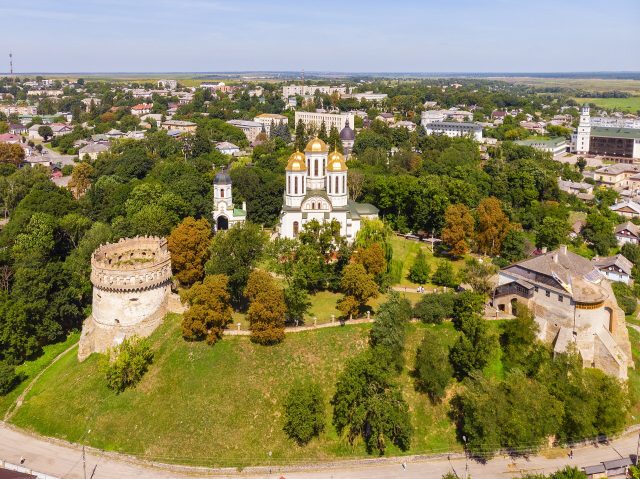
Today, the Tatar Tower is one of the town’s most recognizable sights. It sits on a gentle rise, surrounded by a small park where locals and visitors alike come to stroll or sit on benches, taking in the view of the old town. The tower is open to the public, and climbing its steep steps offers more than just a panoramic view—it’s a chance to step into the past, to imagine the town as it once was. From the top, the modern world feels distant, and it’s easy to picture the bustling activity of the castle below, the clatter of hooves on cobblestones, the murmur of voices in the market square.
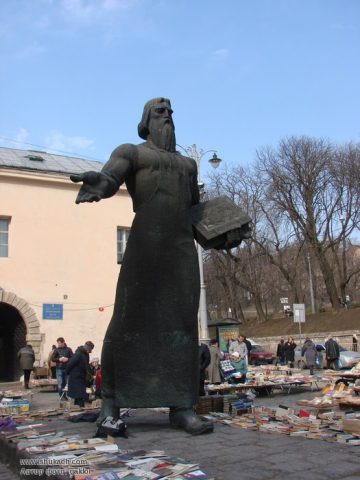
Ostroh itself is like an open-air museum, where history isn’t confined to plaques or glass cases. Near the Tatar Tower, other landmarks tell their own stories—the imposing walls of Ostroh Castle, the domes of the Epiphany Cathedral, the ancient Lutsk Gate. Together, they create an atmosphere that’s hard to find elsewhere, a sense of continuity that connects the present to the past. This was a town of learning and culture, where Ivan Fedorov, the father of East Slavic printing, published the famous Ostroh Bible. It was home to one of Ukraine’s first institutions of higher education, the Ostroh Academy, where scholars and students shaped the intellectual life of the region.
The Tatar Tower isn’t just a structure; it’s a piece of Ostroh’s soul. It stands as a reminder that history isn’t something that fades away—it lingers in the stones, in the landscape, in the stories passed down through generations. Visiting here isn’t about rushing from one sight to the next. It’s about slowing down, wandering the quiet streets, stopping in a café for a cup of coffee or a plate of local food, or simply sitting in the park, watching the tower as the light changes over the town. There’s a quiet magic in the way the past and present coexist here, as if the tower is still keeping watch, just as it has for centuries.
Time moves differently in Ostroh. It doesn’t hurry, but invites you to look back, to understand how the town has evolved, how wars and trade and ideas have shaped its character. The Tatar Tower is where that journey begins. It doesn’t demand attention with flashy displays or loud attractions, but in its quiet strength, there’s a depth that’s hard to ignore. If you listen closely, the wind through its arches might just carry the whispers of those who once stood where you stand now. And that’s when you realize that some places don’t just tell history—they let you feel it.