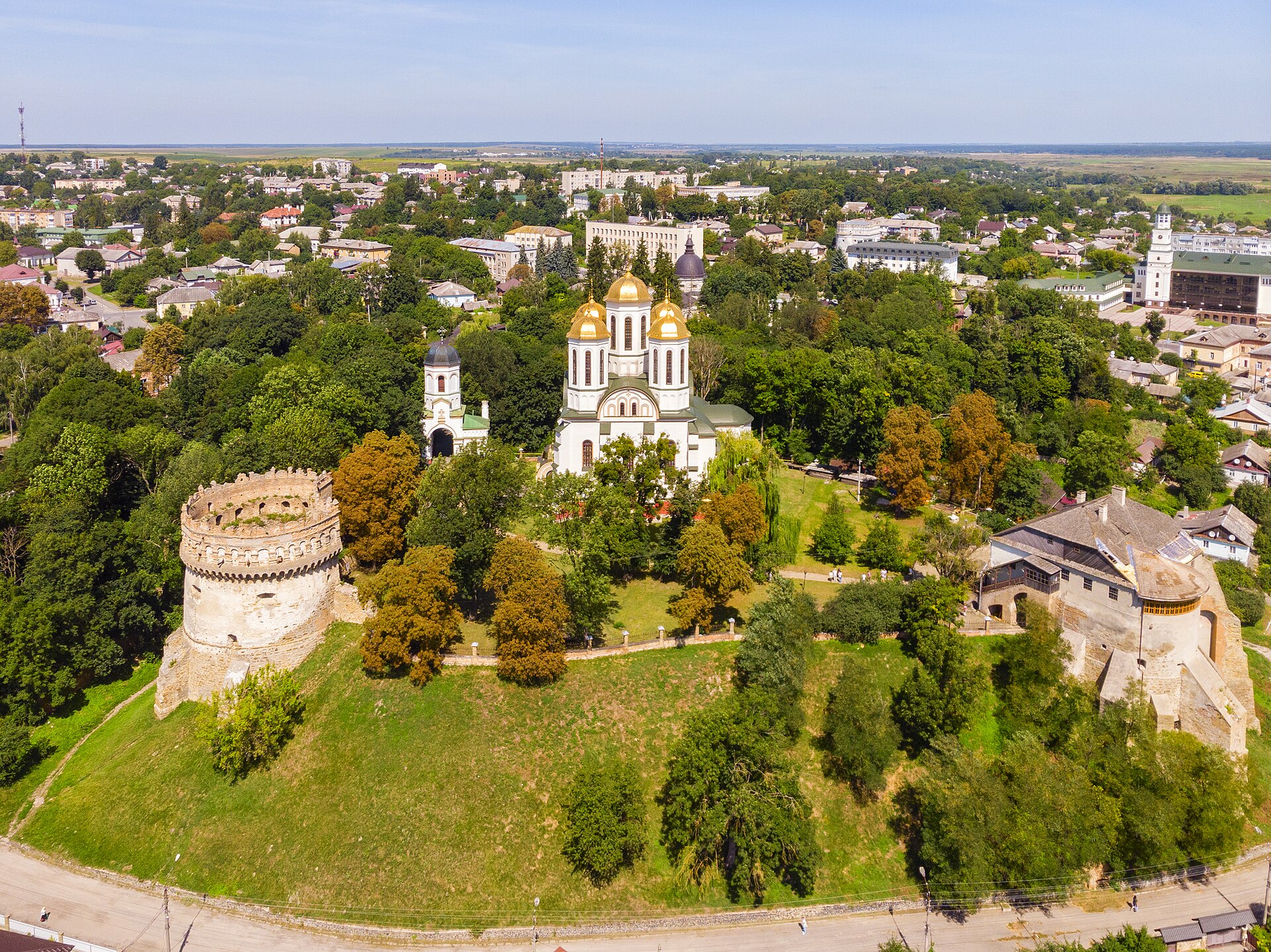
Perched on a hill overlooking the quiet town of Ostroh, the bell tower of Ostroh Castle is one of those rare places where history doesn’t just feel close—it feels alive. The structure rises above the red-tiled roofs of the old town, its slender silhouette cutting against the sky, a reminder of a time when this corner of Ukraine was a center of learning, faith, and political power. From a distance, its four tiers seem almost delicate, yet the closer you get, the more you sense the weight of centuries in its stone. The tower wasn’t just built to mark time; it was meant to endure, to stand as a witness to the shifting fortunes of a city that once shaped the intellectual and spiritual life of Eastern Europe.
The story of the bell tower is inseparable from that of Ostroh Castle itself, founded in the 14th century by the Ostrozhsky princes, one of the most influential dynasties of the Grand Duchy of Lithuania. The castle was more than a fortress; it was a statement. By the 16th century, under Prince Konstantin Ostrozhsky, it had become a stronghold of Orthodox culture at a time when religious and political tensions were reshaping the region. Konstantin, a patron of scholarship and faith, established the Ostroh Academy here—the first institution of higher learning in what is now Ukraine. The academy drew students and scholars from across Eastern Europe, turning Ostroh into a place where ideas, languages, and traditions collided and converged. The bell tower, added in the 17th century, wasn’t just an architectural flourish; it was a symbol of the city’s resilience and ambition.
What makes the tower so striking is how it blends different eras and styles into a single, cohesive whole. The lower tier is all solidity and strength, built from rough-hewn stone that speaks of medieval fortifications. It’s the kind of base you’d expect from a structure meant to withstand sieges, its thick walls and narrow windows designed for defense. But as your eye travels upward, the character of the tower shifts. The upper tiers soften into the curves and ornamentation of Baroque, with slender pilasters, arched openings, and decorative details that lighten the mass of the stone. The clock face on one of the tiers isn’t just functional; it’s a declaration. In a city where time was measured not just in hours but in the rhythms of scholarship and prayer, the clock served as a reminder that Ostroh operated on its own terms.
Inside, the tower feels like a vertical time capsule. The spiral staircase winds tightly upward, its steps worn smooth by centuries of footsteps. Along the walls, fragments of old frescoes and inscriptions hint at the lives that once filled this space. The bell that once hung here was more than an instrument; it was the voice of the city, calling people to worship, warning them of danger, marking the passage of days. On clear days, its peal could carry for miles, echoing across the Viliya River valley. Today, the bell is gone, but the tower still offers something just as valuable: a view. From the top, Ostroh unfolds like a living map. The old town sprawls below, its narrow streets lined with low-slung houses, their gardens spilling over fences. Beyond the rooftops, the river winds through the landscape, and in the distance, the rolling hills fade into the horizon.
Ostroh has always been a place of intersections. Here, Orthodox and Catholic traditions met, Byzantine influences mingled with Western European ideas, and local customs absorbed broader cultural currents. The bell tower, like the castle it belongs to, stands at the heart of these exchanges. It has seen the comings and goings of scholars, the debates of theologians, the negotiations of diplomats. It has survived wars, fires, and the slow erosion of time, yet it remains a quiet but insistent presence in the life of the town. When you stand at its base, it’s easy to imagine the bustle of the 16th century—the students hurrying to lectures, the merchants setting up their stalls in the square, the princes receiving envoys in the castle halls. The tower doesn’t just preserve history; it invites you to step into it.
Today, Ostroh is a sleepy town where life moves at an unhurried pace. The streets are quiet, the air is thick with the scent of linden trees in summer, and the only sounds are the occasional chime of a church bell or the murmur of the river. But the bell tower still commands attention. In winter, when frost clings to its stone and the town is blanketed in snow, it looks like something out of a folk tale. In spring, when the hills turn green and the river swells with meltwater, it stands as a reminder of the cycles of nature and history. The tower doesn’t need to shout to be heard; its very presence is enough to make you pause and consider the layers of time beneath your feet.
Visiting the bell tower is more than just a stop on a sightseeing itinerary. It’s a chance to reflect on how much—and how little—has changed in this part of the world. The castle and its tower have seen empires rise and fall, borders redrawn, and religions clash and coexist. Yet they endure, not as relics of a distant past, but as living parts of the landscape. They remind us that history isn’t just a series of events; it’s a continuum, a thread that connects the people who came before us to those who will come after. The tower’s stones have absorbed the voices of generations, and when the wind blows through its arches, it carries those voices forward.
There’s something humbling about standing in a place like this. It’s not just the height of the tower or the weight of its history that leaves an impression; it’s the realization that you’re standing where others have stood for centuries. The view from the top hasn’t changed much—same river, same hills, same sky. What has changed is the world around it. The bell tower has watched as Ostroh transformed from a bustling center of learning into a quiet provincial town, yet it remains a constant, a fixed point in a shifting landscape. It doesn’t offer grand narratives or easy answers, but it does offer something rarer: a sense of continuity, a feeling that the past isn’t as distant as it seems.
If you find yourself in Ostroh, the bell tower is worth the climb. Not just for the view, though that alone is reason enough, but for the chance to step outside of time for a moment. To feel the weight of the stone beneath your hands, to hear the echo of your footsteps on the stairs, to look out over a town that has seen so much and yet remains. It’s a reminder that history isn’t something we observe from a distance; it’s something we walk through, something we touch. And sometimes, all it takes is a single tower to make that connection real.