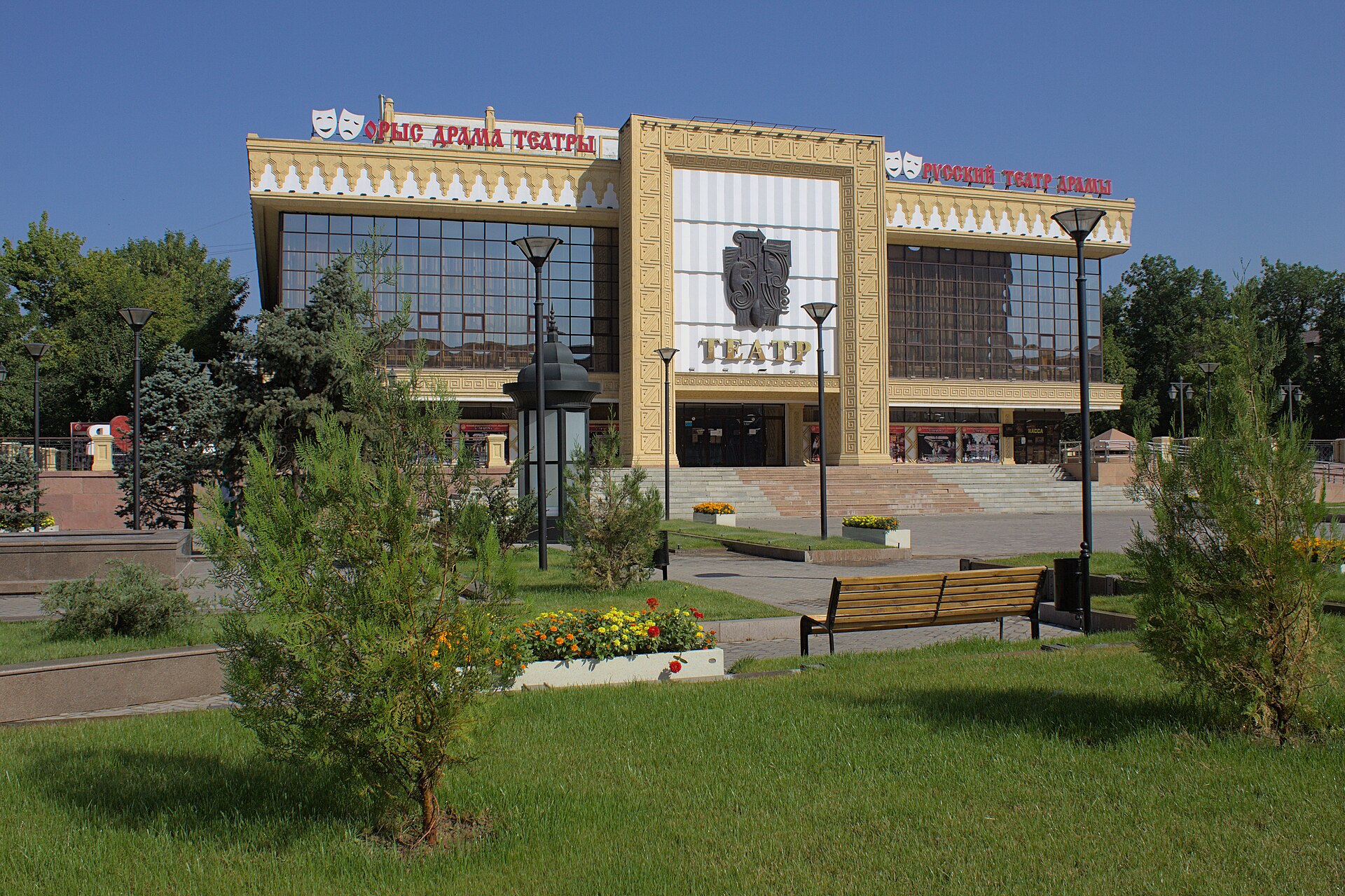
Shymkent Regional Drama Theatre stands where the city’s past and present quietly intersect, a place where art isn’t just performed but woven into everyday life. Located in the heart of Shymkent, the building overlooks Al-Farabi Square, a spot where the city’s rhythm is always visible—people hurrying to work, families strolling, friends catching up over coffee. The theatre isn’t just a landmark; it’s a cultural anchor that has shaped the tastes and conversations of generations.
The building itself is a striking example of Soviet modernism, designed in the mid-20th century with the kind of functional grandeur typical of regional theatres of that era. High ceilings, a spacious auditorium, and wide staircases give it an air of openness, while the facade is adorned with subtle bas-reliefs that nod to local motifs without overwhelming the structure. Inside, original details like plaster mouldings, chandeliers, and wooden panelling have been preserved, creating a space that feels both grand and intimate.
The theatre didn’t emerge in isolation. Shymkent has long been a crossroads of cultures—Kazakh, Uzbek, Russian, Uyghur—each leaving its mark on the city’s artistic life. By the early 20th century, amateur theatre groups were already active, and by the 1920s, a professional troupe had formed. The current theatre opened in 1967, becoming a platform for Kazakh drama, Russian classics, and experimental works that reflect the region’s evolving identity.
The repertoire is diverse, but there’s always a thread connecting it to the local experience. Kazakh playwrights feature prominently, their works exploring life in the steppe, traditional values, and contemporary issues. Russian classics—Chekhov, Ostrovsky, Gorky—are staged in fresh interpretations, while occasional forays into world drama are adapted to resonate with local audiences. Even when the material is universal, the approach feels rooted in the here and now.
The theatre’s influence extends beyond Shymkent. Its productions have toured across Kazakhstan and beyond, earning recognition at festivals and competitions. At the same time, the stage has hosted visiting troupes from Almaty, Astana, Moscow, and Tashkent, bringing new perspectives and styles. These exchanges keep the theatre dynamic, ensuring it doesn’t exist in a bubble but remains part of a broader cultural conversation.
For many in Shymkent, the theatre is more than a venue for performances. The foyer often hosts exhibitions by local artists, literary readings, and discussions about theatre and literature. In winter, it’s a warm refuge; in summer, the thick walls keep the heat at bay. Some people come just to sit quietly, read, or enjoy a cup of tea in the buffet before a show. It’s a place where the city gathers, not just for entertainment but for connection.
The actors here are a mix of seasoned performers and rising talents, many of whom have spent decades on this stage. Their dedication is palpable—audience members often return not just for the stories but for the familiar faces they’ve come to know. The bond between performers and spectators is part of what makes the theatre feel alive, a shared experience rather than a passive one.
What sets Shymkent Drama Theatre apart is its ability to evolve without losing its essence. The repertoire changes, new directors bring fresh ideas, and experiments with form keep things interesting. Yet the core remains the same: a place where people can step away from their routines, reflect, laugh, or lose themselves in a story. It’s not a museum piece or a polished entertainment hub but a living institution that grows with the city.
Visiting the theatre offers more than just a night at the theatre—it’s a way to feel the pulse of Shymkent. This isn’t a city overrun by tourists, and there’s no pressure to document every moment. Here, the theatre is simply part of life, unpretentious and real. You can walk in without expectations and still leave with the sense that you’ve touched something genuine.