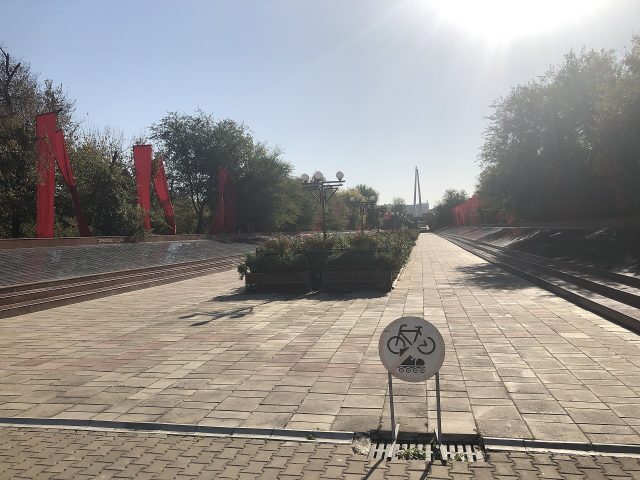
Shymkent’s Central Park of Culture and Rest is one of those rare urban spaces where the city’s usual hum fades into the background, replaced by the quiet rustle of leaves and the soft crunch of gravel underfoot. Tucked in the heart of the city, it isn’t just a place to walk—it’s a green refuge where locals and visitors alike come to slow down, breathe, and step away from the rush of daily life. The park’s wide paths wind beneath towering trees, their branches forming a natural canopy that offers shade from the sun and a sense of seclusion. There are no highways cutting through here, no blaring horns, just open lawns where people spread out blankets for picnics, read books, or simply sit and watch the world go by.
The park’s origins trace back to the Soviet era, when such green spaces were designed as communal hubs for public life. Decades ago, it was a stage for festivals, concerts, and gatherings, its alleys filled with the chatter of families and the laughter of couples strolling arm in arm. While the city around it has changed, the park has retained its role, though its character has shifted. Today, it feels less like a venue for grand events and more like a quiet sanctuary. On weekends, you’ll still find children playing near the fountains, elderly couples taking their time on the benches, and groups of friends lingering by the water, but the atmosphere is one of ease rather than excitement.
The park’s design is unassuming yet deliberate. The main entrance opens onto a broad avenue leading to a central square, where a fountain now stands in place of the old stage that once hosted performances. In summer, people gather around it, cooling off in the mist; in winter, the basin transforms into an ice rink, its surface glinting under the pale sunlight. The trees lining the paths—oaks, poplars, chestnuts—are some of the oldest in Shymkent, their gnarled trunks and sprawling branches a living record of the city’s past. In autumn, their leaves turn gold and amber, blanketing the ground in a soft carpet that muffles footsteps and adds a touch of magic to every walk.
One of the park’s most charming features is its small lake, a tranquil spot that has become its unofficial emblem. A paved path encircles the water, popular with joggers and walkers, while benches along the shore offer a place to rest. In the warmer months, ducks glide across the surface, and if you’re lucky, you might spot a pair of swans, their graceful presence adding to the lake’s serene beauty. The water is still, reflecting the sky and the trees like a mirror, and the air here feels cooler, as if the lake holds onto a little of the night’s chill even in the heat of the day. Nearby, a modest café serves tea and coffee, its tables set just far enough from the water to let visitors enjoy the view without the distraction of crowds.
Beyond its natural beauty, the park also holds fragments of Shymkent’s history. Tucked away in one corner is an open-air museum, a collection of artifacts that tell the story of the city’s past. There are no glass cases or guided tours here—just a scattering of old photographs, tools, and household items displayed under the open sky. It’s the kind of place you might stumble upon during a walk, pausing to examine a black-and-white image of the city as it once was or a rusted plow that speaks to the region’s agricultural roots. These small details give the park a sense of continuity, a reminder that it’s not just a green space but a living archive of the community.
Unlike many urban parks, this one isn’t packed with flashy attractions. There are no roller coasters or Ferris wheels, no loud music or carnival games. Instead, it offers something quieter: the chance to wander without purpose, to find a secluded bench under a tree, or to watch the light change as the sun moves across the sky. In summer, you can rent a bicycle or a pair of rollerblades, and in winter, the paths are groomed for cross-country skiing, but these are subtle additions, not the main draw. The real appeal lies in the park’s unhurried rhythm, the way it seems to exist outside the usual pace of city life.
For many in Shymkent, the park is a daily ritual. Some come every morning for a run, their footsteps falling into the same familiar pattern along the paths. Others bring their children to the playground, where the sound of laughter mixes with the rustling leaves. There are those who come simply to sit, to watch the ducks on the lake or the way the light filters through the branches, content to let the hours pass unnoticed. The park isn’t a tourist hotspot—it’s a local institution, a place where people know the best spots for shade, the quietest benches, and the times of day when the light is just right. That intimacy is part of what makes it special; it doesn’t try to impress or entertain, only to offer a moment of peace.
Over the years, the park has seen small changes—a fresh coat of paint on the benches, new paving stones on the paths, the occasional addition of a sculpture or a flower bed. But its essence remains the same. It’s a place where nature and the city coexist without tension, where the noise of traffic and the demands of daily life fade into the background. Here, you can forget, if only for a little while, that the world outside is moving at its usual frantic pace. The trees, the lake, the winding paths—they all invite you to slow down, to notice the way the wind moves through the leaves or the way the water ripples when a duck takes flight. In the end, that’s what makes the park more than just a patch of green in the middle of the city. It’s a reminder that sometimes, the most valuable things aren’t the ones that shout for attention, but the ones that quietly wait for you to find them.