The sacred tree of Sri Maha Bodhi stands at the heart of Anuradhapura, a place that has drawn pilgrims and travelers for over two thousand years. This is not just a site for Buddhists—it is a living symbol of enlightenment, said to be a direct descendant of the very tree under which Siddhartha Gautama attained Buddhahood. The story of this tree is woven into the fabric of Sri Lanka itself, a quiet witness to centuries of devotion, history, and the slow, steady rhythm of faith.
According to ancient chronicles, the sapling was brought to the island in the 3rd century BCE by Sanghamitta, the daughter of Emperor Ashoka of India. She arrived at the request of King Devanampiya Tissa, who sought to establish Buddhism in his kingdom. The tree took root in Anuradhapura, and over time, the city grew around it, becoming the spiritual center of Sri Lanka. Today, the complex surrounding Sri Maha Bodhi is a testament to that legacy, with temples, stupas, and monasteries built in reverence over generations. The tree itself is encircled by a golden railing, a mark of protection and respect, its branches supported by stone pillars as if to hold up the weight of its own significance.
The atmosphere here is one of quiet reverence. The wide, stone-paved courtyard is often filled with monks in saffron robes, pilgrims in prayer, and visitors who come simply to sit in silence. The air carries the scent of incense and flowers, while the rustling of the tree’s leaves seems to whisper stories of the past. Even those unfamiliar with Buddhist traditions often find themselves moved by the sense of timelessness that lingers in this place. There is no grand spectacle, no loud proclamation of holiness—just the steady, unshaken presence of a tree that has stood through empires and eras.
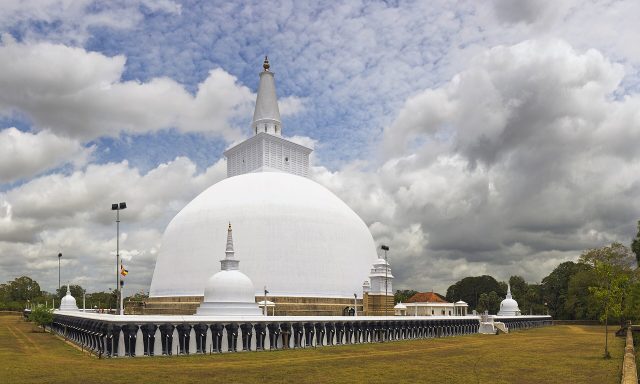
The architecture surrounding Sri Maha Bodhi reflects the evolution of Buddhism on the island. Ancient stupas rise in various states of preservation, from simple, weathered structures to more elaborate shrines adorned with intricate carvings. Stone railings inscribed with Pali and Sinhala script tell of donations made by kings and commoners alike, each inscription a small act of devotion preserved in stone. The oldest of these structures date back to the early centuries of the Anuradhapura Kingdom, when the city was a thriving center of learning and faith. Walking through the complex, one can sense the layers of history beneath their feet, each step a connection to those who came before.
For many, a visit to Sri Maha Bodhi is more than sightseeing—it is a moment of reflection. Pilgrims often walk clockwise around the tree, offering lotus flowers or garlands at its base. Monks bless visitors with chanted prayers, while locals share stories of the tree’s resilience—how it has never fully shed its leaves, even in drought, and how its branches always reach toward the east, as if pointing the way forward. The rituals here are simple but deeply meaningful, a reminder that faith is not just in grand gestures but in quiet, repeated acts of devotion.
Anuradhapura itself is a city shaped by history. Once the capital of a powerful kingdom, it was a center of Buddhist scholarship and culture for over a thousand years. Today, its ruins—palaces, monasteries, vast reservoirs—speak of a time when the city was one of the great urban centers of the ancient world. Yet among these remnants of the past, Sri Maha Bodhi remains the most vital, the most alive. It is the reason many come to Anuradhapura, not just to see, but to feel the continuity of a tradition that has endured through centuries.
Visiting Sri Maha Bodhi requires a certain mindfulness. Modest dress is expected, and shoes must be removed before entering the sacred grounds. Photography is allowed, but it is best done with discretion, without flash or intrusion. Small stalls near the entrance sell flowers, incense, and handmade offerings, but bargaining is uncommon—prices are fixed, and purchases are often made as part of the ritual rather than mere commerce. The focus here is not on transaction but on connection, on the quiet exchange between the visitor and the place.
What makes Sri Maha Bodhi different from other historical sites is its unassuming power. There are no grand monuments demanding attention, no dramatic vistas to capture in a photograph. Instead, there is the tree, the stone, the people, and the quiet hum of devotion that has filled this space for centuries. It is a place where time seems to slow, where the noise of the outside world fades, and where one is left with the simple, profound realization of being part of something much larger than themselves. Whether you spend an hour or a day here, the memory lingers—not as a tourist snapshot, but as a moment of stillness, a pause in the rush of life.