Anuradhapura is one of those rare places where time feels suspended, yet the layers of history are impossible to ignore. Nestled in the northern plains of Sri Lanka, this ancient city was the island’s first capital, founded in the 4th century BCE. It was here, beneath the sprawling branches of sacred trees and beside vast man-made reservoirs, that Sinhalese civilization took root. Buddhism flourished in these lands, with the first monasteries and temples rising from the earth, shaping not just the spiritual life of the island but its very identity. For centuries, Anuradhapura was the heart of Sri Lanka, a place where kings ruled, monks meditated, and merchants traded under the watchful gaze of towering stupas.
Today, the city exists as a vast archaeological park, where the ruins of a once-great metropolis blend seamlessly with the surrounding wilderness. Walking through its expansive grounds, it’s easy to imagine the city in its prime—bustling with monks in saffron robes, artisans crafting intricate carvings, and pilgrims arriving from distant lands. The monuments are scattered across a wide area, and exploring them properly takes time, but even wandering without a plan feels rewarding. Every weathered stone, every crumbling brick seems to whisper stories of the past, of empires that rose and fell, of faith that endured.
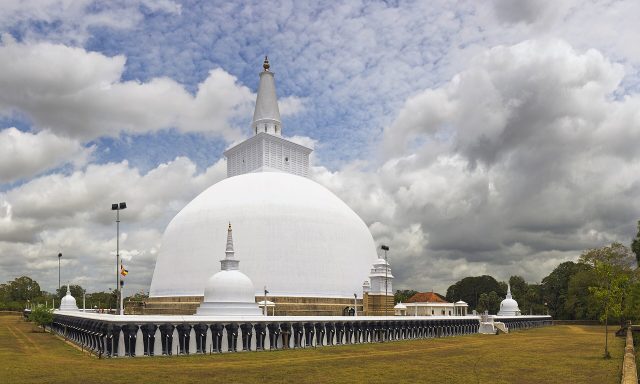
Among the most striking structures is the Ruwanwelisaya stupa, built in the 2nd century BCE. Its white dome, gleaming under the sun, dominates the landscape and can be seen from miles away. The stupa is encircled by the remains of ancient colonnades, where pilgrims once gathered to pay their respects. Even now, locals come here to leave offerings of flowers and light oil lamps, their quiet devotion adding a living pulse to the ancient site. As dusk falls, the white stone takes on a golden hue, and the air fills with a sense of reverence, as if the past and present momentarily merge.
No visit to Anuradhapura would be complete without seeing the sacred Sri Maha Bodhi tree. Planted in the 3rd century BCE, it is said to be a direct descendant of the Bodhi tree under which the Buddha attained enlightenment. Enclosed by a golden railing, the tree stands as a symbol of unwavering faith. Around it, pilgrims sit in meditation, chant prayers, or simply rest in the shade of its broad branches. For Buddhists across Sri Lanka, this is one of the most sacred sites on the island, a place of pilgrimage that transcends generations. The energy here is palpable, a mix of quiet reflection and deep spiritual connection.
The architecture of Anuradhapura is a study in both grandeur and simplicity. The stupas, or dagobas as they’re known locally, follow a similar design—massive bases, smooth domes, and a spire crowning the top—but each has its own character. The Jetavanarama stupa, once the tallest brick structure in the world at 120 meters, is a testament to the engineering prowess of the time. Though only a portion of it remains today, its sheer scale is still awe-inspiring. Nearby, the ruins of a vast monastery hint at the thousands of monks who once lived and studied within its walls. The precision of the brickwork, the symmetry of the layouts—it’s clear that these structures were built not just for function, but as expressions of devotion.
Beyond the religious monuments, Anuradhapura also offers glimpses into the secular life of the ancient kingdom. The Mahavihara complex, for instance, was once the royal palace, where kings held court and conducted the affairs of state. Today, only fragments remain—weathered columns, worn steps, and the outlines of grand terraces—but they’re enough to spark the imagination. Water played a crucial role in the city’s survival, and the rulers of Anuradhapura engineered an intricate system of reservoirs and canals to sustain their people. Some of these, like the Tissa Wewa, still hold water today, their surfaces reflecting the sky and the surrounding greenery. Farmers still use them, just as they have for centuries, a living link to the past.
What makes Anuradhapura special is the way history feels alive here. Unlike modern cities, where the past is often buried beneath layers of concrete, Anuradhapura wears its history openly. There’s no rush, no modern clamor to distract from the quiet weight of the centuries. Mornings begin with the rustle of leaves and the calls of birds, while evenings soften into the murmur of prayers and the gentle sway of branches. The people who live on the edges of the archaeological zone, in modest homes built among the ruins, carry on traditions that have been passed down for generations. Their presence adds a layer of authenticity, a reminder that this isn’t just a relic of the past, but a place that still breathes.
Visiting Anuradhapura is more than just a history lesson—it’s an experience of how the past and present coexist. There’s no clear divide between the sacred and the everyday, between the ruins and the living city. Pilgrims and tourists move through the same spaces, their paths crossing without conflict. The city has a rhythm of its own, one that visitors quickly adapt to. Even a single day here leaves a lasting impression, not just because of the monuments, but because of the atmosphere—the sense of stepping into a world where time moves differently. That’s why Anuradhapura continues to draw those who seek more than just sights; it offers a connection to something deeper, something enduring.