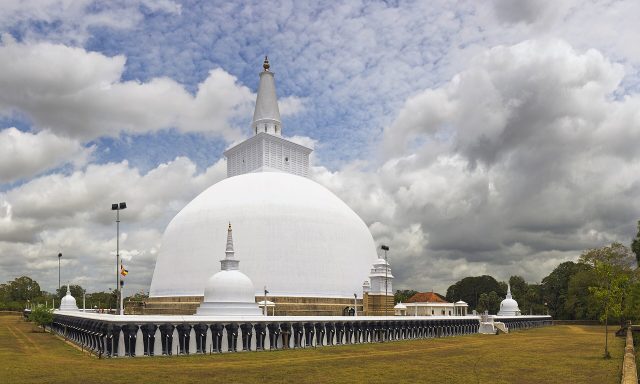
Ruvanvelisaya stands in the heart of Anuradhapura, a place where time seems to slow down just enough to let the weight of history settle around you. This ancient stupa, one of the most revered in Sri Lanka, has watched over the island for over two thousand years, its white dome rising above the flat landscape like a silent guardian. It was built by King Dutugemunu, a ruler whose name still carries the weight of legend—a man who united the island and left behind a monument meant to endure far beyond his own lifetime.
The story of Ruvanvelisaya is woven into the very fabric of Sri Lanka’s past. Construction began in the second century BCE, not just as an architectural feat but as a statement of faith and power. Dutugemunu, so the tales go, oversaw the work himself, driven by a vision of a stupa that would embody the ideals of Buddhism and stand as a testament to his reign. He never lived to see it completed. The chronicles say he was brought to the site on his deathbed, carried in a chariot so he could gaze upon the nearly finished structure one last time. Whether the details are exact or embellished by time, the emotion behind them feels real—the urgency of a man who wanted to leave something lasting behind.
What remains today is a structure of quiet grandeur. The stupa’s base is encircled by a low stone wall, its surface carved with rows of elephants, their trunks raised as if in reverence. The dome itself, smooth and white, curves upward in a perfect arc, its surface once polished to a shine that would have caught the sunlight for miles. At its peak, a gilded spire reaches toward the sky, though time and weather have softened its edges. Inside, beneath layers of brick and plaster, lie sacred relics—said to include the remains of the Buddha himself—making this one of the most sacred sites in Sri Lankan Buddhism.
Around the stupa, the land stretches out in a patchwork of ruins and living history. Monasteries, once home to thousands of monks, now stand as skeletal remains, their stone pillars and weathered walls hinting at the scale of the complex in its prime. Nearby, the sacred bodhi trees—descendants of the very tree under which the Buddha attained enlightenment—cast dappled shade over the ground where pilgrims still come to meditate. The air here is thick with the scent of earth and old stone, the kind of quiet that makes it easy to imagine the footsteps of those who walked this same ground centuries ago.
Anuradhapura, the city that cradles Ruvanvelisaya, was once one of the great centers of the Buddhist world. For over a thousand years, it thrived as a place of learning, devotion, and political power, its streets lined with temples and its reservoirs teeming with water that sustained both the city and its people. But by the 11th century, invasions and drought had taken their toll, and the city was abandoned, swallowed by the jungle. It wasn’t until the 19th century that British archaeologists began to peel back the layers of time, revealing the ruins beneath. Today, Anuradhapura is a place where the past isn’t just remembered—it’s still alive, breathing in the spaces between the stones.
Visiting Ruvanvelisaya is less about ticking off a sight and more about stepping into a rhythm older than memory. Early mornings are the best time to come, when the air is cool and the light soft, painting the stupa in shades of gold and pink. Pilgrims arrive with offerings—flowers, incense, small bundles of leaves—leaving them at the base of the stupa before circling it in quiet procession. Tourists often linger under the bodhi trees, watching the play of light and shadow, or sit on the low stone walls, listening to the distant chants of monks. There’s no rush here, no agenda beyond the simple act of being present.
What makes Ruvanvelisaya endure isn’t just its size or its beauty, but the way it has absorbed the faith of generations. It has been damaged by war, worn by time, and restored again and again, each repair a testament to the belief that some things are worth preserving. For many Sri Lankans, this isn’t just a monument—it’s a living connection to their history, a place where the past feels tangible. You don’t need to be a Buddhist to sense the weight of that. The stupa doesn’t demand reverence; it simply stands, patient and unchanging, as it has for centuries.
There’s a particular kind of silence at Ruvanvelisaya, the kind that settles into your bones if you let it. It’s not the absence of sound—birds call, leaves rustle, the occasional murmur of a prayer rises and fades—but the quiet of a place that has seen empires rise and fall and still remains. The wind moves through the ruins, carrying with it the scent of dry grass and old stone, and for a moment, it’s easy to forget the world beyond. That’s the gift of this place: not just the chance to see history, but to feel it, to let it settle over you like the slow fall of dusk.