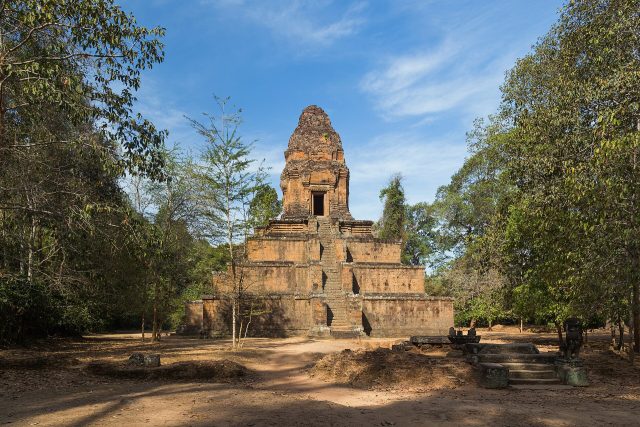
Sra Srang is one of those quiet corners of Angkor that lingers in the memory long after the grand temples fade from view. Unlike the crowded ruins of Angkor Wat or the moss-choked stones of Ta Prohm, this ancient reservoir carries an air of stillness, as if the centuries have settled here like dust on its worn steps. Tucked just east of the Bayon, it was once a vital part of the Khmer capital’s ritual life, though today it feels more like a forgotten pause in the landscape—a place where the past breathes without fanfare.
Built in the 10th century under King Rajendravarman II, Sra Srang began as a sacred bathing pool, a place where water was not just a practical necessity but a spiritual force. Later, during the reign of Jayavarman VII, it was expanded and refined, becoming a site for royal purification rites before major ceremonies. The Khmer believed water connected the earthly and divine realms, and this reservoir was meant to mirror the cosmic ocean from which the world emerged. Its very existence was a statement of order, a man-made reflection of the heavens.
What remains today is a vast rectangular basin, its edges lined with stone steps that descend toward the water. In the dry season, the pool shrinks, revealing a sandy bed that stretches like a pale scar across the earth. But when the monsoon rains arrive, the basin fills, and the still surface becomes a mirror, blurring the line between sky and stone. On the western shore, a stone landing juts into the water, guarded by two weathered lions. Their forms are worn, their details softened by time, yet their presence is undeniable—silent sentinels of a world that once revolved around this place.
There is no intricate carving here, no towering spires or elaborate galleries. Sra Srang’s beauty lies in its simplicity, in the way the stone steps curve gently toward the water, in the way the trees along the edges have begun to claim the ancient masonry, their roots weaving through cracks like veins. It feels less like a monument and more like a natural extension of the land, a place where human ambition and the slow work of time have reached a kind of equilibrium.
For the Khmer, water was never just water. It was life, power, and divine favor all at once. Reservoirs like Sra Srang were engineering marvels, designed to store water for drinking, irrigation, and ritual, but they were also sacred spaces. In Angkor’s heyday, this pool would have been alive with activity—priests chanting, crowds gathering for ceremonies, the air thick with the scent of incense and damp earth. It was a place where the community came together, where the boundaries between the ordinary and the sacred blurred.
Now, Sra Srang sees fewer visitors than the more famous temples, and that is part of its charm. There are no tour groups here, no guides pointing out every last detail. Instead, there is space to sit on the stone steps, to listen to the rustle of leaves, to watch the light shift across the water. In the early morning, before the heat sets in, the air is cool and quiet, and it’s easy to imagine the echoes of long-ago rituals—the murmur of prayers, the splash of water, the distant sound of drums.
This isn’t a place for quick snapshots or hurried visits. It’s a place for slowing down, for letting the weight of history settle in. When the crowds at Angkor Wat feel overwhelming, when the sheer scale of the ruins starts to numb the senses, Sra Srang offers a different kind of experience. Here, the past doesn’t announce itself with grand gestures. It lingers in the stillness, in the way the light falls across the stone, in the quiet certainty that this same water once reflected the faces of people who believed, as deeply as we do, in something greater than themselves.
If you come to Angkor, don’t rush past it. Take the time to walk the short distance from the Bayon, to step onto the landing where the lions stand guard, to sit for a while and let the silence settle. You might not find the answers to the questions that rise up in places like this, but you’ll find something just as valuable—the sense that the past is not as distant as it seems.