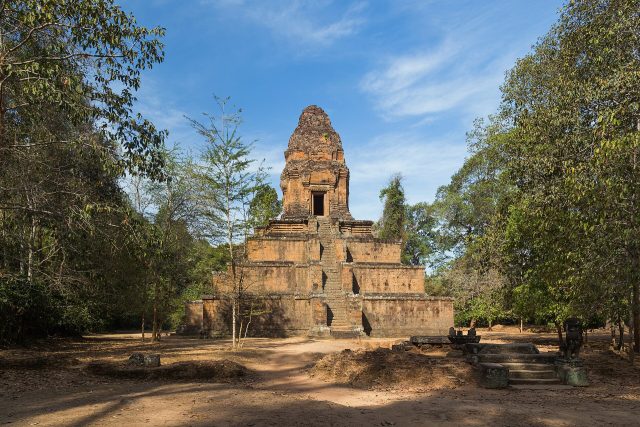
Baphuon stands apart from the more crowded temples of Angkor, a quiet giant half-swallowed by the jungle. Built in the mid-11th century under King Udayadityavarman II, it was meant to be the state temple, a monumental tribute to Shiva that would anchor the spiritual and political heart of the Khmer Empire. At its peak, the temple complex was vast, encircled by walls and a moat, its towering central spire visible for miles above the treetops. Today, only fragments remain, yet even in ruin, Baphuon commands attention—not for its pristine beauty, but for the sheer ambition of its construction and the layers of history etched into its stones.
The temple’s design is a striking example of the temple-mountain concept, a physical representation of Mount Meru, the mythical home of the gods in Hindu cosmology. Three tiers rise from the earth, each more compact than the last. The lowest level stretches east to west, its long galleries now reduced to scattered pillars and crumbling walls. The second tier is more intricate, adorned with false doors and bas-reliefs that play with perspective, creating an illusion of endless corridors. The uppermost level culminates in a steep staircase leading to the central tower, a climb that demands effort but rewards with sweeping views of the surrounding jungle and, in the distance, the unmistakable silhouette of Angkor Wat.
Baphuon’s history is as layered as its architecture. In the 13th century, when the Khmer Empire shifted from Hinduism to Buddhism, the temple underwent a dramatic transformation. Workers dismantled parts of the structure to create a colossal reclining Buddha on the western facade, its 40-meter form assembled from stones repurposed from other sections of the temple. The effect is surreal—the Buddha seems to emerge from the temple itself, a new spiritual identity imposed upon the old. Over time, nature and neglect took their toll. Earthquakes weakened the foundations, roots pried apart the stones, and by the 20th century, Baphuon was little more than a jigsaw puzzle of fallen blocks. It wasn’t until the early 2000s that French archaeologists painstakingly reassembled the temple, piece by piece, restoring a semblance of its former grandeur.
What makes Baphuon unique is its atmosphere. Unlike Angkor Wat, where tour groups cluster at every turn, Baphuon offers space to wander, to linger over the details. The bas-reliefs here are less refined than those at other temples, but that only adds to their charm. Some depict scenes from Hindu epics, others show everyday life—warriors on elephants, women grinding rice, dancers in mid-motion. The carvings bear the marks of the tools that shaped them, and in places, faint traces of red and black pigment hint at the temple’s original vibrancy. At dawn, when the first light filters through the trees, the stones seem to glow, and the shadows deepen the reliefs, as if the temple is slowly waking from a long slumber.
Baphuon is a testament to the impermanence of human achievement. The jungle has already begun to reclaim it—vines coil around columns, roots split the masonry, and moss softens the edges of the carvings. There’s a raw honesty to its decay, a reminder that even the mightiest empires fade. Unlike the symmetrical perfection of Angkor Wat or the delicate artistry of Banteay Srei, Baphuon feels lived-in, as if the past is still present in its cracks and crevices. It doesn’t dazzle at first glance, but those who take the time to explore it often leave with a deeper appreciation for its quiet resilience.
The temple was more than a religious site; it was a stage for the rituals of power. Coronations, diplomatic receptions, and state ceremonies once took place within its walls. The bas-reliefs offer glimpses into that world—kings leading armies, hunters stalking prey, musicians playing for royal audiences. Standing before these scenes, it’s easy to imagine the temple as it was: a place of noise and color, where incense filled the air and the sound of chanting echoed through the galleries. Today, the silence is broken only by the rustle of leaves and the occasional call of a bird, but the echoes of the past remain.
Visiting Baphuon requires patience. There are no quick photo opportunities here, no neatly packaged highlights. The temple reveals itself slowly, through careful observation and physical effort. The climb to the upper level is steep, the steps uneven, but the view from the top is worth it—a panorama of green stretching to the horizon, with the spires of other temples just visible in the distance. The reclining Buddha on the western side is particularly striking. Though its features are worn by time, the sheer scale of the figure is awe-inspiring, a silent guardian watching over the ruins.
Baphuon is a place where history and nature exist in uneasy balance. The jungle is patient, and it’s clear that one day, it will reclaim the temple entirely. For now, though, the stones stand as a reminder of what was—and what might have been. There’s no grand restoration here, no attempt to erase the passage of time. Instead, Baphuon offers something rarer: the chance to see a monument as it truly is, not as it once was. It’s a place that doesn’t demand admiration, but rewards those who are willing to look beyond the surface. In the end, that’s what makes it unforgettable.