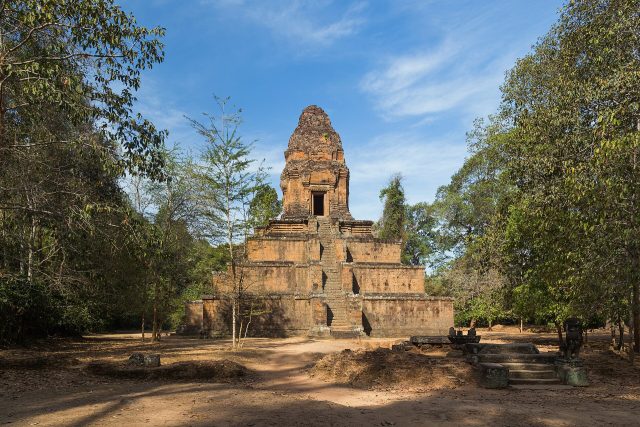
Ak Yom is one of Angkor’s quieter sites. Few visitors stop here, preferring the scale of Angkor Wat or the carved faces of Bayon. The temple sits apart, its stones worn by centuries, half-hidden under vines and moss. Built in the late 10th or early 11th century during the reign of King Jayavarman V, it honors Shiva. The name means "little Yom," likely referring to its size or a larger temple elsewhere in the region.
The design marks a shift in Khmer architecture. Earlier temples followed strict forms; Ak Yom’s builders tried something different. No towering spires or long corridors here. The central sanctuary is a simple brick square, once topped by a shikhara, now reduced to fragments. Around it stand smaller pavilions and libraries, plus later additions showing the site remained in use long after its founding.
Ak Yom stands on a man-made island in an ancient reservoir. These barays were essential for irrigation, but they also symbolized the cosmic ocean in Hindu belief. Today, the reservoir is mostly dry, though water collects at its edges in the wet season. The temple then appears as it might have centuries ago—rising from the shallows. Locals call it the "temple on the lake," though it rests on dry ground just beyond the water’s reach.
The temple reflects Cambodia’s religious changes. Originally Hindu, it later absorbed Buddhist elements as the Khmer Empire adopted Mahayana Buddhism in the 13th century. Carvings and Buddha statues were added long after its construction. Unlike many Angkor sites, Ak Yom was never fully abandoned. Its isolation may have protected it from the looting that damaged more prominent temples during conflicts.
Few tourists come here. No souvenir stalls, no guides calling out. Just the sound of leaves and the occasional visitor arriving by bicycle or motorbike. The silence lets you notice details—the faint Sanskrit on weathered stones, doorways carved with apsaras, traces of frescoes on the walls. At sunset, the ruins glow, shadows stretching across the stones.
Ak Yom shows a turning point in Angkor’s architecture. Builders began moving away from rigid symmetry, experimenting with new forms. Some elements here—like galleries and elongated structures—later defined 12th-century temples such as Angkor Wat and Preah Khan. The site connects the past to what came after.
Visit Ak Yom alongside other lesser-known temples like Pre Rup or Banteay Srei. The road winds through rice fields and palm groves, past villagers selling coconuts and fruit. In the rainy season, the landscape turns lush and green, the temple an island in the vegetation. In the dry season, golden grass and blue sky frame the grey stones.
What stays with you is not the size or grandeur, but the quiet. No grand stories, just history in the cracks and crevices. Moss between the stones, carvings smoothed by time, birdsong breaking the silence. Ak Yom was built for the gods, not tourists. That’s why it feels real.