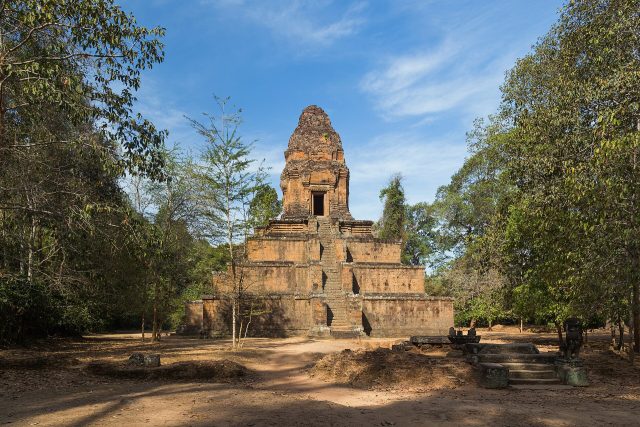
The Terrace of the Elephants stretches along the heart of Angkor Thom, a silent witness to the grandeur of the Khmer Empire. Three hundred and fifty meters of weathered stone once served as the royal viewing platform, where kings and their courts gathered to oversee parades, ceremonies, and public spectacles. Now, the space is quiet, but the carvings tell stories of a time when this was the center of a bustling capital. The air here feels thick with history, as if the echoes of ancient crowds still linger between the cracks in the stone.
The architecture is deceptively simple—massive blocks form the base, while the upper sections are adorned with intricate bas-reliefs. Elephants dominate the scene, their figures carved with such precision that they seem almost alive. Some bear towers on their backs, carrying warriors into an imagined battle, while others stand in solemn rows, as if frozen mid-procession. These aren’t mere decorations; they symbolize the empire’s strength and the divine protection believed to shield its rulers. Alongside them, lions, garudas, and mythical creatures weave a narrative of power and reverence, a visual language understood by all who once gathered here.
Built in the late 12th century under King Jayavarman VII, the terrace reflects the ambitions of one of Angkor’s most influential rulers. Jayavarman VII was a conqueror and a builder, transforming the capital into a city of unparalleled scale. Though he was a devout Buddhist, the terrace doesn’t bear overt religious symbols. Instead, it embodies a broader philosophy—one where authority was intertwined with nature, the divine, and the cosmic order. The elephants, in particular, were more than animals; they were emblems of royal might, their presence reinforcing the idea that the king’s rule was both earthly and sacred.
The terrace wasn’t an isolated structure but part of a larger urban complex. It connected to the royal palace and other key monuments, like the Baphuon temple and the Terrace of the Leper King, forming a cohesive architectural and symbolic whole. The nearby Terrace of the Leper King, named for a statue that may depict the Hindu god Yama rather than a diseased monarch, adds another layer to this narrative. Together, these structures created a stage for royal rituals, where every detail—from the placement of a statue to the direction of a procession—carried meaning. The city’s layout wasn’t just practical; it was a carefully constructed reflection of the Khmer worldview.
Today, the Terrace of the Elephants is one of Angkor’s most photographed sites. Visitors arrive at dawn or dusk, when the light softens the stone, revealing the depth of the carvings. Early mornings are especially peaceful, the cool air making it easy to linger over the details—a curled trunk, the curve of a lion’s mane, the delicate patterns on a mythical creature’s wings. Yet it’s worth remembering that this isn’t just a picturesque ruin. It was once the political and cultural heart of an empire that stretched across modern-day Thailand, Laos, and Vietnam, a place where decisions were made that shaped the lives of millions.
Time has taken its toll. Some carvings are worn smooth, their edges blurred by centuries of rain and wind. Others have cracked or crumbled, leaving gaps in the once-continuous frieze. Yet even in its weathered state, the terrace commands attention. Restoration work is ongoing, with teams carefully cleaning moss from the stone or reinforcing weakened sections. It’s painstaking labor, but necessary—each block, each carving, is a piece of history that deserves to endure.
The atmosphere shifts with the hours. In the morning, the stone is cool underfoot, the air crisp and clean. By midday, the heat presses down, turning the terrace into a sunbaked expanse where only the most determined visitors remain. It’s then, under the harsh light, that the smallest details become visible—the texture of an elephant’s hide, the intricate patterns on a warrior’s armor. As evening falls, the shadows lengthen, and the jungle’s sounds grow louder. The place takes on a different mood, as if the past is closer to the surface, ready to spill into the present.
The Terrace of the Elephants is more than a relic of architecture; it’s a bridge to another era. It reminds us that Angkor wasn’t just a religious center but a living, breathing city where power, culture, and daily life intersected. Here, kings addressed their subjects, armies marched in triumph, and festivals unfolded under the watchful eyes of the gods. Standing on the terrace today, it’s easy to imagine the scene—the rustle of silk robes, the murmur of the crowd, the distant beat of drums. The stones may be silent, but they still speak, offering a glimpse into a world that shaped Southeast Asia in ways that resonate even now.