Perched on a bluff overlooking the slow-moving Desna River, the Transfiguration Cathedral in Chernihiv feels like a place where time has settled into stillness. Its white stone walls have stood for over a thousand years, bearing silent witness to invasions, fires, and the rise and fall of empires. This is not just an old building—it’s one of the oldest surviving churches in Eastern Europe, a monument that carries the weight of Kyivan Rus’ within its ancient masonry.
The cathedral was founded in the early 11th century under the rule of Prince Mstyslav Volodymyrovych, son of Volodymyr the Great. At the time, Chernihiv was a thriving center of power, rivaling Kyiv and Novgorod in wealth and influence. The church was conceived as the grandest symbol of the principality, a statement of both faith and authority. Built in the Byzantine tradition but with local adaptations, its design reflects the austere spirit of the era—thick walls, restrained proportions, and an absence of unnecessary ornamentation. Inside, however, the cathedral was once a dazzling display of devotion, adorned with mosaics, frescoes, and precious liturgical objects meant to reflect the glory of God and the prince.
History has not been kind to the cathedral. In the 13th century, Mongol forces under Batu Khan looted it, though they spared its structure from complete destruction. Later, in the 17th century, the church was restored after fires and wars, with elements of Ukrainian Baroque added to its facade—elaborate window frames and decorative gables softened its severe lines. Another restoration in the 18th century sought to preserve its original character, though traces of each era remain visible. Today, the building is a patchwork of styles: ancient arches sit beside Baroque flourishes, and sturdy buttresses contrast with delicate cornices.
Stepping inside, the atmosphere shifts. The high vaulted ceilings and dim light filtering through narrow windows create a sense of quiet reverence. There are no garish colors or ostentatious details—just a solemn grandeur that feels timeless. Some fragments of the original frescoes survive, though much was lost or concealed beneath layers of later plaster. The crypt beneath the cathedral, once the burial place of Chernihiv’s princes, now lies empty, but its very existence is a reminder that this was more than a house of worship—it was a resting place for rulers.
The cathedral has served many roles over the centuries. It began as a princely church, later became part of a monastery, and eventually rose to the status of a cathedral. During the Soviet era, it was closed and turned into a museum, and in World War II, it suffered heavy damage from shelling. Yet each time, it was restored, its original form carefully reconstructed. Today, it functions once again as an active church, drawing not only the faithful but also those who come to connect with the past.
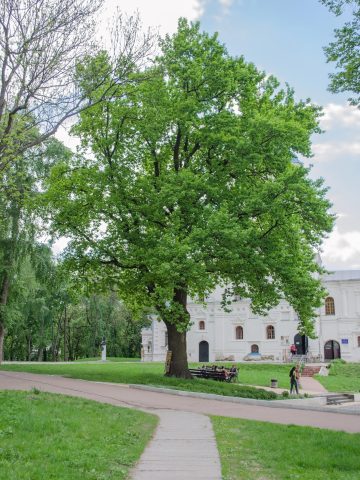
Surrounding the cathedral is a quiet park where visitors can sit on benches and take in the view of the Desna. In summer, the green trees frame the white stone of the church, while the river drifts lazily past the ancient riverbank. Winter transforms the scene—the cathedral stands stark and majestic against the snow-covered hills. No matter the season, it remains a focal point for those who appreciate history and understated beauty.
The cathedral is part of a larger historical landscape in Chernihiv. Nearby are the Anthony Caves, an ancient underground monastery, and the Borisoglebsky Cathedral, another 11th-century church. Together, they form a unique ensemble that offers a glimpse into Chernihiv’s golden age. Walking among these sites, it’s impossible not to reflect on the generations of people who have passed through here, leaving behind only stone and stories.
There’s something about the Transfiguration Cathedral that makes history feel tangible. Every stone, every crack in the wall seems to hold a memory. You don’t need a guidebook or a lecture to sense the weight of the centuries—just step inside, listen to the silence, and let the past settle around you. It’s a place where the present and the distant past exist side by side, quietly.