Perched on a bluff overlooking the slow-moving Desna River, the Borisoglebsky Cathedral in Chernihiv feels like a place where time has learned to pause. It has stood here for nearly nine centuries, bearing silent witness to invasions, fires, and the rise and fall of empires. The cathedral is not merely an ancient monument; it is a living fragment of the city’s history, still breathing long after its foundation.
Built in the mid-twelfth century, the cathedral was dedicated to Saints Boris and Gleb, the first Russian martyrs, whose names symbolized humility and devotion. Chernihiv was then one of the most powerful centers of Kyivan Rus, and the cathedral was conceived both as a tribute to the princely dynasty and a declaration of the city’s strength. Its architecture reflects the era’s distinctive style: a cross-domed structure with thick walls of plinthos—flat bricks typical of the period—and a restrained, almost austere design. Inside, fragments of frescoes remain, once covering the walls in a continuous narrative of biblical stories, though now only glimpses of those vivid scenes survive.
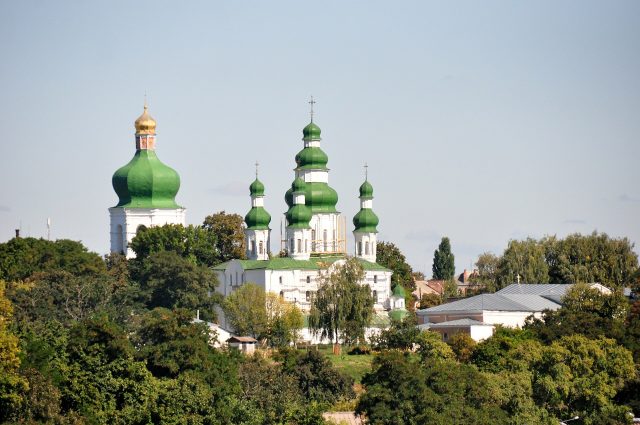
The cathedral has endured its share of destruction. Mongol forces ravaged it in the thirteenth century, fires consumed it in later years, and in the seventeenth century, it was partially rebuilt in the Ukrainian Baroque style. That renovation added the bell tower that now rises above the ancient structure, lending it a more imposing presence. In the nineteenth century, restorers attempted to return the cathedral to its original appearance, though some later additions remained, becoming part of its layered history, like scars on an old warrior’s face.
Remarkably, the Borisoglebsky Cathedral was never abandoned. Even in the darkest periods, it remained an active place of worship, a destination for pilgrims, and a spiritual heart for the community. During the Soviet era, like many churches, it was closed, but unlike others, it was not repurposed as a warehouse or an atheist museum. Whether due to its historical significance or sheer luck, the building survived intact. By the late twentieth century, it was returned to the faithful, and today, the sound of prayers and church bells once again fills its ancient walls.
Stepping inside, the atmosphere is immediately striking. The high vaults, the dim light filtering through narrow windows, the scent of wax and aged wood—all combine to create a sense of stepping back in time. The frescoes, though fragmented, still command attention. Faces of saints, scenes from the Gospels, and even traces of Old East Slavic inscriptions can be discerned. The iconostasis, crafted in the nineteenth century, blends seamlessly with the medieval architecture, as if it had always belonged there.
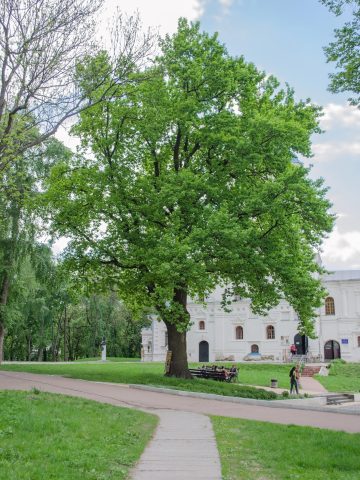
The cathedral is also an integral part of Chernihiv’s urban landscape. Situated in the historic center, it stands near other ancient churches and princely burial mounds, remnants of a time when the city was the capital of a powerful principality. A park surrounds the cathedral, where locals stroll and visitors pause to photograph the weathered brick walls. In summer, the greenery contrasts beautifully with the reddish hue of the cathedral, and in the evening, when the lights come on, the building seems to glow from within.
For Chernihiv, the Borisoglebsky Cathedral is more than just a landmark. It embodies the continuity of generations, the connection between past and present. The lives of princes, monks, artisans, and ordinary citizens have all intertwined here, each leaving their mark on the cathedral’s history. Even those who have no interest in religion or architecture often feel a quiet pull to this place, as if sensing the weight of centuries contained within its walls.
Today, the cathedral remains a place where people come not only to pray but also to stand in silence, to reflect, or simply to admire the beauty of ancient craftsmanship. In a world that moves too quickly, such places are rare, and perhaps that is why they matter so much. The Borisoglebsky Cathedral does not demand attention or seek to draw crowds; it simply exists, as the Desna River flows beside it, as the sky arches above, and as the earth holds it steady beneath its foundations.