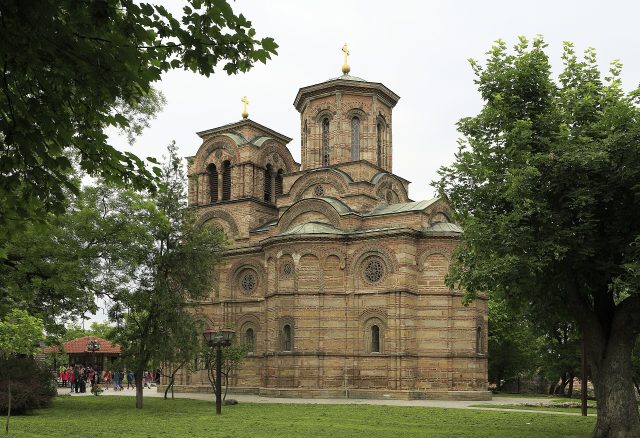
Kruševac is a city where the past lingers in unexpected ways, and few places embody this as quietly yet powerfully as the Cathedral Church of Saint George. Built in the mid-19th century, it stands where an older church once did, a silent witness to Serbia’s shifting fortunes. The city itself has long been a crossroads of history—once the capital of the medieval Lazarević principality, later a military stronghold and trading hub. The cathedral bridges these eras, its stones holding the echoes of faith and identity that have shaped the nation.
The architecture reflects the romantic revivalism of 19th-century Serbia, a deliberate nod to the grandeur of medieval Byzantine design. Light-colored stone clads the exterior, catching the sun in soft golden hues, while domes and arches rise in graceful symmetry. Inside, the space feels both vast and intimate. High vaults and slender columns draw the eye upward, while frescoes and icons—painted in a refined academic style—lend the interior a sense of timeless serenity. The craftsmanship isn’t just decorative; it’s a dialogue between past and present, a way of preserving tradition without freezing it in time.
The iconostasis, crafted in the late 1800s, is a masterpiece in its own right. Every detail, from the intricate carvings to the gilded frames, was designed not just to adorn but to tell a story. The icons here aren’t mere religious objects; they’re fragments of history, reflecting how Serbian art evolved over centuries. Some depict biblical scenes with a quiet intensity, while others bear the marks of the era’s political and cultural currents. To stand before them is to glimpse the hands of artists who sought to capture something enduring in a world of constant change.
The church has been more than a place of worship—it’s been a gathering point in times of crisis and celebration. Services here marked Serbia’s liberation from Ottoman rule, and during the world wars, its walls bore witness to both destruction and resilience. The damage from the First World War was later repaired, but the scars of history remain, woven into the fabric of the building. Even now, the cathedral feels like a living archive, where the weight of the past isn’t just remembered but actively felt.
Today, the church remains a working parish, drawing both the devout and the curious. On weekdays, it’s a place of quiet reflection, the air thick with the scent of candle wax and the murmur of prayers. Sundays and feast days bring a different energy—choirs fill the space with music, and the congregation spills out onto the steps. For many in Kruševac, Saint George’s isn’t just a landmark; it’s a place of solace, a rare pocket of stillness in the rush of daily life.
The small park surrounding the cathedral is where the city’s rhythms play out. On warm afternoons, elderly men gather for chess games under the trees, while children chase each other across the grass. In summer, musicians sometimes set up near the steps, their melodies mingling with the toll of the bells. Winter transforms the scene entirely—the domes dusted with snow, the windows glowing against the dusk. It’s a place where time seems to slow, if only for a moment.
Kruševac is a city where old and new coexist without fanfare, and the cathedral is one of the few places where that balance is most visible. It’s not just a relic; it’s a thread in the fabric of the city, still woven into the lives of those who pass through its doors. You might come to admire the architecture, but you’ll stay for the sense of continuity—the way the light falls on the same stones that have seen generations come and go.
For visitors, the church often comes as a surprise. Unlike Serbia’s more famous religious sites, it hasn’t been overtaken by crowds or commercialized. There’s no rush here, no scripted tour experience. Instead, there’s the chance to see the country as it is—unpolished, unhurried, rooted in something deeper than tourism. The cathedral doesn’t demand attention; it simply offers itself, open to those who take the time to look.
Saint George’s is more than a monument. It’s a reminder that some things endure—not just as relics, but as living parts of a community. In a world that moves too fast, it stands as a quiet counterpoint, a place where faith, memory, and beauty intersect. And perhaps that’s why it draws people in, not just as a destination, but as a pause in the journey.