Kruševac Fortress stands on a gentle hill above the Rasina River, a quiet witness to centuries of Serbian history. Built in the heart of the country, its ruins tell a story not just of battles and rulers, but of everyday life in a medieval principality. Though time has worn down its walls, the fortress remains a powerful symbol of the era when Kruševac was the capital of Moravian Serbia, a center of power and culture under Prince Lazar Hrebeljanović.
The fortress was founded in the mid-14th century, a time when Serbia was asserting its independence amid the shifting politics of the Balkans. Prince Lazar chose this site as his stronghold, and from here, he prepared for the Battle of Kosovo—a turning point in Serbian history. The fortress was more than a military outpost; it was a political and cultural hub where diplomats, merchants, and nobles gathered. Its walls saw both the grandeur of court ceremonies and the hardships of wartime, offering shelter to the people of Kruševac when threats loomed beyond its gates.
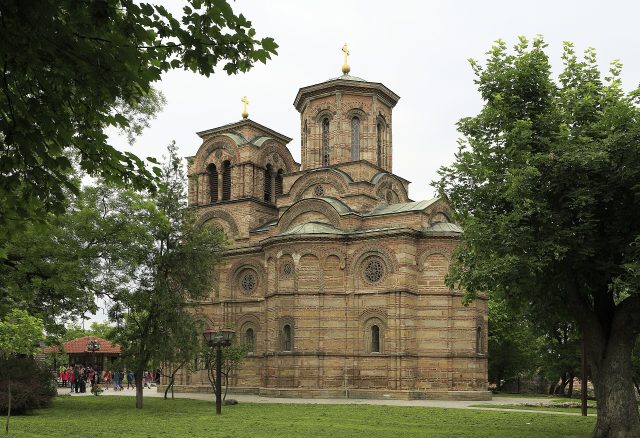
The architecture reflects the practical yet imposing style of medieval Serbian fortifications. The thick stone walls, built without mortar, followed the natural contours of the hill, making the fortress nearly impregnable. Inside, the remains of living quarters, storage buildings, and a church hint at the daily life that once thrived here. The most striking feature is the base of the Nebojša Tower, named after a legendary Serbian hero. Though only its lower section survives, the tower still commands attention, evoking images of sentries scanning the horizon for approaching enemies.
By the 15th century, the fortress had lost its strategic importance after the Ottoman conquest of Serbia. Over time, its stones were repurposed for local construction, leaving little more than ruins. Yet the site never faded from memory. In the 20th century, archaeologists began uncovering its past, piecing together fragments of its history. Today, the fortress is not just a monument but a living space where festivals, historical reenactments, and cultural events bring the past to life. On summer evenings, the illuminated walls seem to breathe, while the rustling leaves and the murmur of the river create an atmosphere where time feels suspended.
Walking through the fortress is like stepping into another era. The main gate, once the entrance for dignitaries and traders, leads to a narrow path winding past the remnants of inner structures. Along the walls, arrow slits and scorch marks bear silent testimony to past conflicts. The so-called Lazar’s Court, where the prince’s chambers once stood, now features informational plaques that help visitors imagine the fortress in its prime. The stones here are worn smooth by centuries, yet they retain a sense of the people who once walked among them.
For Serbs, the fortress holds deep national significance. During the 19th-century struggle for independence from the Ottomans, it became a symbol of resistance and the revival of Serbian statehood. Patriots gathered here to honor Prince Lazar and his legacy, reinforcing the fortress’s place in the collective memory. Even now, it draws not only tourists but locals who come to connect with their heritage. The ruins serve as a reminder of resilience—a place where history feels tangible, not just recorded in books.
Beyond the fortress walls, modern Kruševac stretches out, a city where the past and present coexist. From the hill, the view encompasses rolling green hills, the winding Rasina River, and the red-tiled roofs of houses below. On clear days, distant mountain peaks emerge on the horizon. In summer, the site buzzes with activity: visitors photographing the ruins, children playing among the stones, and families strolling as if the fortress were just another park. Winter transforms it into a stark, almost mystical landscape, where the silence amplifies the weight of history.
Visiting Kruševac Fortress is less about ticking off a tourist attraction and more about experiencing history in its raw, unfiltered form. There are no grand restorations or glass cases here—just the authenticity of weathered stone and the stories it holds. Some come to wander for hours, reconstructing the past in their minds; others simply sit on a bench, watching the sunset over the river. Either way, the fortress leaves an impression that lingers long after leaving Kruševac, a quiet testament to the enduring spirit of a place and its people.