Paola’s St. Paul’s Cathedral is one of those places in Malta where history isn’t just remembered—it lingers in the air, in the worn stone steps, in the quiet hum of prayers beneath the vaulted ceiling. Perched on a hill overlooking the town, the cathedral has stood here since the mid-17th century, a silent witness to centuries of faith, conquest, and everyday life. It’s dedicated to St. Paul, whose shipwreck off Malta’s coast in the first century AD became a turning point for the island. According to tradition, it was Paul’s arrival that brought Christianity to Malta, and his legacy has shaped the island’s identity ever since.
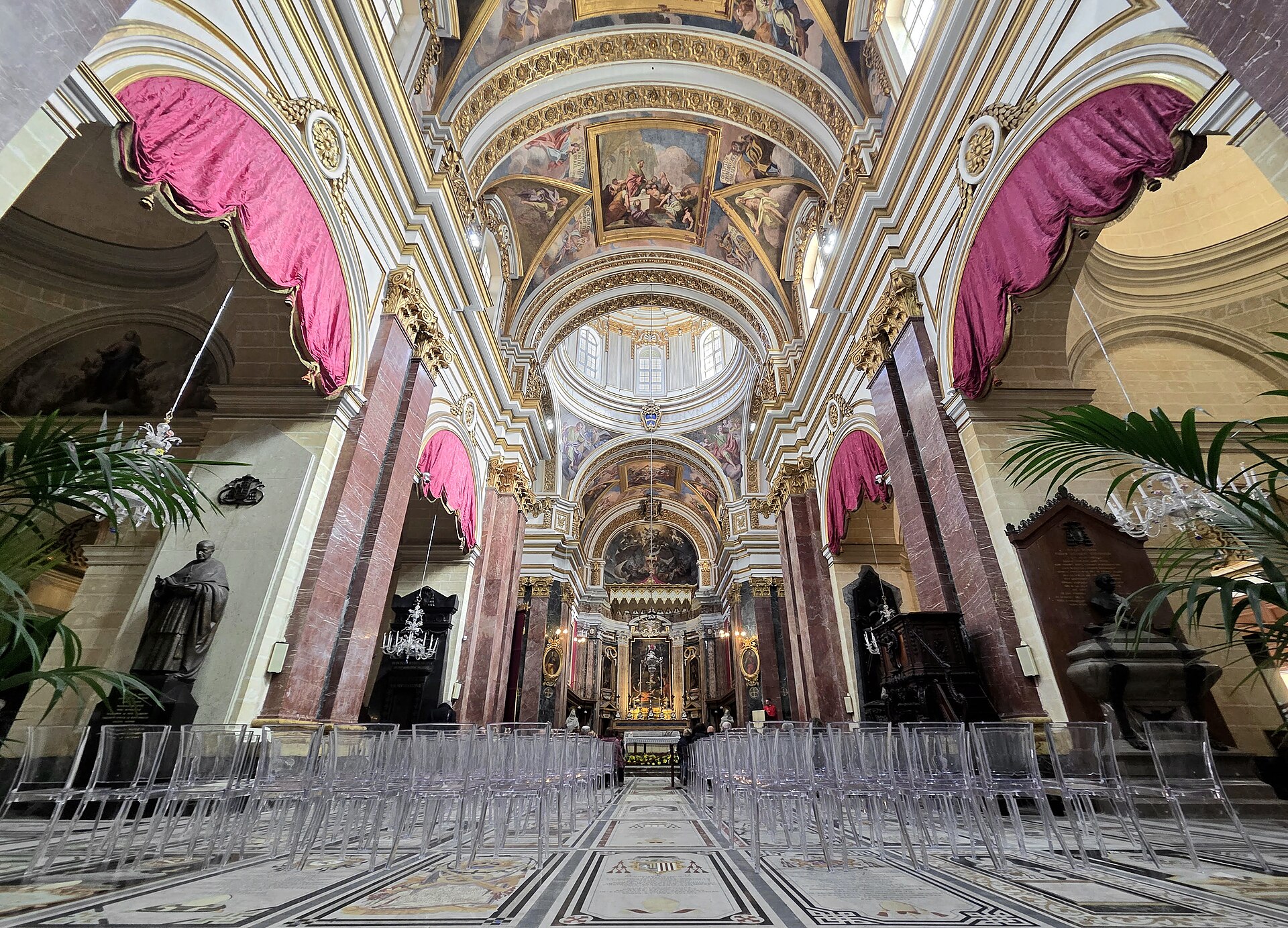
The cathedral’s architecture is a blend of Baroque grandeur and local craftsmanship, a style that feels both imposing and intimate. The façade, carved from Malta’s golden limestone, is restrained yet elegant, with two symmetrical bell towers framing the entrance. Inside, the space opens up into a luminous nave, where high windows filter sunlight into soft, shifting patterns. The main altar is a focal point, adorned with gilded details and paintings depicting scenes from Paul’s life. But it’s the ceiling that often draws the eye upward—elaborate frescoes weave together biblical stories and moments from Malta’s past, a visual chronicle of faith and history.
Paola itself is a town that exists outside the usual tourist circuits, a place where Malta’s working-class roots are still visible in the narrow streets and modest houses. It’s not a postcard-perfect destination, but that’s part of its charm. The cathedral sits at the heart of this community, a place where people come not just for Mass, but to sit in quiet reflection or to catch their breath from the climb up the hill. From the steps outside, the view stretches across the town and toward the harbor of Marsaxlokk, a reminder of Malta’s long history as a crossroads of trade and conflict.
The cathedral was built during a period when the Knights of St. John ruled Malta, a time of ambitious construction and artistic patronage. Paola was then a small settlement, but its proximity to Valletta made it strategically important. The cathedral wasn’t just a place of worship—it was a symbol of the Knights’ influence and a unifying presence for the local population. Even today, its role in the town’s life hasn’t faded. On Sundays, the square outside fills with families, the scent of fresh pastizzi drifting from nearby bakeries, while inside, the murmur of prayers and the occasional notes of the organ create a rhythm that feels timeless.
One of the most striking things about St. Paul’s Cathedral is how it bridges the sacred and the everyday. The side chapels hold relics and statues of saints, their faces worn smooth by centuries of devotion. Among them are the remains of local holy figures, objects of veneration that connect the present to Malta’s early Christian past. Every June, the cathedral becomes the center of festivities honoring St. Paul, with processions, music, and flowers adorning the streets. For a few days, Paola transforms, its usual quiet giving way to celebration, but even then, the cathedral remains a steady presence, anchoring the town in tradition.
For those curious about Malta’s layered history, the cathedral offers more than just architectural beauty. Its walls hold traces of the island’s past—the Knights’ era, the colonial period, even the scars of World War II, when Malta endured relentless bombing. The crypts below house ancient tombs, while the small museum attached to the cathedral displays religious artifacts spanning centuries. It’s a place where history isn’t confined to plaques or exhibits but is alive in the very stones, in the way light falls across the pews, in the stories passed down through generations.
The view from the cathedral’s hill is worth the climb. On clear days, the gaze stretches over rooftops and out to sea, where the harbor of Marsaxlokk glints in the distance. It’s easy to imagine the Knights standing here, watching for ships on the horizon—merchant vessels laden with goods or enemy fleets threatening invasion. Malta has always been a meeting point of cultures, from the Phoenicians and Romans to the Arabs and Europeans, and this view captures that sense of connection, of being both an island and a crossroads.
What makes St. Paul’s Cathedral special isn’t just its age or its artistry, but the way it fits into the fabric of daily life. Unlike the polished tourist sites of Valletta or Mdina, Paola feels lived-in, unpretentious. After Mass, people linger outside, chatting in Maltese or English, children darting between the benches while older residents watch the world go by. The cathedral isn’t just a monument—it’s a place where history and the present coexist, where the past isn’t something distant but something you can almost touch. In that way, it’s not just a stop on a map, but a piece of Malta’s ongoing story.