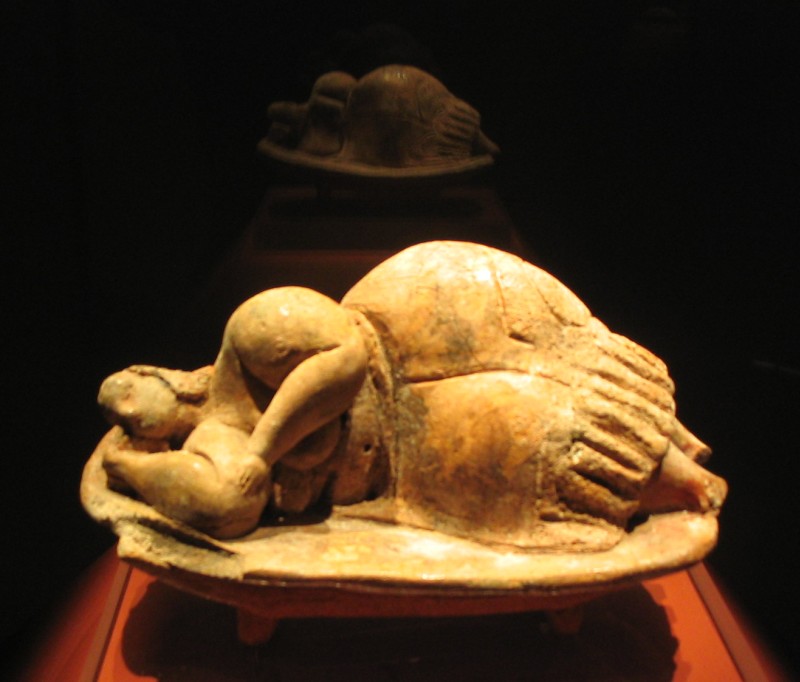
The Ħal Saflieni Hypogeum is one of those rare places that make you pause and reconsider how little we truly understand about the ancient world. Carved into solid limestone over five thousand years ago, this subterranean complex in Paola, just outside Malta’s capital Valletta, remains an enigma. It was discovered by chance in the early 20th century when workers digging a well stumbled upon something far more intricate than a simple cave. What they found was a labyrinth of chambers, passages, and halls—an entire underground world shaped by Neolithic hands.
The architecture of the hypogeum is astonishing in its precision. Three levels descend twelve meters into the earth, each serving a distinct purpose. The upper level, with its recessed niches and circular openings in the ceiling, was likely used for rituals, possibly allowing light to filter in during ceremonies. The middle level is more expansive, with larger chambers that may have accommodated gatherings. The lowest level, however, is the most mysterious. Here, small rooms are coated in red ochre, and one chamber contains the remains of thousands of individuals. Scholars still debate whether this was a necropolis, a burial site for leaders, or something else entirely—perhaps a place where the living and the dead intersected in ways we can no longer comprehend.
One of the most intriguing spaces is the Oracle Chamber, a small room with remarkable acoustic properties. A whisper against one wall carries clearly throughout the chamber, amplified as if by some unseen force. The builders, without modern knowledge of sound physics, created a space where voices took on an almost supernatural quality. It’s easy to imagine this room as a place of divination, where priests or elders spoke to spirits—or perhaps where important decisions were made, ensuring every word was heard by all present.
The hypogeum is closely linked to Malta’s other megalithic sites, such as the Ġgantija and Mnajdra temples. Built around the same time, they share similar architectural features: massive stone blocks, spiral carvings, and alignments with celestial events. Yet the hypogeum stands apart because of its underground nature. While the other temples were built in the open, this complex was hidden away, as if its creators intended to preserve its secrets. Was it a sacred space reserved for the initiated, or a refuge in times of crisis? The answer may never be known, but its seclusion adds to its mystique.
Visiting the hypogeum today is like stepping into another era. The air is cool and damp, carrying the faint scent of limestone, and the silence is so profound that you can hear your own breath. The experience is carefully controlled—only small groups are allowed inside at a time to protect the delicate environment. As you navigate the narrow passages, dimly lit and worn smooth by millennia of use, it’s impossible not to wonder about the people who once walked these same paths. The weight of history here is tangible, pressing in from all sides.
The construction of the hypogeum remains a marvel. Without metal tools, how did its builders carve such intricate spaces into solid rock? Some theories suggest they used stone and bone implements, possibly softening the limestone with fire. Others believe the work spanned generations, passed down as a sacred duty. Whatever the method, the result is extraordinary—a structure that has endured for over five thousand years with remarkable preservation.
The hypogeum’s rediscovery in the 20th century brought both fascination and challenges. After its initial discovery, archaeologists quickly realized its significance, but the influx of visitors threatened its stability. In 1980, it was designated a UNESCO World Heritage site, helping to secure its protection. Today, access is strictly regulated, and conservation efforts are carried out with extreme care to maintain the fragile underground conditions.
A visit to the Ħal Saflieni Hypogeum is more than just a tour; it’s a quiet confrontation with the past. This place forces you to reflect on the continuity of human experience—how, despite the passage of millennia, people have always sought answers to the same fundamental questions. The builders of this underground labyrinth were grappling with ideas of life, death, and the divine, just as we do today. While their exact intentions may remain forever unknown, the hypogeum itself stands as a testament to the depth and complexity of early human civilization. In its silent chambers, time feels suspended, offering a fleeting connection to something enduring.