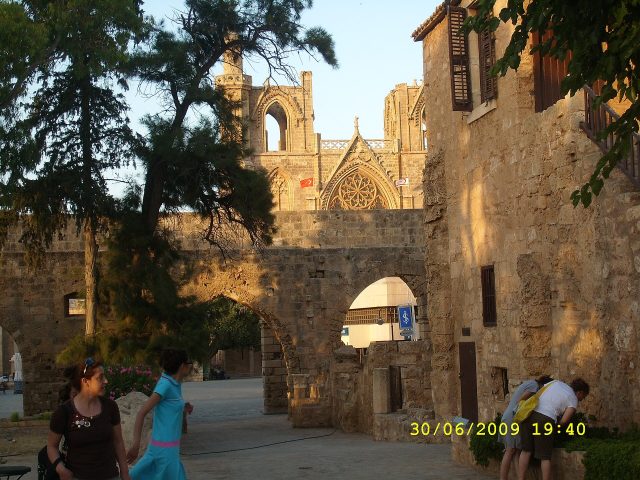
St. Nicholas Cathedral in Famagusta stands as a quiet witness to centuries of change, its weathered stones holding stories of power, faith, and transformation. Built in the early 1300s under the Frankish Lusignan dynasty, it was conceived as the city’s grand Catholic cathedral, a symbol of both religious devotion and the wealth that flowed through Famagusta’s bustling medieval port. Though time and conquest have stripped away much of its former glory, the ruins still carry the weight of history, offering a glimpse into an era when this coastal city rivaled even Constantinople in its prosperity.
The cathedral’s architecture remains striking, even in its current state of partial ruin. Designed in the Gothic style that swept through medieval Europe, it bears the hallmarks of that era—soaring pointed arches, sturdy buttresses, and intricate stonework that once adorned its facade. The main portal, though worn by time, still hints at the craftsmanship that went into its creation, with traces of carvings that once told stories of faith and artistry. Inside, the vast nave would have once been filled with light filtering through stained glass, though today only fragments remain, barely visible against the crumbling walls.
What makes St. Nicholas particularly fascinating is its layered history, shaped by the shifting tides of power on Cyprus. Unlike many other religious sites on the island, it was never an Orthodox church, despite the strong Byzantine influence in the region. When the Venetians took control of Famagusta in the late 15th century, the cathedral remained a Catholic place of worship, though its importance waned as the city’s fortunes declined. The Venetians fortified the city, enclosing the cathedral within its walls, which may have spared it from complete destruction during the Ottoman conquest in 1571. Yet that same conquest marked the end of its life as a Christian sanctuary.
The Ottomans repurposed the building as a mosque, adding a minaret that still looms over the ruins today. Though partially collapsed, the minaret’s silhouette is unmistakable, a reminder of the centuries when the call to prayer echoed where church bells once rang. Inside, the changes are visible—niches for prayer, remnants of the mihrab pointing toward Mecca, and faint Arabic inscriptions that speak to its new role. The Christian imagery was erased, but the structure itself endured, a testament to the pragmatic reuse of sacred spaces in a changing world.
St. Nicholas Cathedral is more than just an architectural relic; it is a physical record of Famagusta’s rise and fall. In its heyday, the city was a crossroads of trade, where merchants from Europe, Asia, and Africa converged, and the cathedral stood as a symbol of both spiritual and temporal authority. After the Ottoman takeover, Famagusta entered a long decline, and the cathedral shared its fate. For centuries, it stood abandoned, its significance forgotten by all but a few. It wasn’t until the 19th century that travelers and scholars began to rediscover its history, recognizing it as a key to understanding Cyprus’s complex past.
Today, the cathedral is one of Famagusta’s most evocative landmarks, though it lacks the fame of the city’s other ruins, like Othello Castle or the Venetian walls. Tucked away in the old quarter, surrounded by narrow streets and half-collapsed houses, it feels like a place suspended in time. Visitors come not just to see the stones but to feel the weight of history in the silence, broken only by the wind rustling through the ruins. A small park surrounds the site, offering a quiet spot to sit and imagine the sounds that once filled the space—choir hymns, the murmur of prayers, or the distant call of the muezzin.
There is a certain melancholy beauty in the cathedral’s current state. It has survived the rise and fall of empires, the shift from one faith to another, and the slow march of time, yet it has never been restored to its former glory. Perhaps that is part of its appeal. Unlike meticulously reconstructed monuments, St. Nicholas retains an authenticity that comes from bearing the marks of history without embellishment. Its walls tell a story of resilience, adaptation, and the inevitable passage of time, making it a powerful symbol of Cyprus’s layered identity.
Famagusta itself is a city of contrasts, where modern life unfolds against a backdrop of crumbling grandeur. St. Nicholas Cathedral occupies a unique place in this landscape—not quite a museum, not a functioning place of worship, and not a typical tourist attraction. It is something more intangible: a place where the past feels tangible, where the echoes of different eras linger in the air. For those who seek more than just picturesque ruins, the cathedral offers a chance to connect with the deeper currents of history, where the boundaries between East and West blur, and the stories of the past refuse to be forgotten.