Salamis stands where the Mediterranean meets the eastern edge of Cyprus, a place where the past feels almost tangible. The ruins sprawl along the coast, just north of modern Famagusta, where the sea breeze carries the scent of salt and wild thyme. Once the island’s most important city, Salamis was a hub of trade, politics, and culture for over a thousand years. Today, its crumbling columns and weathered mosaics tell a story of rise and fall, of empires that shaped the region and left their mark on the stones beneath your feet.
Founded in the 11th century BC, Salamis began as a small settlement, but its location made it destined for greatness. The city sat at the crossroads of the ancient world, where ships from Greece, Egypt, and the Levant docked to trade goods and ideas. By the 8th century BC, it had grown into the capital of Cyprus, a role it would hold for centuries. The city flourished under Assyrian, Egyptian, and Persian rule, each leaving their own layer of history in its streets and temples. The most visible remnants of this era are the massive stone blocks of the gymnasium, where athletes once trained under the Mediterranean sun, and the remains of the agora, where merchants haggled over spices, wine, and olive oil.
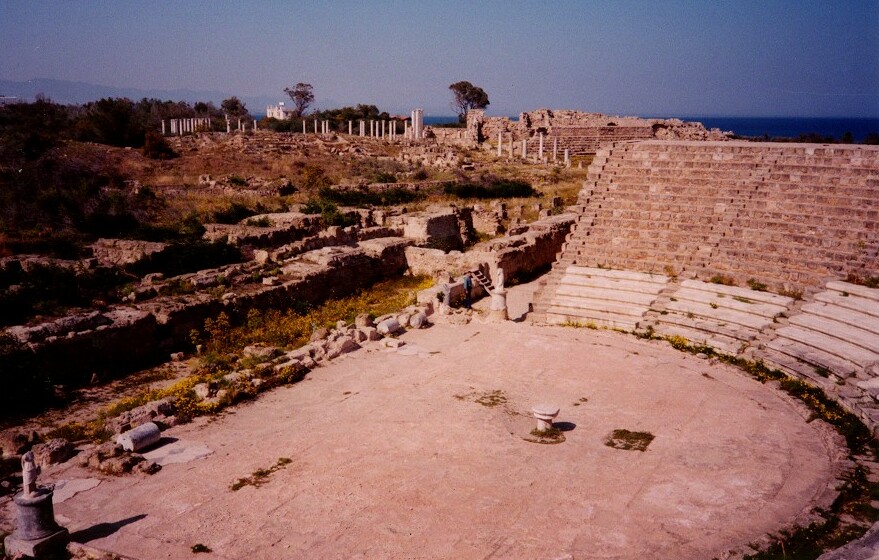
The Roman period brought Salamis its greatest prosperity. The city expanded, its streets lined with grand public buildings, baths, and theaters. The Romans rebuilt the gymnasium, adding marble columns and intricate mosaics that still hint at the city’s former splendor. Nearby, the theater, carved into the hillside, could seat up to 15,000 spectators, a testament to the city’s wealth and cultural ambitions. Performances of Greek tragedies and Roman comedies once echoed through its arches, though today the only audience is the wind rustling through the ruins. The nearby baths, with their underfloor heating and elaborate frescoes, speak of a society that valued leisure as much as power.
Christianity arrived early in Salamis, and by the 4th century AD, the city had become an important religious center. The ruins of the basilica of St. Epiphanius, one of the largest early Christian churches on the island, stand as a reminder of this era. Its mosaic floors, though faded, still show traces of the intricate designs that once covered them. The church was named after Epiphanius, a bishop of Salamis who was known for his fierce defense of Christian doctrine. Nearby, the necropolis, with its rows of stone sarcophagi, offers a quieter glimpse into the lives of the city’s inhabitants. Some of the tombs are simple, while others are adorned with carvings, hinting at the status of those buried within.
Salamis’s decline began in the 7th century, when Arab raids weakened the city’s defenses. A devastating earthquake in 332 AD had already damaged much of the infrastructure, and by the 7th century, the population began to dwindle. The final blow came in the 7th century, when the city was largely abandoned in favor of nearby Famagusta, which offered better protection from invaders. Over time, the sea encroached on the ruins, and sand buried what remained. For centuries, Salamis was forgotten, its stones scattered and its history nearly lost.
Rediscovery came in the 19th century, when archaeologists began excavating the site. What they uncovered was a city frozen in time, its streets and buildings preserved beneath the sand. Today, visitors can walk along the same paths that merchants, soldiers, and philosophers once trod. The gymnasium, with its towering columns, still dominates the landscape, while the theater offers a panoramic view of the sea. The mosaics, though worn, retain their beauty, their colors muted by time but still vibrant enough to imagine the hands that laid them.
The atmosphere at Salamis is one of quiet reflection. Unlike some ancient sites, which are crowded with tourists, this place often feels almost empty, as if the past is still lingering just out of sight. The sound of the waves crashing against the shore blends with the rustle of the wind through the ruins, creating a sense of timelessness. It’s easy to sit on a fallen column and imagine the city as it once was—bustling with life, filled with the sounds of commerce and conversation. The ruins don’t just show what Salamis was; they invite you to feel it.
For those interested in history, Salamis offers a rare opportunity to step into the layers of the past. The site is large enough to explore for hours, with each section revealing something new. The Roman baths, with their hypocaust system, show the ingenuity of ancient engineering. The basilica, with its remnants of Christian art, speaks to the city’s spiritual life. And the necropolis, with its silent tombs, reminds visitors of the fleeting nature of human endeavors. There are no grand reconstructions here, no modern interpretations—just the stones themselves, speaking in their own quiet way.
Visiting Salamis is not just about seeing an ancient city; it’s about understanding the forces that shaped Cyprus and the wider Mediterranean world. The city was a microcosm of the region’s history, a place where cultures collided and blended. Walking through its ruins, you can almost hear the echoes of the past—the shouts of traders in the agora, the applause of the crowd in the theater, the prayers of the faithful in the basilica. It’s a place where history feels alive, not because of any grand spectacle, but because of the stories etched into every stone.