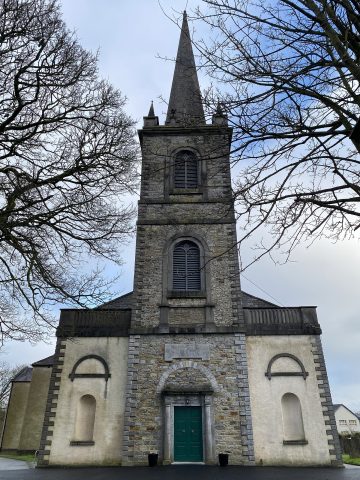
St Mel’s Cathedral in Longford is one of those places that doesn’t demand attention at first glance, yet it lingers in the mind long after you’ve left. Standing quietly on a slight rise in the town centre, it feels like a reminder that Ireland’s history isn’t always written in grand events, but often in the quiet, enduring presence of stone. The cathedral is dedicated to St Mel, an early Irish saint said to have been a nephew of St Patrick himself. According to tradition, Mel founded a monastery here in the 5th century, and though little remains of those early days, the site has retained its spiritual continuity across the centuries.
The building you see today dates to the mid-19th century, a time when Ireland was experiencing a religious revival. Its architecture reflects the Gothic Revival style popular at the time—tall, pointed arches, soaring stained-glass windows, and solid stone walls designed to inspire reverence. From the outside, the cathedral appears austere, even stern, but step inside and the space softens under the glow of coloured light filtering through the glass. The high altar, carved from marble with delicate gilding, is particularly striking, a testament to the skill of local craftsmen who wove Irish tradition into every detail.
The cathedral hasn’t always looked as it does now. Originally, a more modest church stood on this site, built in the 18th century, but it was destroyed by fire in 1840. The decision was made to construct something grander, a building that would serve not just as a place of worship but as a symbol of resilience for the Catholic community in the region. Construction was slow, hampered by financial struggles and the political tensions of the era, but the cathedral was finally consecrated in 1856.
Inside, a few details stand out. The intricately carved wooden pews have been here since the building’s early days, their craftsmanship still evident. The organ, installed in the late 19th century, remains in use during services, its music filling the space as it has for generations. The stained-glass windows, depicting scenes from the lives of Christ and the saints, were crafted in the renowned Mayer workshop in Munich, a studio whose work graced churches across Europe. Each window tells a story, and if you look closely, you’ll notice how biblical themes intertwine with Irish symbolism—a subtle nod to the cathedral’s roots.
Beyond its religious role, St Mel’s is woven into the cultural life of Longford. It hosts not only services but also concerts of sacred music, exhibitions by local artists, and occasional lectures on history and architecture. In recent decades, it has begun to attract visitors, though not in the numbers that flock to Dublin’s or Galway’s more famous cathedrals. Perhaps that’s because Longford itself isn’t a major tourist destination, or perhaps it’s because the cathedral retains an authenticity that’s harder to find in places overrun by crowds.
Visit on a quiet weekday, when the cathedral is nearly empty, and you’ll notice a particular kind of silence—not oppressive, but enveloping, as if time moves differently here. The light through the stained glass shifts slowly across the stone floor, casting shifting patterns of colour and shadow. In those moments, it’s easy to imagine the walls holding not just the prayers of the faithful, but the echoes of centuries past, when the first sermons were preached on this very ground.
Outside, the cathedral is surrounded by a small park where locals often sit on warm days. A modest statue of St Mel, erected in the 20th century, stands nearby, frequently adorned with flowers left by both the devout and those who simply see him as the town’s patron. On feast days, especially St Patrick’s Day, the cathedral becomes the heart of celebrations—processions wind through the streets, music fills the air, and the facade is draped in green garlands.
Today, St Mel’s Cathedral is a place where different eras and lives intersect. It doesn’t compete with Europe’s great cathedrals, and that might be its greatest charm. There are no crowds rushing for photographs, no tourist hustle. Instead, there’s the chance to stand quietly inside, to listen to the stillness, and to feel how the history of this place endures—not in textbooks, but in the stone, the light, and the air.