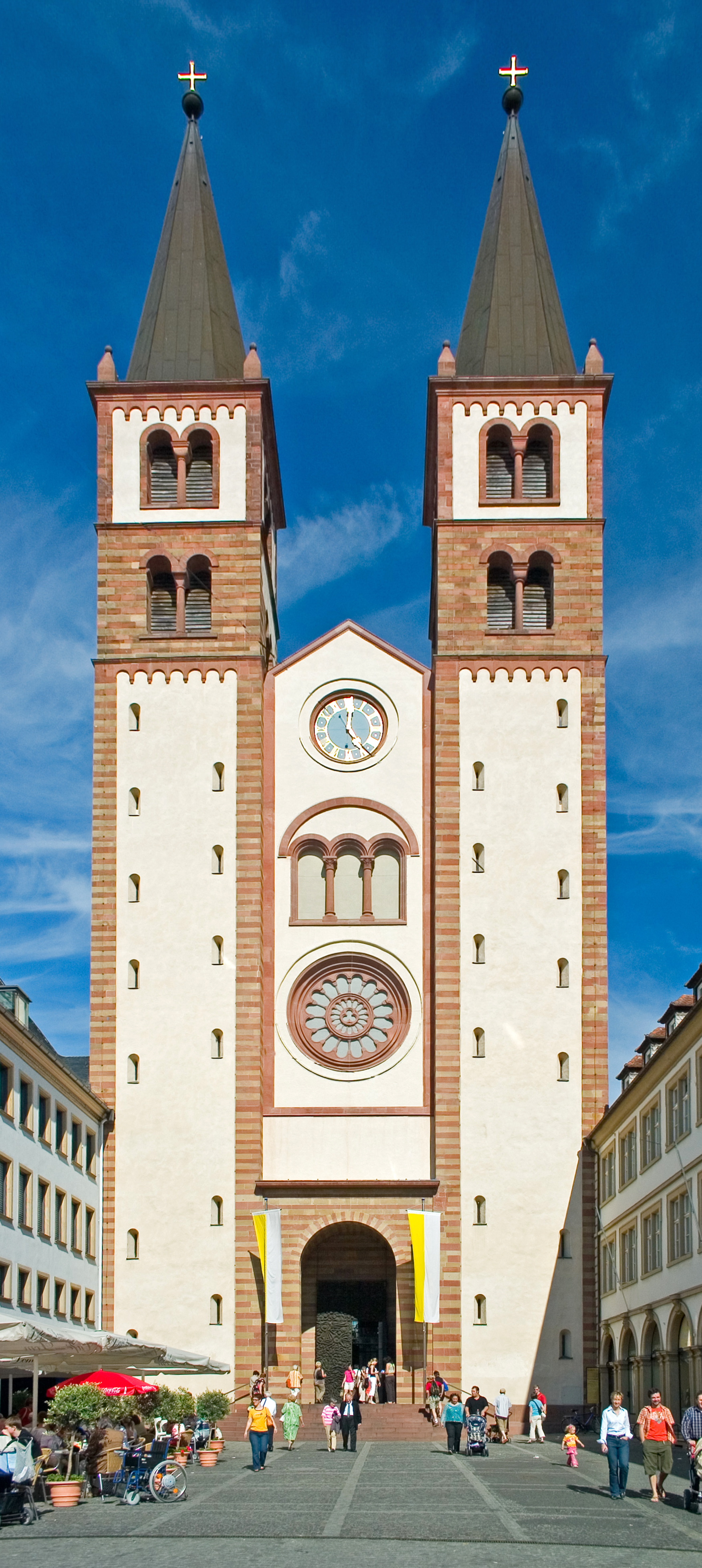
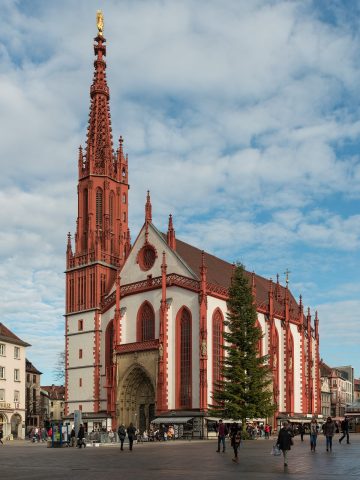
Würzburg’s St. Kilian Cathedral is the kind of place that doesn’t reveal itself at first glance. Tucked into the heart of the old town, it stands on a quiet square surrounded by narrow streets and houses with their warm terracotta roofs. From the outside, the building is imposing in its simplicity—thick walls of pale sandstone, tall Gothic windows, and twin towers reaching toward the sky. But step inside, and the space opens up in a way that feels almost unexpected. The light, the height of the vaulted ceilings, the layers of history all come together to create something far more intimate than the exterior suggests.
The cathedral’s origins trace back to the 11th century, when Würzburg was a powerful bishopric at the center of both political and religious life in the Holy Roman Empire. What began as a Romanesque basilica evolved over centuries, absorbing Gothic and Baroque influences along the way. The most dramatic changes came after a devastating fire in the 17th century, when the interior was transformed into the ornate, almost theatrical space we see today. Walking through the cathedral is like moving through time—each era left its mark, from the sturdy Romanesque columns to the elaborate Baroque altars, all coexisting in a single structure.
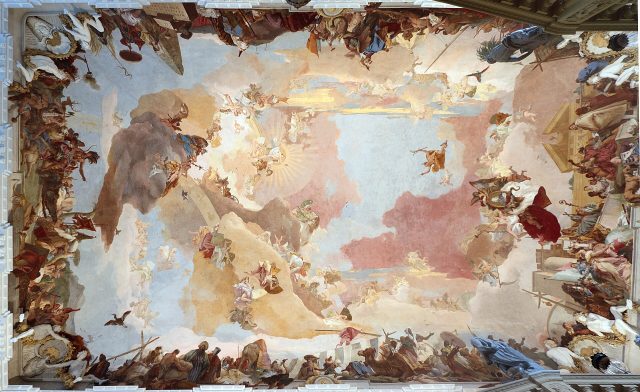
The main nave is striking in its height and airiness. Sunlight filters through the tall windows, illuminating the slender columns and the delicate tracery of the vaulted ceilings. The most eye-catching feature is the ceiling itself, covered in 18th-century frescoes depicting scenes from the lives of saints and biblical stories. The figures seem to float, creating an illusion of depth that draws the eye upward. In the side chapels, old episcopal tombs line the walls, each one a reminder of the men who once held power here. Their names may be forgotten by most, but their presence lingers in the stone, a quiet testament to the cathedral’s role in shaping the region’s history.
For centuries, St. Kilian’s was more than just a place of worship—it was the heart of Würzburg. Bishops were crowned here, decisions that shaped the fate of the region were made within these walls, and the cathedral served as a cultural hub where manuscripts were preserved and artists worked. Even after Würzburg lost its status as an episcopal seat, the cathedral remained a living part of the city. On Sundays, the sound of the organ fills the space, its deep notes resonating through the nave. On weekdays, the silence is broken only by the occasional footsteps of visitors, making it easy to imagine the centuries of prayers and ceremonies that have taken place here.
The crypt is the oldest part of the cathedral, a remnant of the original Romanesque structure. It feels cooler and darker than the rest of the building, the air thick with the weight of history. This is where St. Kilian, an Irish monk who brought Christianity to the region in the 7th century, is honored. According to legend, Kilian was martyred here, and his relics now rest in a silver shrine in one of the chapels. For many pilgrims, the crypt is the most meaningful part of the cathedral—a place to connect with the earliest days of Christianity in Franconia.
What makes St. Kilian’s different from many historic churches is that it hasn’t been reduced to a museum piece. It still functions as it was meant to, hosting services, weddings, and baptisms. The atmosphere shifts with the seasons—cool in the summer, warm in the winter—but it always feels like a place where time moves differently. There’s no rush here. Visitors can spend hours studying the details: the intricate carvings on the wooden pews, the way the stained glass casts colored light across the floor, or the patterns of the mosaic tiles underfoot. Every element has a purpose, every design a story.
From the outside, the cathedral might seem austere, even forbidding. But inside, it offers something rare in a city full of tourists—a sense of stillness. There are no crowds, no guided tours rushing through, no pressure to move along. Even in peak season, it’s possible to find a quiet corner and sit for a while. That might be why the cathedral has a way of drawing people back. It doesn’t try to impress; it simply exists, allowing each visitor to find their own meaning in it. For some, it’s an architectural marvel. For others, a place of quiet reflection. For many, it’s just a moment of peace in the middle of a busy day.
Würzburg is often called a city of wine and Baroque architecture, but St. Kilian’s Cathedral reminds us that its roots go much deeper. It has stood here for nearly a thousand years, surviving wars, fires, and countless changes, yet it has never lost its significance. Perhaps that’s because it was never just a building. It was always part of the city’s life, a witness to its joys and sorrows. Today, as trains rush past and modern life carries on outside, the cathedral remains a place where time slows down. A place to pause, look around, and feel the weight of history in the air.