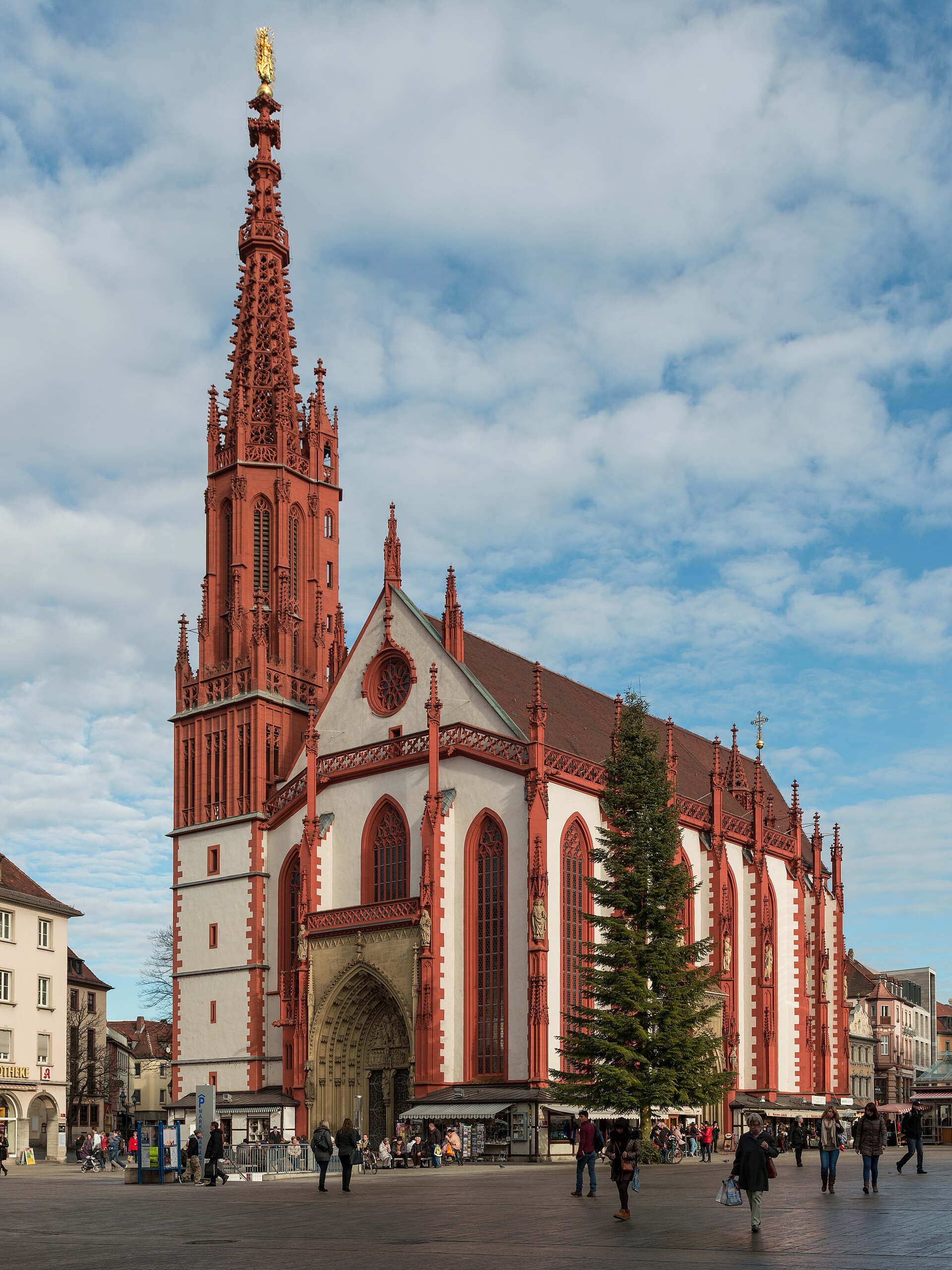
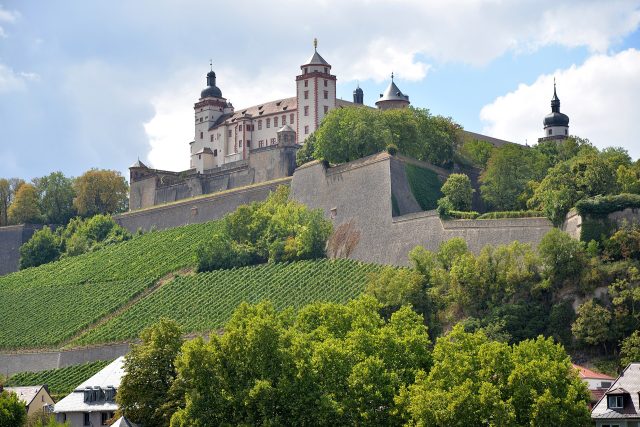
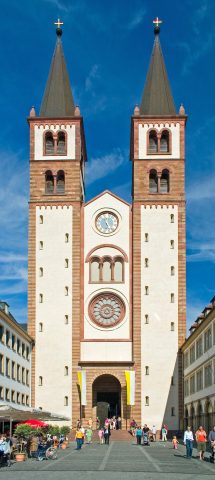
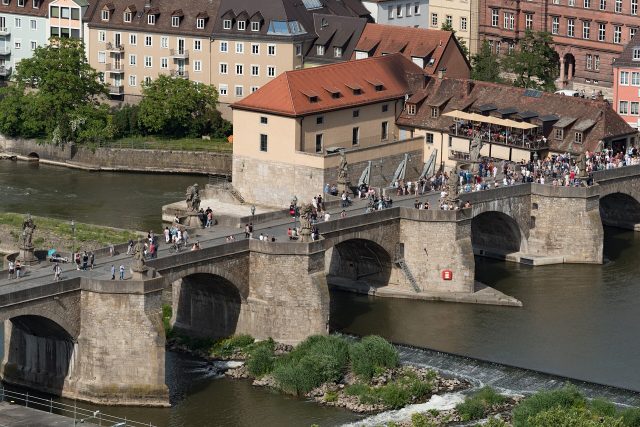
St. Mary’s Church in Würzburg is the kind of place that doesn’t demand attention but quietly lingers in memory long after you’ve left. Tucked away from the well-trodden paths leading to the Residenz or Marienberg Fortress, it offers a different kind of encounter with the city—one that feels unhurried and authentic. From the outside, it appears modest, almost unassuming, yet within its walls lies a history stretching back to the Middle Ages, when Würzburg was a vital religious and commercial hub at the crossroads of Europe.
The church’s origins trace to the 12th century, though the exact date of its founding has faded into time. What began as a small Romanesque basilica serving the local parish gradually evolved, as medieval churches often did, absorbing new architectural influences with each passing era. The structure we see today is a patchwork of these changes, most notably the Gothic choir and the Baroque façade added in the 18th century. Inside, fragments of older layers remain—subtle reminders of the generations who gathered here for prayer, celebration, or solace.
Unlike the grand cathedrals that dominate Germany’s skyline, St. Mary’s doesn’t overwhelm with scale or opulence. Instead, it invites intimacy. The interior is restrained but carefully composed, with tall, pointed windows filtering soft light onto faded frescoes and worn wooden pews. The Baroque altar, gilded and adorned with saints, avoids excess, its details serving a quiet reverence rather than spectacle. There’s a sense of proportion here, a balance between the sacred and the human scale, as if the space was designed to hold both devotion and everyday life.
Throughout its history, the church has been more than a place of worship. In the Middle Ages, it functioned as a civic anchor, where proclamations were read, guilds convened, and townspeople sought refuge during conflicts. Even as Würzburg endured fires and bombings in later centuries, St. Mary’s endured, though not unscathed. After World War II, it was restored not just as a monument but as a living part of the community, a role it still fulfills today. Services continue to be held, and the sound of the organ and hymns still fills the nave on Sundays, grounding the church in the present rather than confining it to the past.
On weekdays, the doors remain open to visitors, offering a rare stillness in the heart of the city. There’s no need for grand gestures here—just the chance to sit, to let the light play across the ancient stones, or to simply be. Occasionally, small concerts or exhibitions take place nearby, but even without them, the church carries an atmosphere of quiet resilience. It’s a place where time feels different, where the weight of centuries settles lightly rather than oppressively.
Würzburg itself is a city of contrasts—baroque palaces stand alongside crooked medieval alleys, and the hum of student cafés mingles with the silence of old churches. St. Mary’s occupies a space where these contrasts meet. It doesn’t compete with the city’s more famous landmarks, nor does it try to. Instead, it offers something simpler: a pause, a moment of reflection, or the quiet pleasure of discovering a place that has endured without fanfare. Perhaps that’s why it feels so genuine. There’s no script here, no performance—just the quiet persistence of a building that has witnessed centuries of change and still stands, open to those who choose to step inside.