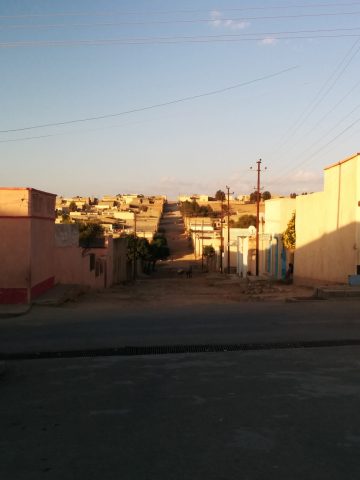
St. Joseph’s Cathedral in Addi Keyh is one of those places that doesn’t announce itself. It sits on a low rise in the center of town, surrounded by reddish stone houses.
The cathedral was built in the early 20th century, when Eritrea was under Italian colonial rule. Its architecture blends European influences with local building techniques. The facade, made of pale stone, glows under the sun. Tall, narrow windows with arched tops hint at Romanesque style. Inside, the space is small. Light filters through stained glass, casting colored reflections on the walls and floor. The altar is adorned with wooden figures of saints, carved by local artisans.
Addi Keyh isn’t a tourist hub, and St. Joseph’s rarely appears in guidebooks. The town has narrow streets, markets selling spices, fabrics, and fresh fruit. The cathedral fits into this setting. It doesn’t dominate the landscape; it belongs.
On Sundays, the congregation gathers here, many of them part of the Catholic community that has endured since the Italian era. Services are held in local languages, sometimes in Latin. The church’s history is intertwined with Eritrea’s own. During the colonial period, Catholic churches were built as places of worship and symbols of influence. After Eritrea gained independence in 1993, the country became secular, yet religious communities retained their place.
St. Joseph’s has weathered wars, political shifts, and economic hardships. Today, it remains an active place of worship. People come to pray, to mark holidays, to find stillness. The building feels lived-in—wooden pews worn smooth by time, a stone floor that has borne footsteps. There’s no gilded opulence. Just the quiet hum of the wind outside.
In summer, the cathedral stays cool. In winter, when the highlands grow chilly, the thick stone walls retain warmth. The building holds the memories of everyone who has passed through its doors over the years.
For those who visit Addi Keyh, the cathedral might come as a surprise. The town doesn’t offer flashy attractions. Here, history and the present coexist. You won’t need to photograph every corner. Just sitting on a pew, listening to the silence, can be enough. Some places don’t demand attention; they offer a space to pause.
Around the cathedral, a small garden with acacia and olive trees provides shade. Locals come to rest under the branches. On hot days, the air is filled with the scent of herbs, and from the rise, you can see the town stretching toward the hills. In the distance, the mountains shift color—blue in the midday light, golden as the sun sets.
St. Joseph’s Cathedral isn’t Eritrea’s most famous landmark. It doesn’t need to be. It’s part of the town’s life, a witness to its past, a quiet corner for reflection. Such unassuming spots are becoming rare.