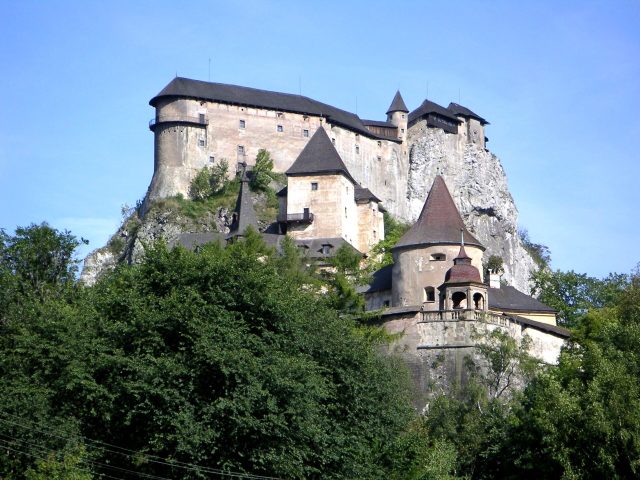
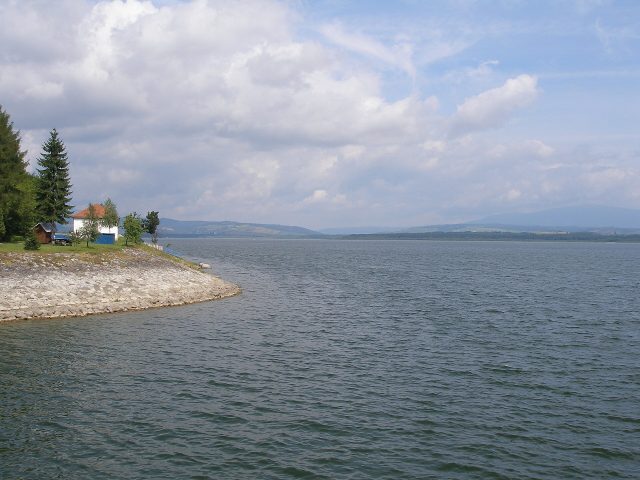
Perched on a steep limestone cliff above the Orava River, Oravský Hrad is one of those rare places that feels untouched by time. Its jagged silhouette—towers, battlements, and weathered stone—rises abruptly from the surrounding hills, as if carved directly from the rock itself. But to truly grasp the scale and drama of this medieval fortress, you need to step back, away from its walls, to the viewpoint just below. From here, the castle isn’t just a relic; it becomes part of a living landscape, framed by rolling green hills, the winding river, and the quiet villages nestled in the valley below.
The history of Oravský Hrad stretches back to the 13th century, when these lands were part of the Kingdom of Hungary. The first written records date to 1241, though it’s likely that some form of fortification stood here even earlier. Over the centuries, the castle served as a strategic stronghold, guarding trade routes and river crossings along the northern frontier. Its ownership changed hands many times—from the powerful Thurzó family to Hungarian kings and later the Habsburgs—each leaving their mark on its architecture. Gothic vaults stand alongside Renaissance arcades, while Baroque flourishes blend with older stonework, creating a patchwork of styles that tells the story of its turbulent past.
The viewpoint isn’t just a place for photographs, though the views are undeniably striking. On a clear day, the horizon stretches far beyond the castle, revealing the Malá Fatra mountains to the north and the Oravská Magura range to the south. Below, the Orava River meanders through the valley, its banks dotted with small farms and clusters of traditional wooden houses. In summer, the contrast between the castle’s grey stone and the lush greenery is vivid, the air thick with the scent of pine and wild herbs. Winter transforms the scene into something quieter, almost dreamlike, with snow softening the edges of the landscape and muffling the sounds of the valley.
Reaching the viewpoint is part of the experience. A steep but short path winds up from the base of the castle, taking about ten minutes to climb. Along the way, signs offer snippets of history, explaining the castle’s role in regional conflicts and its evolution over the centuries. The climb is worth it—not just for the view, but for the sense of anticipation as the panorama unfolds with each step. Unlike more famous castles in Slovakia, Oravský Hrad doesn’t draw crowds, so the viewpoint often feels like a private discovery, a moment of stillness before the grandeur of the fortress itself.
The castle itself is a maze of courtyards, staircases, and towers, each corner revealing another layer of its past. Today, it houses a museum with exhibits spanning centuries, from medieval weaponry to 19th-century furnishings. One of the most intriguing collections is the array of antique clocks and musical instruments, alongside displays that recreate the daily lives of Orava’s peasant communities. Even without stepping inside, the outer walls and battlements offer plenty to explore. Narrow passages, crumbling stone, and the occasional glimpse of the valley through an arrow slit make it easy to imagine the castle as it once was—a place of power, intrigue, and constant vigilance.
Beyond the castle, the Orava region has a character all its own. The villages scattered along the river retain much of their traditional charm, with wooden houses topped by steep, shingled roofs and adorned with intricate carvings. Some locals still practice old crafts, like woodworking and pottery, and in summer, folk festivals bring the past to life with music, dance, and food. Villages like Oravská Lesná and Zuberec feel particularly untouched, where the rhythms of rural life have changed little over the decades. A visit to one of these places offers a glimpse into a Slovakia that exists beyond the well-trodden tourist paths.
What makes the viewpoint at Oravský Hrad special isn’t just the scenery, but the way it connects you to the land’s history. This was once a place of defense, a symbol of control over a rugged frontier. Now, it’s a quiet observer of the valley’s slow, unchanging rhythms. There are no tour buses here, no souvenir stands, just the wind rustling through the grass and the distant murmur of the river. It’s a reminder that Slovakia’s beauty isn’t just in its castles or mountains, but in the spaces between them—the quiet corners where time moves differently. Standing here, you don’t just see the landscape; you feel its weight, its stories, and its enduring presence.