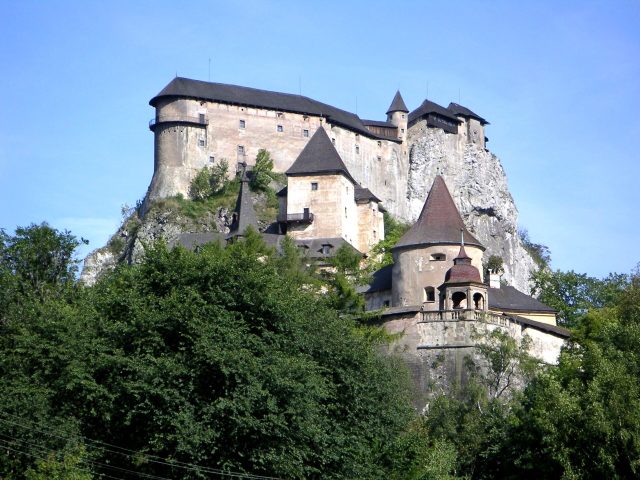
Perched on a gentle rise at the foot of Orava Castle, the Church of St. Michael the Archangel feels like a quiet guardian of centuries past. Its weathered stone walls, softened by creeping ivy and patches of moss, stand in stark contrast to the dramatic cliffs above, where the castle looms like a silent sentinel. From here, the view stretches across the village of Oravský Podzámok, its red-tiled roofs clustering along the winding Orava River. The church itself is unassuming—narrow stained-glass windows, heavy oak doors darkened by age, and an air of stillness broken only by the occasional chime of bells or the rustle of leaves in the breeze. It doesn’t demand attention; it simply endures, as it has for hundreds of years.
The first records of the church date back to the 13th century, when this region was part of the Kingdom of Hungary. Back then, it wasn’t just a place of worship but a strategic stronghold, integrated into the castle’s defenses. During raids and wars, it offered refuge to villagers, its thick walls shielding them from danger. Over time, the church underwent several renovations, particularly in the Baroque period, yet its Gothic core remained intact. Today, it stands as one of the few surviving examples of medieval architecture in the area, its original elements still visible in the arched doorways and rough-hewn stone.
Inside, the church is a study in quiet dignity. There are no gilded altars or elaborate frescoes here—just simple wooden pews, a worn stone floor, and a handful of icons painted by local artisans. The main altar is dedicated to St. Michael, the archangel who has long been the patron of these lands. His image, rendered in muted tones, seems to hold the weight of history in its gaze. The pulpit, intricately carved with religious symbols, is said to have been crafted by monks who once lived here. The overall effect is one of humility, a place where faith was practiced without ostentation.
The church’s connection to Orava Castle is more than just geographical. In the Middle Ages, the two structures functioned as a single complex, the castle providing physical protection while the church offered spiritual solace. Local legends speak of underground tunnels linking the church to the fortress, used to smuggle people and treasures to safety during sieges. Though the passages are now sealed, the stories persist, and some claim that on quiet nights, the ghosts of knights still wander between the two.
Despite its age, the church remains an active place of worship. On Sundays, the congregation gathers for services in Slovak, the sound of hymns drifting through the open doors. During festivals, the bells ring with particular fervor, their echoes carrying across the valley. In summer, visitors are welcome to explore the interior or climb the bell tower for a sweeping view of the surrounding countryside. Winter transforms the church into something even more atmospheric—its snow-dusted silhouette against the darkening sky feels like a scene from a folktale.
The village itself is just as steeped in history as the church. Narrow cobblestone streets wind past houses with carved shutters and steeply pitched roofs, their facades bearing the marks of time. Life here moves at a slower pace, and it’s easy to imagine a knight on horseback or a robed monk rounding the corner. In warmer months, a small market springs up at the base of the hill, where vendors sell local honey, cheese, and traditional Slovak pastries. As evening falls, the castle lights up, casting long shadows across the square and making the church appear almost alive.
For those with an interest in history, the Church of St. Michael offers more than just architecture. The interior holds tombstones of noble families who once ruled these lands, their inscriptions worn but still legible. Fragments of Renaissance frescoes peek out from behind later additions, hinting at the church’s layered past. The sacristy houses a collection of ancient manuscripts and books, though access is restricted. Occasionally, exhibitions are held to showcase these rare texts, offering a glimpse into the religious and cultural life of the region over the centuries.
This church is more than a relic; it’s a living piece of history. It has survived wars, fires, and the passage of time, yet it still stands, a testament to the people who built it and those who have sought solace within its walls. There’s no need to rush when visiting. Sitting on one of the benches outside, listening to the wind in the trees, it’s impossible not to wonder about the countless lives that have passed through its doors—those who came in search of comfort, protection, or simply a moment of peace. That’s the quiet power of such places: they don’t just tell stories, they let you feel them.