Perched on the slopes of Bhutan’s sacred peaks, this spot stays with you. It doesn’t reveal itself easily—you walk for hours, leave the road behind, and still it waits, half-hidden by ridges. When you arrive, the mountain fills the frame, silent and unshaken.
Jomolhari rises nearly seven thousand meters at the border with Tibet. Its snow-capped summit is believed to be the dwelling of deities. Below, the Paro Valley spreads out: rice terraces cut into the hillsides, clusters of whitewashed houses, trails worn by travelers and pilgrims over centuries. The contrast between the icy peak and the lush valley is sharp, a reminder of how quickly the land changes here.
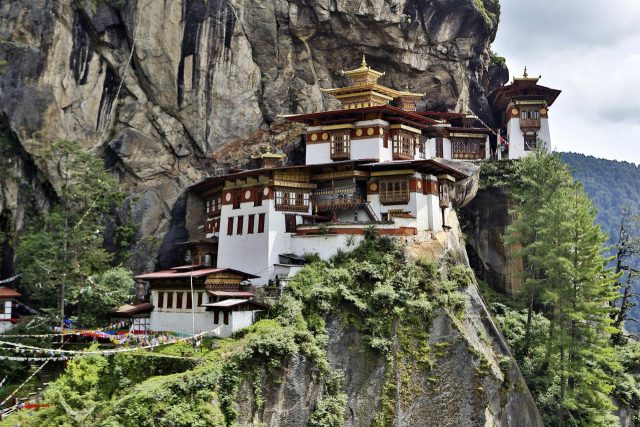
The trek starts in Paro, usually after visiting Tiger’s Nest Monastery. The path climbs through pine forests and alpine meadows. The air thins. Dense greenery gives way to rocky slopes, then to stretches of snow. Jomolhari is visible from afar on clear days, but only from the viewpoint does its scale become real. The mountain looms, close enough to touch, yet untouchable.
For the Bhutanese, Jomolhari is home to Jomo, a protective goddess. Stories say she appears as a white tigress or a woman in flowing robes. Pilgrims once journeyed to the mountain’s base, leaving offerings and seeking blessings. Even now, elderly locals carry prayer flags up the trail, hanging them in the wind—a quiet act of devotion.
There is little here. A low stone wall with prayer wheels. A few wooden benches. The occasional flutter of prayer flags. No crowds, no vendors, no guided tours. Just wind, grass, and the distant call of birds.
Time slows.
The view changes with the seasons. In summer, the valley is green, dotted with yaks and wildflowers. Autumn turns the rice fields golden. Winter brings snow, leaving only the silhouettes of trees and rocks. Dawn and dusk are best—the sun bathes the peak in pink and orange, and for a moment, the mountain feels alive.
This is not a place for those who want monuments or crowds. There are no museums, no shops, no cafes. For some, that might feel empty. But if you come looking for stillness, for a connection to something beyond the everyday, the viewpoint gives exactly that. The most meaningful experiences often arrive quietly, without announcement.
The trek is not easy. Altitude makes even simple steps feel heavy. The body adjusts slowly, so take breaks and drink water. Weather shifts quickly—sunshine can turn to fog, rain, or snow in minutes. Bring a warm layer, a waterproof jacket, and start early to return before dark. Guides recommend setting out at first light, when the air is crisp and the trails are quiet.
Even if clouds hide the summit, the place leaves its mark. Bhutan is called the Land of Happiness not because life is easy, but because its people find joy in simplicity. The viewpoint at Jomolhari shows that. It’s not just a spot on a map. It’s a place where nature and belief meet, where the past and present exist side by side. Standing there, you understand why some places feel sacred. They don’t need to explain themselves—they simply are.