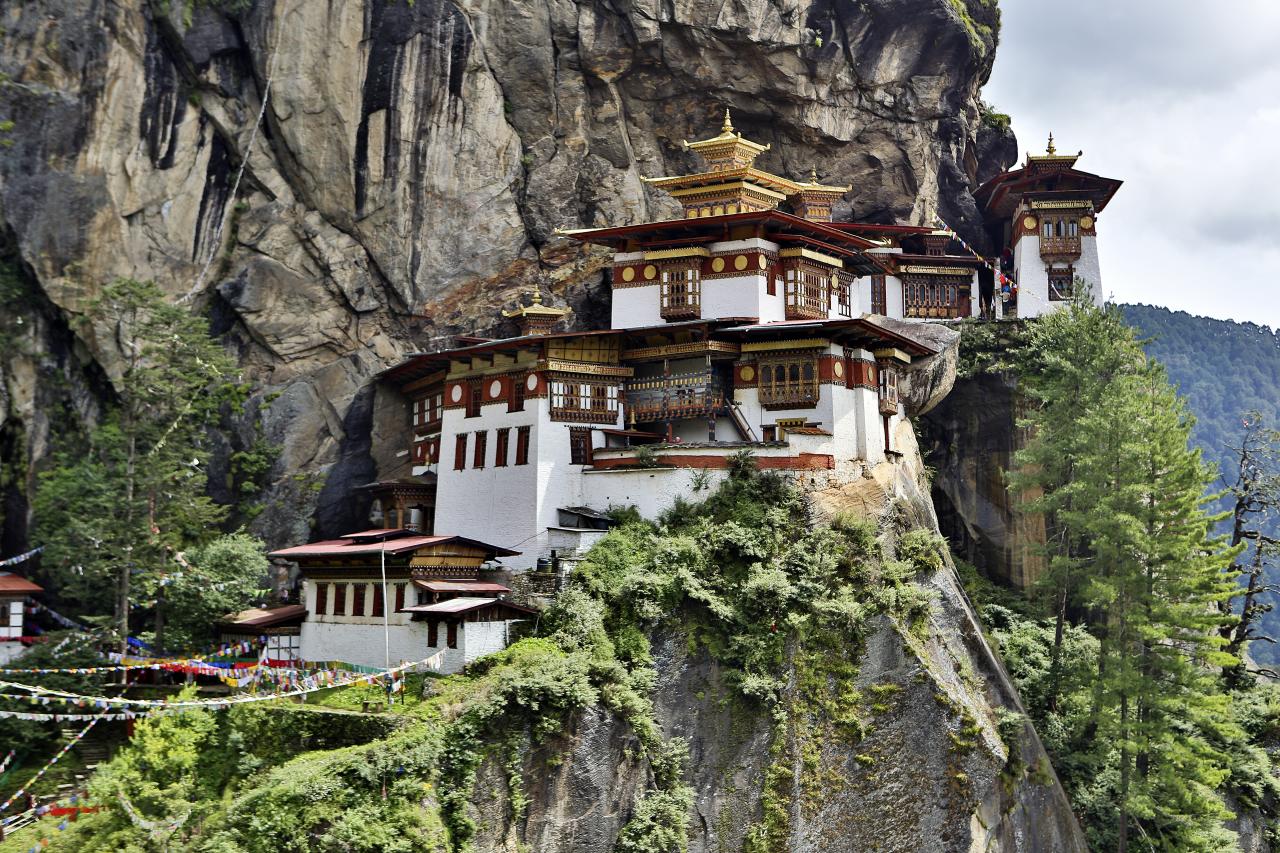
Perched on a sheer cliffside nearly three thousand meters above the Paro Valley, Taktsang Lhakhang—more widely known as the Tiger’s Nest—feels like a place where the earth and the heavens barely touch. The monastery clings to the rock face as if defying gravity, its whitewashed walls and golden roofs blending into the mist that often shrouds the mountains. To reach it, you must follow a winding path through forests of pine and rhododendron, where the air grows thinner with every step. The journey itself is part of the experience, a slow ascent that prepares you for what lies ahead.
The legend of Taktsang begins in the eighth century, when Guru Rinpoche, the revered Buddhist master who brought tantric Buddhism to the Himalayas, is said to have flown here on the back of a tigress. He meditated in a cave for months, subduing the local spirits and converting them into protectors of the dharma. The name Taktsang, meaning "Tiger’s Lair," still carries the weight of this myth. Even today, some say that in the early morning fog, the outline of a great cat can be seen among the rocks, watching over the valley below.
The monastery is not a single structure but a cluster of buildings added over centuries. The oldest and most sacred is the temple dedicated to Guru Rinpoche, its walls covered in faded murals depicting his life and teachings. Inside, the air is thick with the scent of butter lamps, their flickering light casting long shadows over statues of buddhas and bodhisattvas. The wooden beams, darkened by time, creak underfoot, and the silence is broken only by the murmur of prayers or the distant toll of a bell. Monks move quietly through the halls, their presence a reminder of the monastery’s living spiritual purpose.
The climb takes several hours, depending on your pace. The trail is well-maintained, with railings and bridges to help navigate the steepest sections, but the altitude makes every step a challenge. Along the way, small shrines and resting spots offer a chance to catch your breath and take in the view. On clear days, the Paro Valley stretches out below, a patchwork of terraced fields and villages framed by snow-capped peaks. Other monasteries dot the landscape, their distant forms seeming to float above the earth.
For many, Taktsang is more than a destination—it’s a pilgrimage. Bhutanese from across the country make the journey, often as part of a spiritual practice or to seek blessings. Foreign visitors, too, are drawn here, though for some it’s less about faith and more about the quiet awe of the place. There’s no rush, no sense of time pressing forward. The rhythm of the monastery is set by the wind in the pines, the chanting of monks, and the slow turning of prayer wheels.
The history of Taktsang is as resilient as the rock it stands on. The monastery has survived fires, earthquakes, and even a devastating blaze in 1998 that destroyed much of its structure. Each time, it has been rebuilt, stone by stone, by craftsmen and monks who see their work as an act of devotion. The restoration took years, but today the monastery appears almost untouched by time, a testament to the care and skill of those who maintain it.
What lingers after a visit to Taktsang isn’t just the memory of the view or the effort of the climb. It’s the sense of having stepped into a place where the ordinary rules of the world don’t quite apply. The monastery exists in a space between the tangible and the intangible, where the line between myth and reality blurs. As you descend, the Tiger’s Nest remains visible for a long time, a small white speck against the vastness of the cliff. It’s not just a landmark; it’s a feeling that stays with you, long after you’ve left.