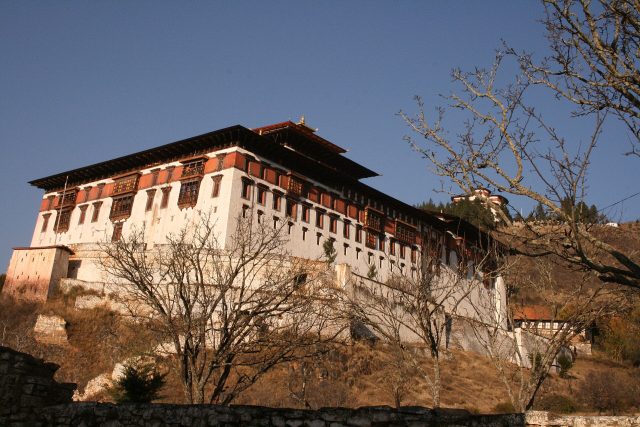
Nyakhor Bridge in Paro is one of those rare places that feels untouched by the rush of modern life. Stretching across the Paro Chu River, it does more than connect two banks—it links the past with the present, tradition with the everyday. The wooden planks, draped in colorful prayer flags, lead toward the towering Rinpung Dzong, a fortress-monastery that has watched over the valley for centuries. The bridge isn’t just a crossing; it’s a threshold, a quiet introduction to the soul of Bhutan.
The history of Nyakhor dates back to the 17th century, when Bhutan was still forging its identity as a nation. Rinpung Dzong, built around the same time, became the heart of religious and political power in the region. The bridge wasn’t merely a practical structure—it was a strategic one. In times of conflict, it could be dismantled in moments, cutting off access to the fortress. Today, the echoes of that era are faint, but the bridge itself remains, its weathered wood and stone bearing the weight of centuries.
Bhutanese bridge architecture is a study in balance—sturdy yet graceful, unobtrusive yet essential. Nyakhor follows this tradition, its wooden beams fitted together without nails, resting on stone foundations that seem to grow from the riverbed itself. The design doesn’t compete with the landscape; it belongs to it. In spring, when the river swells, the bridge appears to hover just above the water. In winter, the crisp air sharpens its lines, making it stand out against the muted tones of the valley.
For locals, the bridge is more than a path—it’s a sacred space. Before entering the dzong, pilgrims and monks walk its length, murmuring prayers and spinning prayer wheels. Each step is said to cleanse the spirit, while the flags fluttering overhead carry blessings in every direction. Even visitors unfamiliar with Buddhist customs often find themselves slowing down, sensing the quiet reverence that lingers here.
Time moves differently at Nyakhor. Mornings bring a hush, the bridge empty except for the occasional monk or villager. By midday, the air fills with the voices of vendors selling fruit and handmade crafts. As evening falls, the setting sun turns the flags to gold, their shadows stretching across the wood like ink on ancient parchment. In these moments, the bridge feels timeless, a thread stitching together the past and the present.
For many travelers, Nyakhor is their first real encounter with Bhutan. There are no crowded airports or tour buses here—just the river, the mountains, and the soft rustle of prayer flags. Some pause midway to take photos, but most simply stand and watch the water, as if listening to the stories it carries. The bridge asks for nothing but a moment of quiet reflection, a chance to step outside the rush of the world.
Beyond the bridge lies Rinpung Dzong, a fortress that has stood as a symbol of Bhutanese sovereignty for centuries. Inside, relics and murals tell stories of the Buddha and local saints, their colors still vivid despite the passage of time. Nyakhor serves as the gateway to this world, where faith and daily life intertwine. Crossing it feels like stepping into another era, one where the sacred and the ordinary exist side by side.
Bhutan has begun to open its doors to the world, but Paro and its bridge remain unchanged. There are no towering hotels or neon signs here—just the slow rhythm of life shaped by the mountains and the river. That’s why Nyakhor draws people in. It’s a reminder that places still exist where time moves at its own pace, where people live in harmony with tradition and nature. Even a brief visit leaves an impression, one that lingers long after you’ve walked away.