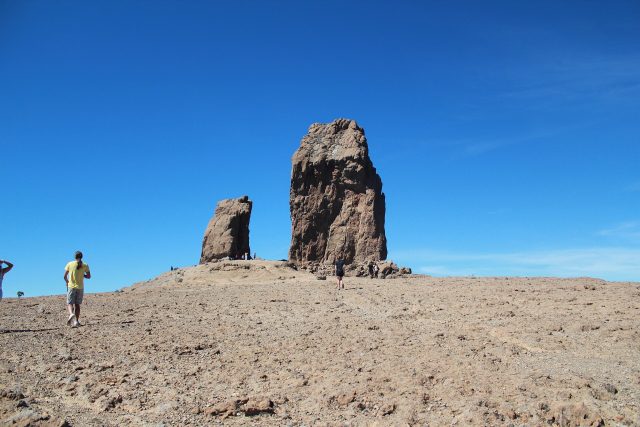
Perched high in the mountains of Gran Canaria, the Mirador de la Dehesa offers one of those rare views that make you catch your breath—not because of the height, but because the landscape feels almost too perfect to be real. From this vantage point near the village of Tejeda, the island unfolds in layers of rock, greenery, and sky. The famous Roque Nublo, a towering monolith that has become the symbol of Gran Canaria, dominates the scene, its jagged silhouette standing out against the softer curves of the surrounding valleys. Below, the land drops away into terraced fields that have been cultivated for centuries, their orderly patterns a testament to the patience and skill of generations of farmers. The air is thin and crisp, carrying only the sound of the wind and the occasional murmur of visitors who, like you, have paused to take it all in.
The viewpoint itself is unassuming, little more than a small paved area with a low fence marking the edge of the cliff. There are no grand structures, no cafes or souvenir stalls—just a few benches where you can sit and let the view sink in. On clear days, the horizon stretches endlessly, and the clouds drifting over the valley below create the strange sensation of floating above the earth. The light here is different, too, especially at sunset, when the sun dips behind the mountains and the sky ignites in shades of pink, gold, and violet. It’s the kind of place where time seems to slow down, where the only thing that matters is the moment and the vastness of the landscape before you.
Tejeda and its surroundings are more than just a scenic stop; they carry the weight of history in every stone and slope. The valley below was once home to the Guanches, the indigenous people of the Canary Islands, who called this fertile land *Asero*, meaning "place of water." Even today, you can see the remnants of their ancient irrigation channels, carved into the hillsides to carry water from the mountains to the fields. After the Spanish conquest, the valley became a vital agricultural hub, producing grain, grapes, and almonds. The almond trees still bloom here every spring, their delicate white and pink flowers blanketing the slopes in a fleeting burst of color. Walking through Tejeda, you can almost feel the layers of time beneath your feet—the echoes of the Guanches, the footsteps of Spanish settlers, the daily rhythms of the farmers who have worked this land for centuries.
The village itself is a quiet, picturesque place, clinging to the mountainside like something out of an old Spanish folktale. Narrow cobblestone streets wind between whitewashed houses with wooden balconies and red-tiled roofs, their shutters often painted a cheerful blue or green. At the heart of Tejeda stands the Church of the Immaculate Conception, a sturdy 17th-century building that has watched over the village for hundreds of years. From the mirador, the town looks almost like a miniature model, its houses scattered across the slope as if placed there by an artist’s hand. On exceptionally clear days, you might even glimpse the distant peak of Mount Teide on Tenerife, a silent sentinel rising above the horizon.
The people of Tejeda are warm but unobtrusive, offering a quiet welcome to those who venture here. Unlike the bustling resorts of Maspalomas or the busy streets of Las Palmas, this part of the island moves at its own unhurried pace. There are no crowds, no pressure to rush from one attraction to the next. Instead, you might find yourself lingering in a small café, sipping a glass of local wine or trying a slice of *bienmesabe*, a sweet almond cream that’s a specialty of the region. The village’s shops sell handmade almond pastries, their recipes passed down through generations, and in the summer, festivals celebrate the harvest with music, dancing, and traditional food. Even during these lively events, though, Tejeda retains its sense of calm, as if the mountains themselves temper the excitement with their steady, ancient presence.
Getting to the mirador is part of the experience. The drive from Las Palmas takes about an hour, winding through mountain roads that twist and turn with each bend revealing a new perspective on the island. The route from Maspalomas is slightly longer but just as scenic, passing through pine forests and rocky outcrops before climbing into the highlands. Along the way, it’s worth stopping at one of the roadside restaurants to sample Canarian dishes like *papas arrugadas*—small, wrinkled potatoes served with a spicy mojo sauce—or *sancocho*, a hearty fish stew that’s a staple of island cuisine. The journey itself feels like a transition, leaving behind the coastal heat and entering a cooler, quieter world where the landscape dictates the rhythm of the day.
This isn’t a place for those seeking amusement parks or shopping sprees. The Mirador de la Dehesa offers something far simpler, yet far more enduring: a connection to the land and its history. Standing at the edge of the cliff, it’s impossible not to wonder how many others have stood in this same spot over the centuries. The Guanches, who first shaped the terraces below; the Spanish settlers, who built the village with its sturdy stone houses; the farmers, who still tend the almond groves and vineyards—all of them have looked out over this same valley, these same mountains, this same sky. Each of them must have found something different in the view, something that spoke to them in a way that only a place like this can. And perhaps that’s why, when it’s time to leave, you find yourself glancing back one last time, already knowing you’ll return.