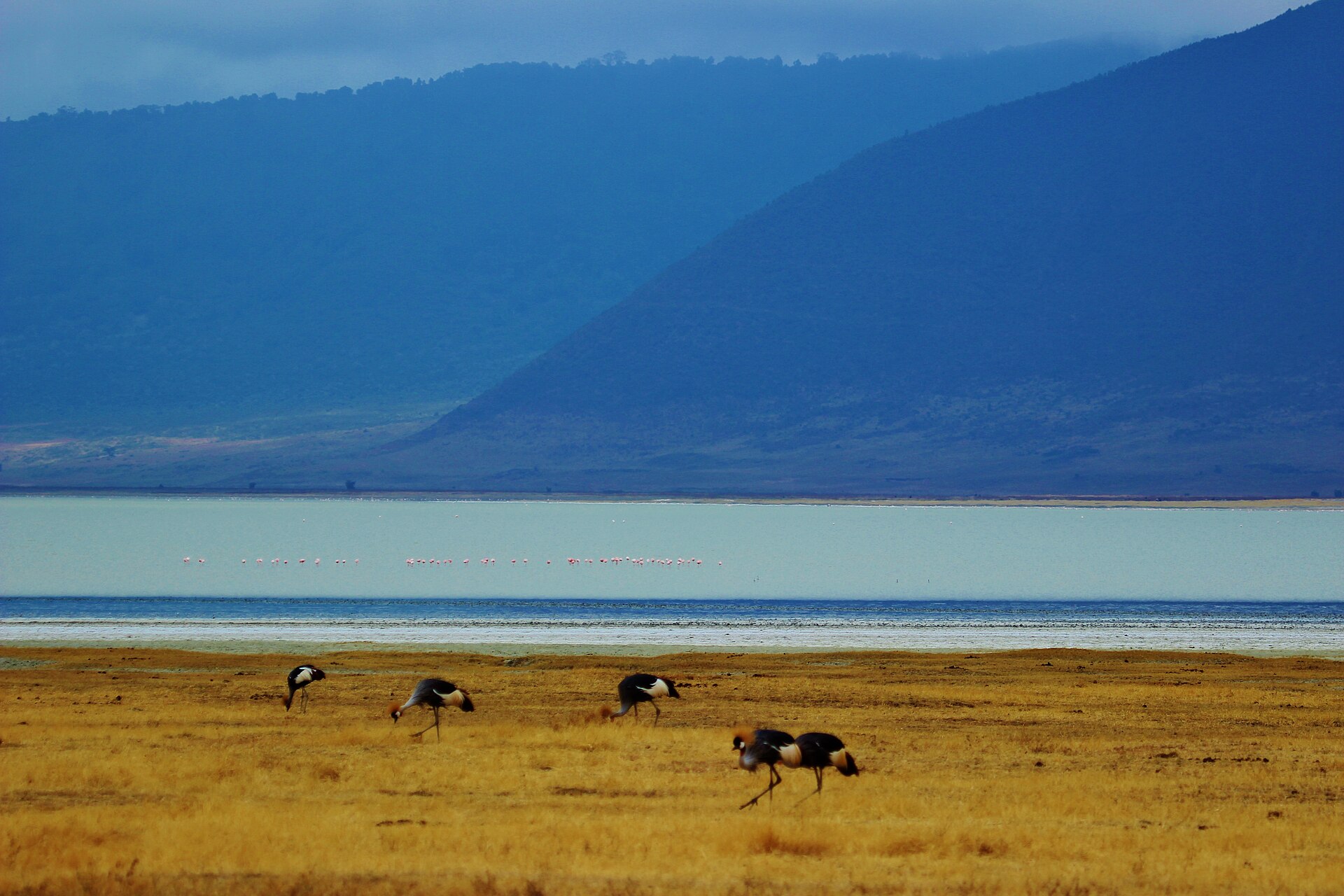
Standing at the rim of the Ngorongoro Crater, it’s easy to see why this place has earned its reputation as one of the natural world’s most breathtaking sights. The view from the viewpoint is nothing short of overwhelming—a vast, sunken bowl stretching nearly twenty kilometers across, its sheer walls rising six hundred meters from the crater floor. Below, an entire ecosystem unfolds: grasslands ripple in the wind, patches of forest cling to the slopes, and shallow lakes glint under the African sun. It’s a landscape so rich in life that it feels almost unreal, as if nature itself had set out to create a perfect sanctuary. Within this compact space, an astonishing variety of wildlife thrives, including all of the Big Five—lions, elephants, buffalo, leopards, and the rare black rhino—often visible in a single day.
The viewpoint sits at an elevation of around 2,300 meters, perched on the edge of the caldera where the air is thin and cool. On clear mornings, the horizon stretches endlessly, the savanna blending seamlessly into the sky. The first light of dawn spills over the crater’s rim, painting the walls in soft gold and casting long shadows across the floor. As the mist rises, the scene takes on an almost dreamlike quality, the stillness broken only by the distant calls of birds or the occasional rustle of wind through the grass. By evening, the colors shift again, the setting sun turning the landscape into a canvas of deep oranges and purples. The sounds of the night begin to emerge—the distant roar of a lion, the whoop of hyenas, the low rumble of elephants moving through the dark.
The crater itself is the remnant of a massive volcanic eruption that occurred nearly three million years ago. When the volcano collapsed inward, it left behind one of the largest intact calderas in the world, a geological marvel that has since become a self-contained world of its own. Unlike many other volcanic craters, Ngorongoro was never flooded by water, allowing its ecosystem to evolve in isolation. The result is a place where life has adapted in unique ways, from the hardy highland plants clinging to the crater’s rim to the dense concentrations of wildlife below. The seasons dictate the rhythm here—during the rains, the grasslands turn lush and green, lakes swell with water, and flamingos gather in their thousands. In the dry months, the landscape transforms, the earth cracking under the sun as animals cluster around the remaining water sources.
For the Maasai, who have lived in this region for centuries, Ngorongoro is more than just a landscape—it is a sacred place, known to them as Empakaai, a land where the spirits of their ancestors reside. Before the area was designated a conservation area in the mid-20th century, the Maasai grazed their cattle within the crater, considering it part of their ancestral home. Though they were later relocated to villages outside the crater, their connection to the land remains strong. Many now work as guides or rangers, sharing their knowledge of the wildlife and traditions that have shaped this place. It’s not uncommon to see Maasai herders moving through the highlands, their red shukas bright against the muted tones of the savanna, a living reminder of the deep ties between people and this land.
The viewpoint itself is a simple wooden platform, unassuming but perfectly positioned for taking in the vastness of the crater. Unlike the crowded lookout points of more famous parks, this spot offers a sense of solitude. There’s no rush here, no jostling for the best view—just the quiet hum of the wind and the occasional shuffle of hooves as elephants or buffalo wander along the rim. The vegetation around the viewpoint is a world apart from the savanna below: towering lobelias and heather-like shrubs dot the landscape, their strange, almost prehistoric forms adding to the sense of stepping into another time. On rare occasions, a leopard might be spotted resting in the branches of a nearby tree, or a herd of eland might pass by, their massive frames moving with surprising grace.
Descending into the crater is an experience in itself. The road winds down the steep inner wall, a series of tight switchbacks that can make even the most seasoned traveler grip their seat. Yet the drivers who navigate these paths know them intimately, their skill turning what could be a nerve-wracking journey into a smooth ride. Once at the bottom, the scale of the crater becomes even more apparent. The floor stretches out in every direction, a patchwork of grasslands, acacia woodlands, and alkaline lakes. There are no fences here, no boundaries—just the open expanse where animals roam freely. Lions might be spotted lounging in the shade of a tree, their tawny coats blending into the dry grass. Elephants move in slow, deliberate lines, their massive forms dwarfing the vehicles that pass by. During the migration seasons, the crater becomes a temporary home for thousands of wildebeest and zebras, their numbers swelling the already impressive wildlife population.
What makes Ngorongoro truly special is the way it makes you feel small in the best possible sense. There’s no grand spectacle here, no man-made attractions—just the raw, unfiltered beauty of the natural world. The crater operates on its own timeline, indifferent to the schedules and expectations of visitors. A day spent here might yield a hundred different sights—a lioness teaching her cubs to hunt, a herd of elephants crossing a lake, a flock of flamingos taking flight against the setting sun—but it’s the quiet moments that linger longest. The way the light changes in the late afternoon, the sound of the wind through the grass, the realization that this place has existed for millennia, long before humans ever set foot here.
For those who return to Ngorongoro, each visit reveals something new. Perhaps it’s the way the morning mist clings to the crater floor in a particular season, or the unexpected sighting of a rare bird. Maybe it’s the way the air feels different at dawn, crisp and full of possibility. Or it could simply be the sense of peace that comes from standing at the edge of this ancient caldera, looking out over a landscape that has remained largely unchanged for millions of years. In a world that often feels crowded and hurried, Ngorongoro offers a rare chance to step back, to breathe, and to remember what it means to be a small part of something much, much larger.