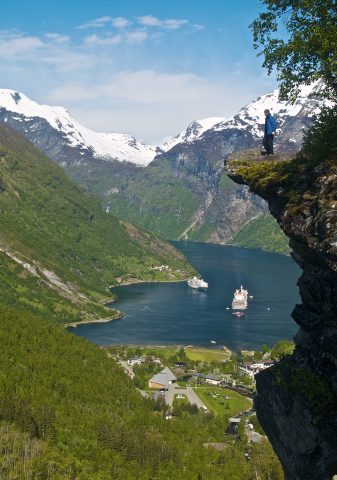
Perched high above the Geirangerfjord, Dalsnibba is where the raw, untamed beauty of Norway reveals itself in its most dramatic form. This isn’t just a viewpoint—it’s a threshold between the familiar and the vast, a place where the landscape shifts from something you observe to something you feel. The journey here is as much a part of the experience as the destination itself, winding up a mountain road that clings to sheer cliffs, each turn offering a new perspective on the fjord below. From this height, the water isn’t just blue; it’s a deep, shifting expanse that stretches between walls of rock, while the tiny houses of Geiranger look like scattered pebbles at the edge of the world.
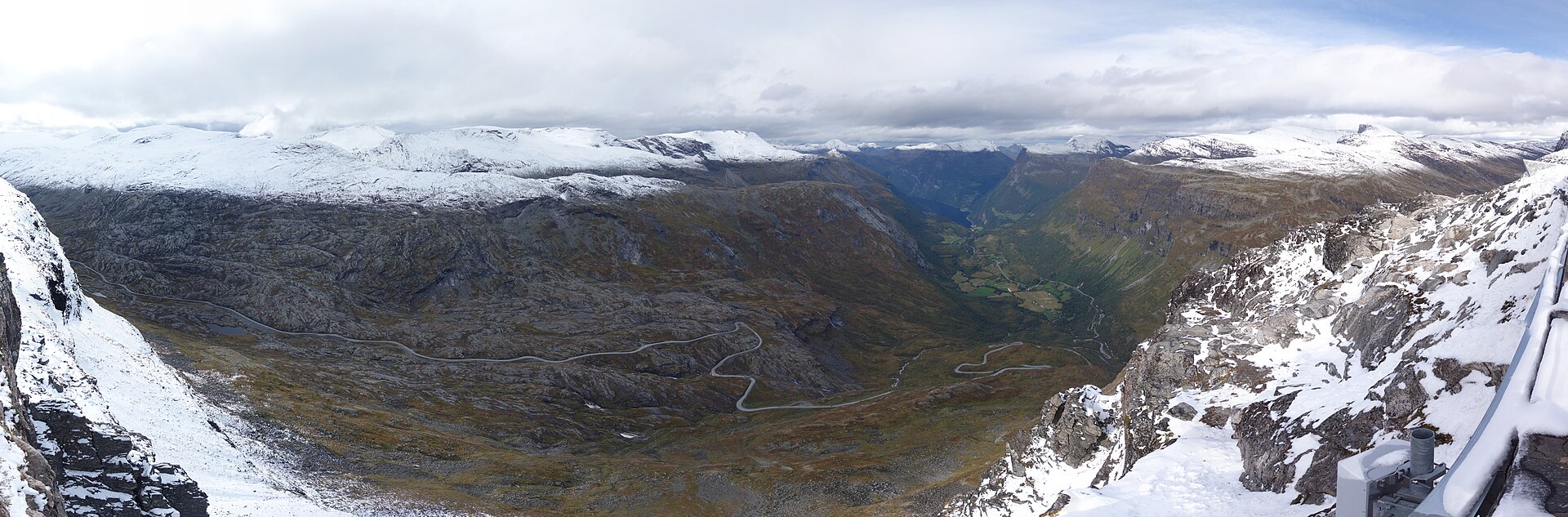
The road to Dalsnibba is an adventure in its own right. Starting in the village, it climbs in tight, dizzying loops, a narrow ribbon of asphalt carved into the mountainside. In summer, cyclists grind their way up, their figures small against the scale of the cliffs, while in winter, the same route becomes a path for skiers, the snow muffling the sound of the world below. There’s no guardrail for long stretches, just the drop and the wind, and the occasional glimpse of a waterfall tumbling hundreds of meters into the valley. The higher you go, the thinner the air feels, and by the time you reach the top, the landscape has changed entirely—no longer a fjord framed by mountains, but a sea of peaks stretching in every direction.
At over 1,500 meters above sea level, Dalsnibba is a place of quiet revelation. The viewpoint itself is simple: a flat expanse of rock, a wooden platform for safety, and a few unobtrusive signs explaining the geology of the surrounding mountains. There’s no grand architecture here, no attempt to compete with the scenery. Even the small café that operates in the warmer months is built to blend in, its low profile ensuring it doesn’t distract from the view. On a clear day, the horizon seems endless—jagged ridges dusted with snow even in summer, valleys folding into one another like the pages of an ancient book, and the fjord far below, its surface shimmering under the light. In winter, the scene transforms entirely, the world reduced to white and the dark ribbon of water cutting through it like a scar.
The history of Dalsnibba is tied to the rise of tourism in this part of Norway, though it wasn’t always an easy place to reach. A century ago, the road was little more than a rough track, and only the most determined travelers made the journey, often on foot or by horse. Locals recall a time when there was no formal viewpoint at all—just a spot where people would pause to catch their breath and take in the view before descending. Over the decades, the road was widened and reinforced, and the platform was built to accommodate more visitors, but the essence of the place remained unchanged. It’s still a spot where you can stand alone, the wind tugging at your jacket, and feel the weight of the landscape pressing in around you.
What makes Dalsnibba special isn’t just the view, but the way it makes you aware of your own smallness. There’s no artifice here, no attempt to soften the edges of the natural world. The mountains are as they’ve always been—steep, indifferent, and ancient. The fjord doesn’t care if you’re there to admire it; it exists on a scale that dwarfs human concerns. Standing at the edge of the platform, looking down at the water far below, it’s impossible not to feel a sense of awe, the kind that lingers long after you’ve left. This is a place that demands stillness, that rewards those who are willing to pause and let the landscape work on them.
For many, Dalsnibba is the culmination of a visit to Geiranger. After cruising the fjord by boat, after walking through the quiet villages and watching waterfalls spill down the cliffs, the ascent to the viewpoint feels like the natural end to the journey. There’s no rush here, no itinerary to follow. Some visitors spend hours sitting on the rocks, watching the light change, the way shadows creep across the slopes or how clouds drift through the valleys. Time behaves differently at this altitude—minutes stretch into something slower, deeper. It’s the kind of place where you might find yourself staring at the horizon for so long that you forget to check your watch.
Winter turns Dalsnibba into a different kind of place entirely. The road, already challenging in summer, becomes a test of skill and nerve, accessible only to those with the right vehicle or a willingness to join a guided tour. But for those who make the trip, the reward is silence—absolute, unbroken, the kind that makes your own breathing sound loud. The fjord below is a dark slash through the snow, the mountains more imposing than ever, their peaks sharp against the pale sky. Skiers glide down the slopes, their tracks the only disturbance in the white expanse, while others simply stand at the edge, listening to the wind and the occasional creak of ice. It’s a landscape that feels both desolate and alive, a reminder of how small we are in the face of nature’s quiet power.
Dalsnibba isn’t a place for everyone. It doesn’t offer distractions or entertainment, no gift shops or guided tours with dramatic narration. It’s for those who want to be reminded of something fundamental—that the world is vast, that beauty can be both gentle and overwhelming, and that sometimes the most profound experiences come from simply standing still. There’s no fanfare when you arrive, no grand welcome. Just the wind, the mountains, and the slow realization that you’ve stepped into a scene that has existed long before you and will remain long after. That’s why people return, year after year. Not for the view alone, but for the way it makes them feel—small, yes, but also connected to something far greater than themselves.