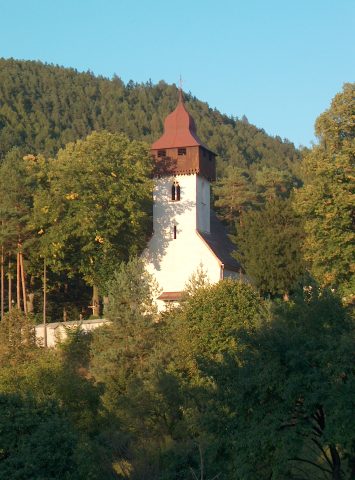
The Strážov Mountain rises quietly above the surrounding landscape, its name meaning "guardian" in Slovak—a fitting title for a peak that has long watched over the undulating valleys and rolling hills of the Slovak Central Uplands. From its slopes, the countryside unfolds in layers of dense forests and open meadows, with the distant silhouette of the Malé Karpaty, or Little Carpathians, fading into the horizon. At the summit, some seven hundred meters above sea level, stands a modest wooden observation tower, a relatively recent addition to the landscape but one that has quickly become a symbol of the area. Built in the early 2000s, when tourism in the region was just beginning to take shape, the tower offers a vantage point unlike any other, inviting visitors to see the world from above.
At just eighteen meters tall, the tower is unassuming, yet its height is enough to lift you above the treetops and into a sweeping panorama that stretches for kilometers. The structure itself is crafted from local timber, its design simple and unpretentious, echoing the practical elegance of traditional Slovak folk architecture. The staircase inside is narrow, with steep steps that demand a slow, deliberate climb, but the effort is rewarded the moment you step onto the viewing platform. Enclosed by sturdy railings, the space feels both secure and open, offering an unobstructed view of the landscape below. On clear days, the vista extends beyond the nearest villages and fields, revealing the faint outlines of distant mountain ranges that frame the horizon.
The choice of location for the tower was no accident. Strážov has served as a natural landmark for centuries, guiding travelers, shepherds, and traders through the region. In medieval times, it may have even hosted a watchtower or outpost, though little physical evidence of such structures remains today. What does endure are the old paths that wind around the mountain’s base—trails once used to drive livestock and transport goods between valleys. Now, these routes have been repurposed for hikers, drawing those who come not only for the view but also for the chance to wander through forests where deer graze quietly and woodpeckers drum against ancient trees.
The mountain reveals its beauty differently with each season. In spring, the slopes burst into color as snowdrops and lungwort carpet the ground, while summer cloaks the forests in deep, verdant shades. Autumn transforms the landscape into a fiery tapestry of gold and crimson, and winter blankets the scene in snow, turning the hills into something out of a fairy tale. Sunsets here are particularly magical, as the sun sinks slowly behind the horizon, painting the sky in hues of pink, orange, and violet. The tower becomes a front-row seat to this daily spectacle, a place to pause and watch the world soften into twilight.
At the base of the tower, a small rest area has been set up with benches and tables, offering a place to sit and soak in the surroundings. During the warmer months, a seasonal café serves hot drinks, providing a welcome respite for those who’ve made the climb. Locals sometimes gather here for picnics, while families often bring children to show them the landscape from above. Below the mountain, a parking lot marks the starting point for several trails leading to the summit. The shortest route takes about half an hour, but longer paths meander through forests and across open clearings, offering a more immersive experience for those who have the time.
Strážov is not a mountain for thrill-seekers or crowded tourist hotspots. It’s a place of quiet reflection, where even in the height of summer, you might find yourself alone on the tower, save for the occasional passerby. The atmosphere is one of stillness, a reminder of how slowly time moves in these parts. From the top, you can see the subtle shifts in the landscape—the way rain carves new paths down the hillsides, how the wind shapes the contours of the fields, and how life unfolds in the villages below, where red-tiled roofs dot the valleys like scattered embers.
In recent years, a handful of informational boards have been installed near the tower, offering insights into the region’s history and natural environment. Visitors can learn about the local flora and fauna, the geological forces that shaped the landscape, and why Strážov has become such an important landmark for those exploring Slovakia’s outdoors. For those with an interest in geology, one of the boards details the types of rock that form the surrounding hills, explaining how layers of sediment and ancient volcanic activity created the terrain we see today.
Standing on the tower, it’s easy to understand why this place holds such appeal. From this height, life below seems to move at a different pace—deliberate, unhurried, in tune with the rhythms of nature. The villages look like miniature models, the fields resemble a patchwork quilt, and the forests stretch out like an endless sea of green. In the distance, the outlines of other mountains blur into the horizon, and for a moment, it feels as though you could see the whole of Slovakia if you just looked hard enough. Perhaps that’s why people keep coming back—not just for the view, but for the sense of connection it brings, a fleeting reminder of the vastness of the world and our small, quiet place within it.