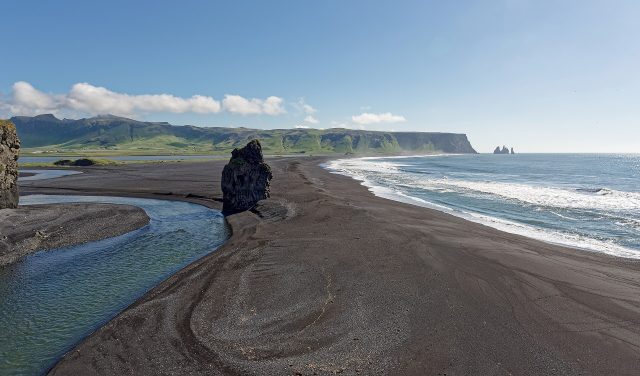
Reynisfjara is one of those places where the raw power of nature feels almost tangible. Just a short walk from the small village of Vík, these jagged basalt sea stacks rise from the ocean like the ruins of some ancient fortress, their dark columns carved by centuries of wind and waves. The locals have long told stories of trolls turned to stone, frozen in time after being caught by the morning sun while trying to drag their ship ashore. Whether you believe the legend or not, there’s something undeniably mystical about the way the light plays across the rocks, especially when the Atlantic crashes against them in great plumes of spray.
The black sand beach at the base of the cliffs is just as striking. Unlike the golden shores most travelers expect, this one is made of volcanic glass, ground down by the relentless ocean. The waves here don’t just roll in—they surge, shifting the sand beneath your feet and leaving behind strange patterns that change with every tide. On clear days, the horizon stretches endlessly, but when storms roll in, the scene becomes almost violent. The wind howls, the water explodes against the rocks, and the air fills with the taste of salt. It’s not a place for the faint of heart, but that’s part of what makes it unforgettable.
For the birds that nest on these cliffs, Reynisfjara is a sanctuary. Puffins, guillemots, and fulmars crowd the ledges during breeding season, their calls echoing over the water. Icelanders have always had a deep connection to these creatures, once relying on them for food and even using their behavior to predict the weather. Today, the birds are protected, but their presence adds another layer to the place—one that feels timeless, as if the cliffs have always been both a home and a warning.
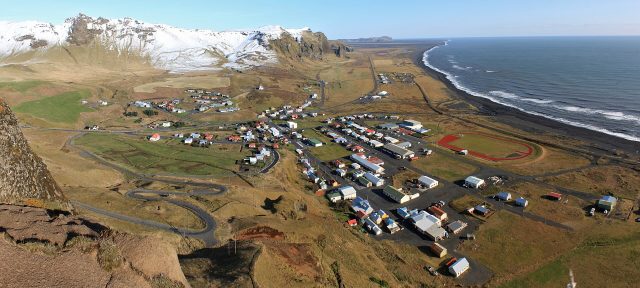
Vík itself is little more than a cluster of houses clinging to the edge of the world. With fewer than 300 residents, it’s the southernmost village in Iceland, a speck of life in a landscape of lava fields and endless ocean. There’s a quiet resilience here, a sense that the people who live in this windswept corner have learned to coexist with forces far greater than themselves. The village has a small shop, a café, and a few guesthouses where travelers can rest before continuing along the Ring Road, the country’s most famous route. But even in the heart of Vík, the ocean is never far away.
What makes Reynisfjara special isn’t just its beauty—it’s the way it makes you feel small. There are no barriers, no neatly paved paths, just the raw elements: rock, water, and wind. You can stand at the edge of the cliffs, the spray misting your face, and for a moment, it’s easy to forget that the modern world exists. The basalt is slick underfoot, and the waves have a habit of sneaking up on you, so caution is wise. The best time to visit is early morning or late evening, when the light is soft and the crowds thin out. That’s when the place feels most like itself—wild, untamed, and utterly indifferent to the people who come to see it.
To Icelanders, Reynisfjara is more than just a geological wonder. It’s a place where the boundaries between the natural and the supernatural blur. The sagas speak of hidden people—elves who live in the rocks—and though few would admit to believing in them today, the stories linger. There’s a sense, standing on that black sand, that the cliffs hold secrets, that the wind carries whispers of something older than memory. It’s the kind of place that stays with you long after you’ve left, not just as an image, but as a feeling.
Just a short walk from the main beach, Dyrhólaey offers another perspective. This narrow headland juts into the ocean, providing a sweeping view of the cliffs and the coastline beyond. On clear days, the horizon seems to stretch forever, but when fog rolls in, the promontory feels like an island cut off from the rest of the world. Photographers often gather here to capture the way the light dances on the water, but even without a camera, the view is mesmerizing. It’s one of those places where you can stand for hours, watching the waves shape the shore.
Vík and its surroundings are steeped in history. The first settlers arrived in the ninth century, and for generations, life here revolved around the sea and the land. Fishing, sheep farming, and survival in a harsh climate shaped the community, and in many ways, little has changed. The village may have a few modern conveniences now, but the rhythm of life still follows the old patterns. The ocean provides, the wind dictates, and the people adapt. It’s a place where time moves differently, where a sunset over the water feels like a gift.
Reynisfjara isn’t just a landmark to check off a list. It’s an experience—one that lingers in the memory long after the photos fade. The sound of the waves, the cry of the birds, the way the wind tugs at your clothes—it all comes together to create something deeper than scenery. This is Iceland at its most elemental: a reminder that nature isn’t just something to admire from a distance, but a force that shapes the world and the people who live in it. And perhaps that’s why, no matter how many times you see it, the sight of those black cliffs rising from the sea never quite loses its magic.