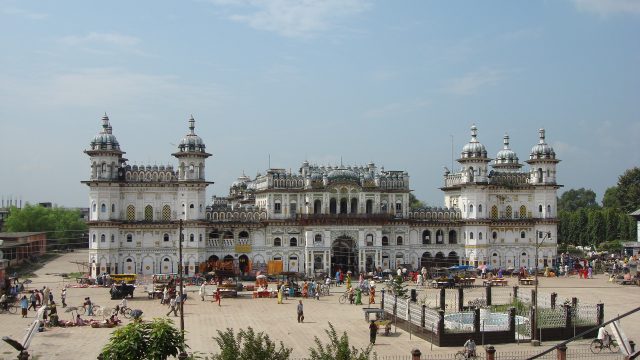
Shiva Mandir in Lahan is one of those places where faith, history, and everyday life intertwine so naturally that it’s hard to tell where one ends and the other begins. Tucked away in the heart of Madhesh Province, in Nepal’s southern plains, this temple dedicated to Shiva doesn’t stand out with grand golden domes or towering marble pillars like the famous shrines of Kathmandu or Varanasi. Instead, its quiet presence is woven into the fabric of the town, as much a part of Lahan’s rhythm as the morning chai stalls or the dusty streets lined with bicycles.
The temple’s architecture is modest but unmistakably Nepali, with a low stone structure crowned by the stepped, pyramid-shaped roof typical of Hindu sanctuaries in this region. The wooden pillars framing the entrance bear the marks of time—faded paint, worn edges, and the dark patina of decades of touch. Inside, the air is cool and dim, pierced only by the flicker of oil lamps and slivers of sunlight filtering through narrow windows. At the center of the sanctum stands the lingam, Shiva’s symbolic representation, the focal point of devotion. The walls are adorned with vibrant, slightly naive murals depicting gods and goddesses in bold colors, their expressions both serene and full of character.
No one knows exactly when Shiva Mandir was built, but its history is as much a part of Lahan as the town itself. For centuries, this area was a crossroads of trade and culture, a stopover between Nepal and India, and the temple likely grew alongside the settlement. Local stories offer different versions of its origins—some say it was founded by a wandering ascetic who meditated here and received Shiva’s blessing; others claim it was commissioned by a long-forgotten royal dynasty. Whatever the truth, the temple has stood for generations as a place of pilgrimage, drawing people from Lahan and the surrounding villages.
Religious life here is deeply communal. During festivals like Maha Shivaratri, the temple transforms into a sea of color and sound, with thousands of devotees gathering to honor Shiva. Marigold garlands drape the shrine, oil lamps glow in the dusk, and the air hums with chants, drumbeats, and the ringing of bells. But even on ordinary days, the temple is far from quiet. Locals come to perform puja, leave offerings of flowers and sweets, or simply sit in the shade, soaking in the peaceful atmosphere. While the temple is open to all, most visitors are Hindu, though the welcoming spirit of the place transcends formal boundaries.
What makes Shiva Mandir unusual is how seamlessly it blends into the life of the town. Unlike many temples enclosed by high walls or strict rules, this one spills into the surrounding streets. A small market thrives just outside, selling everything from incense and fresh flowers to bananas and homemade sweets for offerings. Tea vendors set up their stalls nearby, and sometimes musicians play traditional instruments, their melodies mixing with the murmur of conversation. The scene is ordinary yet deeply alive—women in bright saris carrying baskets of marigolds, children darting between stalls, the occasional cow ambling past. Here, the sacred and the mundane exist side by side, each enhancing the other.
For travelers who find themselves in Lahan, Shiva Mandir offers a glimpse of Nepal far removed from the well-trodden paths of Kathmandu or Pokhara. There are no crowds of tourists, no souvenir shops hawking trinkets, no guides reciting rehearsed facts. Instead, there’s the quiet authenticity of a place where faith is lived, not performed. Visiting requires no special preparation—just a willingness to observe, to remove your shoes before entering, and to move quietly through the sanctum. The temple doesn’t demand reverence; it simply offers a space where it can unfold naturally.
Lahan itself is not a tourist destination, and that’s part of what makes Shiva Mandir so special. The town moves to its own rhythm, untouched by the expectations of outsiders. There are no luxury hotels or Western-style cafes, but there’s something far more interesting: the unfiltered daily life of Nepal’s southern plains. Women wash clothes at communal taps, men gather in the shade to play carrom, and the scent of woodsmoke and spices drifts from open-air kitchens. The temple sits at the center of this world, a quiet anchor for the community.
Beyond its religious significance, Shiva Mandir is a living piece of Nepal’s cultural heritage. Its walls tell a story of the region’s history—its ties to India, its own distinct traditions, and the way Hinduism has absorbed local customs over centuries. You might notice statues of lesser-known deities alongside the familiar figures of Shiva and Parvati, a reminder that faith here is not rigid but adaptive. The temple doesn’t just preserve the past; it reflects how people continue to shape it in their own way.
In an age where many sacred sites feel more like museums than places of worship, Shiva Mandir retains a rare authenticity. There’s no pomp, no performance—just the quiet hum of devotion, the scent of incense, and the occasional laughter of children playing nearby. For those who seek more than just a photo opportunity, this unassuming temple in Lahan offers something far more meaningful: a connection to the living heart of Nepal.