The Sinchon Museum in Sariwon is a place where history feels immediate, where the past isn’t just a series of dates and battles but something lived, remembered, and still deeply felt. Opened in 1958, just a few years after the end of the Korean War, the museum is dedicated to one of the conflict’s most harrowing episodes—the mass killings of civilians in the Sinchon area in late 1950, during the advance of American and South Korean forces. Unlike many war museums that present history in broad strokes, this one focuses on individual lives, on the ordinary people caught in the violence. Every photograph, document, and artifact here is meant to restore a sense of humanity to those who were lost, to show how war doesn’t just disrupt nations but shatters families, homes, and entire communities.
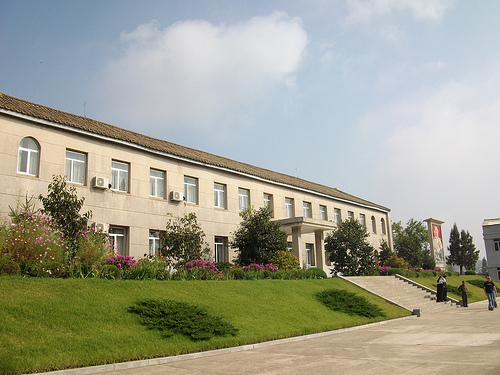
The building itself carries a quiet weight. Designed in the monumental style typical of mid-20th-century North Korea, it combines austere lines with a sense of solemn grandeur. The main hall is spacious, with high ceilings and large windows that let in natural light, softening the starkness of the exhibits. At its center stands a memorial to the dead, while the walls are lined with bas-reliefs depicting scenes of civilian life before and during the war. There’s no overt drama in the architecture—just a sense of reverence, as if the space itself is holding its breath.
The museum’s exhibits are divided into sections, each exploring a different aspect of the tragedy. The first room sets the scene, showing life in Sinchon before the war. Here, farming tools, household items, and family photographs paint a picture of rural existence—simple, hardworking, and peaceful. It’s an ordinary world, one that would soon be torn apart. The next section shifts to the events of autumn 1950, with maps marking execution sites, testimonies from survivors, and images of destroyed villages. The most personal items are the belongings of the dead: a child’s toy, a piece of clothing, a letter never sent. These objects make the history tangible, turning statistics into stories.
One of the most difficult parts of the museum is the room that reconstructs scenes of torture and execution. On display are the tools said to have been used by American and South Korean forces—clubs, knives, ropes—alongside photographs of victims showing signs of violence. The presentation is restrained, but the effect is still visceral. It’s not just about shock; it’s about forcing visitors to confront the brutality of war and the way it dehumanizes both victims and perpetrators. Nearby, however, are accounts of resistance and heroism, stories of people who tried to protect their families or defy their occupiers. The museum doesn’t shy away from the darkness, but it also doesn’t let it overshadow the resilience of those who survived.
Another section focuses on the international response to the Sinchon killings. Newspaper clippings, letters of solidarity from abroad, and photographs of protest rallies show that the world didn’t turn away entirely. The museum frames this as proof that the tragedy had global significance, not just a national one. There are also documents from North Korea’s own post-war investigations, which, while reflecting the official narrative, offer insight into how the country’s collective memory of the war was shaped. It’s a reminder that history is never neutral—it’s always told from a perspective, and here, that perspective is unapologetically partisan.
A smaller exhibit covers the post-war reconstruction of Sinchon, showing how the area was rebuilt from ruins. Photographs of returning villagers and restored villages offer a note of hope, a sense that life, however fragile, goes on. The museum also hosts temporary displays on other aspects of North Korean history, but the core remains the events of 1950. The message is clear: this is a story that must not be forgotten, even as the country moves forward.
Visiting the Sinchon Museum is an intense experience. It’s not a place for detached observation; it demands engagement, even discomfort. The museum doesn’t claim to be impartial. It sides with the victims, and that perspective is woven into every exhibit. Yet there’s no call for vengeance, no overt propaganda—just a quiet insistence on remembering. For foreign visitors, it can be a jarring shift in how they understand the Korean War. Instead of geopolitical strategies or military maneuvers, the focus is on the people who lived, suffered, and died. It’s a history that refuses to be abstract.
Sariwon isn’t a major tourist destination, and the Sinchon Museum rarely appears on must-see lists. That’s part of its appeal. There are no crowds, no gift shops, no distractions—just the exhibits and the silence. The museum sits away from the city center, surrounded by greenery, which adds to the sense of isolation. Visitors often leave with a mix of emotions: sadness, certainly, but also a strange sense of connection, as if they’ve glimpsed something essential about the country’s identity. It’s not an easy place to visit, but it’s an important one.
More than just a collection of artifacts, the Sinchon Museum is a place where history feels alive. It serves as a reminder that behind every war are real people, and that their stories deserve to be remembered. For North Korea, the museum holds particular significance. It’s a testament to survival, a way of honoring those who endured unimaginable hardship. The narrative it presents is one-sided, but that doesn’t make it any less powerful. If anything, it forces visitors to grapple with the complexities of memory and the way history is shaped by those who tell it. In the end, the museum’s greatest value may be its ability to make the past feel urgent, to remind us that the cost of war is measured not just in territory lost or gained, but in lives forever changed.