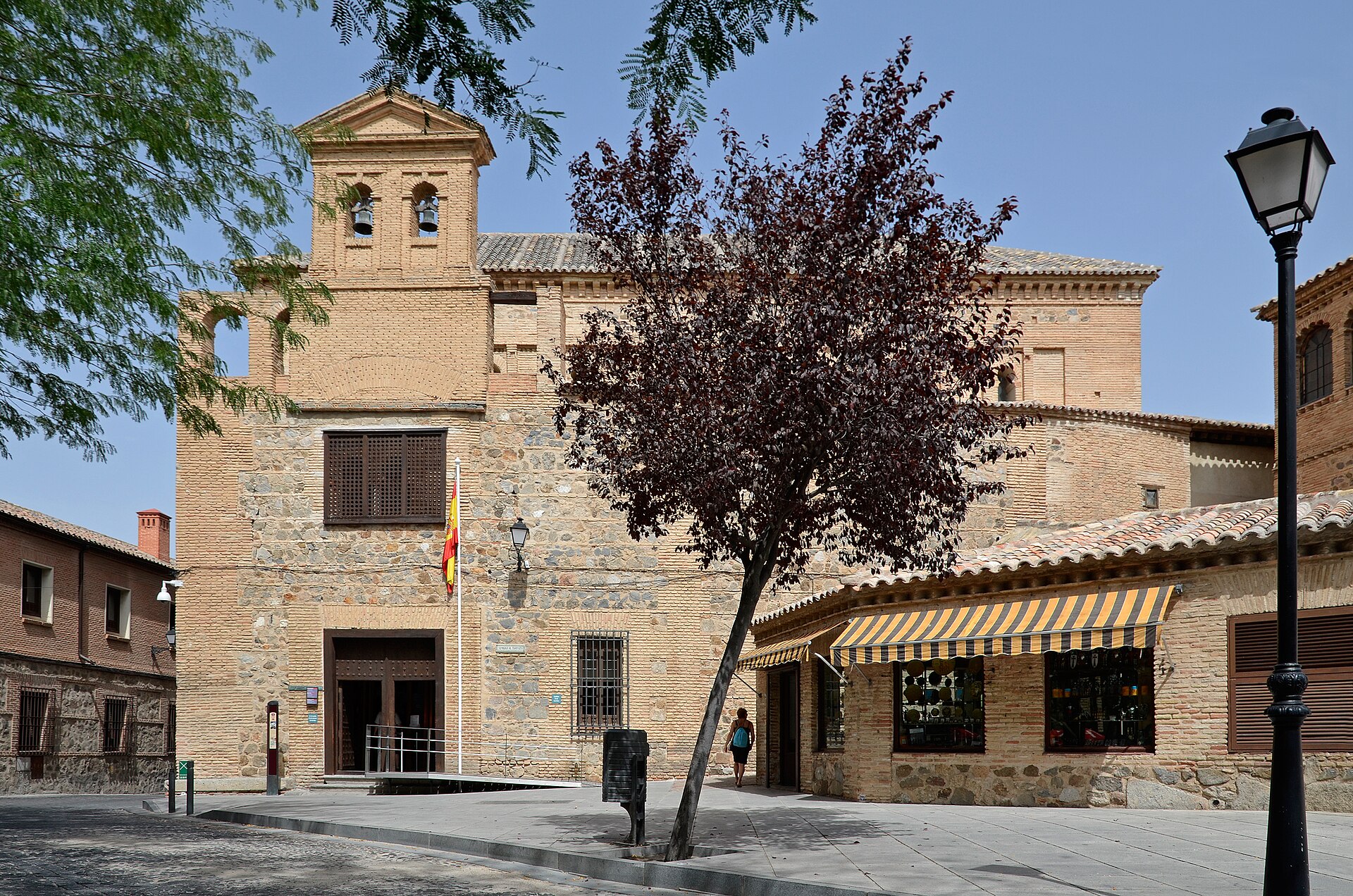
Toledo has a way of holding onto the past, and few places in the city embody that quiet persistence as vividly as the Sinagoga del Tránsito. Built in the mid-14th century, it stands as a testament to a time when the city was a crossroads of cultures, where Jewish, Christian, and Muslim communities coexisted—sometimes uneasily, but often in ways that left a lasting mark on the city’s identity. Today, the building no longer serves as an active place of worship, but stepping inside feels like entering a space where history hasn’t so much faded as settled into the very stones.
The architecture of the synagogue is a study in contrasts. From the outside, it appears unassuming, its plain walls giving little hint of the richness within. But the interior unfolds like a hidden treasure, its high ceilings and slender columns adorned with intricate stucco work that blends Islamic geometric patterns with Hebrew inscriptions. The craftsmanship is so precise that it’s easy to imagine the artisans treating the walls like a canvas, each detail carefully considered. The mihrab, the niche pointing toward Jerusalem, is particularly striking—its delicate carvings and calligraphy suggest a reverence that transcends mere function. It’s the kind of place where you can almost hear the echoes of prayers offered centuries ago.
The synagogue’s history is inseparable from the story of Samuel ha-Levi, a Jewish treasurer in the court of King Pedro I of Castile. Ha-Levi commissioned the building, though he never lived to see its completion. His influence in Toledo was significant, and the synagogue became more than just a house of worship—it was a gathering place for a community that, despite growing pressures, was experiencing a cultural golden age. Here, discussions of trade, law, and philosophy took place alongside religious rituals, reflecting the intellectual vitality of the city’s Jewish population at the time.
When the Jews were expelled from Spain in 1492, the synagogue’s fate shifted dramatically. Over the centuries, it served various purposes—a hospital, a church, even a storage space—each new role leaving its mark on the building. It wasn’t until the 19th century that efforts were made to return it to the Jewish community, though by then, much of its original character had been altered. A restoration in the early 20th century helped reclaim some of its former glory, though certain details were lost to time. Today, it houses the Sephardic Museum, a quiet but powerful reminder of the Jewish heritage that once thrived in Spain.
Walking through the synagogue’s halls, it’s impossible not to feel the weight of history. The space is no longer a center of daily life, but it retains a sense of presence, as if the voices of those who once gathered here still linger in the air. The walls, covered in carved panels, tell stories of their own. The designs blend Moorish artistry with Jewish symbolism—pomegranates, symbols of fertility, intertwine with vine motifs, while Hebrew inscriptions preserve prayers, blessings, and even personal messages from those who built and used the space. These details make the synagogue more than just an architectural relic; they turn it into a living record of faith and culture.
Toledo has long been celebrated for its diversity, and the Sinagoga del Tránsito is one of the clearest examples of how different traditions could coexist, even flourish, side by side. In this city, where mosques, churches, and synagogues stand within steps of one another, it’s not hard to imagine the sounds of bells, calls to prayer, and the chanting of Torah readings blending in the narrow streets. The history wasn’t always harmonious—conflicts and persecution left deep scars—but places like this synagogue show how culture can endure, even in the face of adversity.
Today, the synagogue serves as both a museum and a memorial. Exhibitions explore the history of Sephardic Jews, while concerts of medieval music and lectures on Jewish culture occasionally fill the halls. Sometimes, the sound of Hebrew can still be heard here, a quiet reminder that traditions don’t vanish; they wait. For many visitors, the synagogue is a revelation—not just for its beauty, but for the way it challenges assumptions about history. It’s a place that makes you realize how fragile culture can be, yet how resilient it is when nurtured by memory.
In the end, the Sinagoga del Tránsito is more than a building. It’s a bridge to a past that shaped Spain in ways that are still felt today. The stories it holds—of faith, of creativity, of survival—are woven into the very fabric of Toledo. And while the world outside has changed beyond recognition, stepping into this space feels like a moment of connection, a chance to listen to the echoes of a time when the city was a meeting point of worlds.