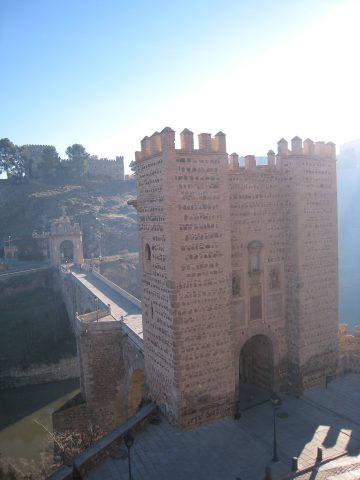
Perched on Toledo’s highest hill, the Alcázar looms over the city like a silent witness to centuries of change. Its stone walls have absorbed the weight of empires, the clamor of battles, and the quiet footsteps of kings and soldiers. From this vantage point, the Tagus River winds through the valley below, its curves framing a maze of medieval streets where time seems to move at its own pace. The fortress didn’t just stand through history—it shaped it, its very name a relic of its past: *Alcázar*, from the Arabic *al-qasr*, meaning palace or stronghold.
The story of the Alcázar begins long before the Reconquista, though its earliest origins are shrouded in the mists of time. Some believe the Romans first fortified this hill, but it was the Moors who transformed it into an impregnable citadel, a symbol of their power in the heart of the Iberian Peninsula. When Christian forces reclaimed Toledo in the 11th century, the Alcázar became a royal residence, its halls echoing with the ambitions of Castilian kings. Alfonso VI and Alfonso X expanded its walls, reinforcing its role as both a military bastion and a seat of power. But it was Charles V, the Holy Roman Emperor, who left the most lasting mark. Under his rule, the fortress was reborn as a Renaissance palace, its grand halls and towering columns designed to reflect the might of an empire that spanned continents.
Yet the Alcázar’s history is far from one of unbroken grandeur. It has weathered sieges, fires, and neglect, each era leaving its scars. During the War of Spanish Succession, the fortress withstood a brutal siege, its defenders clinging to its walls as the city below burned. In the 19th century, it became a military garrison, its once-opulent interiors repurposed for barracks and armories. This pragmatic use saved the building from ruin, but it also stripped away much of its former splendor. The Alcázar’s survival, however, is a testament to its resilience—a quality that defines Toledo itself.
Today, the fortress houses the Army Museum, a fitting role for a building so deeply tied to Spain’s military past. The exhibits trace the evolution of warfare from the Reconquista to modern conflicts, but they do more than document battles. Here, history feels tangible: the weight of a medieval sword, the intricate details of a general’s uniform, the faded maps of campaigns long forgotten. The air carries the scent of aged leather and polished wood, a reminder of the countless soldiers who once walked these halls. The museum doesn’t just display artifacts; it invites visitors to step into the lives of those who shaped Spain’s destiny.
Architecturally, the Alcázar is a palimpsest of styles, each layer revealing a different chapter of its past. The austere strength of its Moorish foundations contrasts with the Gothic arches and Renaissance flourishes added by later rulers. The southern façade, rebuilt under Charles V, stands as a monument to imperial ambition, its symmetrical windows and heraldic crests a nod to the empire’s reach. Inside, the fortress retains a sense of its original purpose—its vaulted ceilings, spiral staircases, and inner courtyards evoke the daily rhythms of life within its walls. Even now, after careful restoration, the Alcázar feels lived-in, as if the ghosts of its past inhabitants might still linger in its shadows.
Toledo is often called a city-museum, but the Alcázar is more than just another historic site. It dominates the skyline not just physically, but in the way it anchors the city’s identity. From its ramparts, the view stretches across a sea of terracotta roofs, whitewashed churches, and the winding Tagus below. At dusk, when the fortress is bathed in golden light, it seems to float above the city, a silent guardian of its secrets. For locals, the Alcázar is part of everyday life—a place to walk the dog, meet friends, or simply watch the sunset. Its history is respected, but not revered to the point of detachment. It’s a living space, not a relic.
Visiting the Alcázar is less about ticking off a tourist attraction and more about immersing yourself in its atmosphere. Unlike the crowded halls of the Prado or the Sagrada Família, the fortress offers a quieter, more intimate experience. There’s no rush here—just the chance to wander through its galleries, pause in a sunlit courtyard, or sit on a bench and listen to the echoes of footsteps bouncing off the stone. Occasionally, temporary exhibitions or lectures add a new dimension to the visit, but even without them, the Alcázar has a way of revealing something new with each return. A play of light on an ancient arch, a detail in the masonry you’d missed before—it’s the kind of place that rewards curiosity.
Beyond its historical significance, the Alcázar has woven itself into the fabric of modern Toledo. It’s a venue for concerts, festivals, and even weddings, its grand halls repurposed for celebrations that bridge past and present. The fortress has become a symbol of the city, a landmark that appears on postcards and in guidebooks, yet it hasn’t been reduced to a mere tourist attraction. It remains a functional part of Toledo’s life, evolving alongside the city while retaining its essence. That duality—between monument and living space—is what makes the Alcázar so compelling. It doesn’t just tell stories of the past; it lets you feel them, as if the stones themselves are whispering the secrets of the centuries.