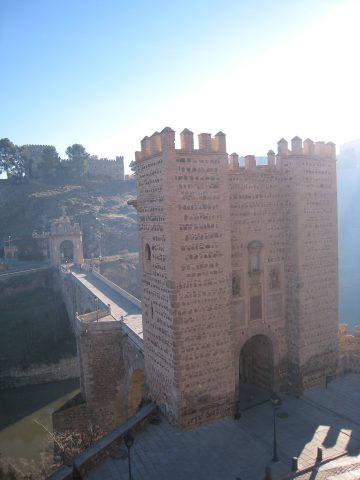
Perched on a hill in Toledo’s old quarter, the Monastery of San Juan de los Reyes feels like a silent guardian of the city’s layered past. Commissioned in the late fifteenth century by the Catholic Monarchs Isabella and Ferdinand, it was built to commemorate their victory at the Battle of Toro and the birth of their heir—a dual celebration of military triumph and dynastic hope. The monastery stands as a masterpiece of late Gothic architecture, infused with the delicate touches of Mudéjar craftsmanship that define so much of Spain’s medieval aesthetic. Its soaring pointed arches, intricate stone carvings, and luminous stained glass create an unexpected lightness, as if the heavy stone were somehow weightless. The two-tiered cloister is particularly striking, with its upper gallery appearing to float above the lower, its columns adorned with the heraldic shields of the royal couple.
Inside, the monastery exudes the quiet solemnity of a place shaped by centuries of monastic life. The church’s nave is vast, its vaulted ceilings stretching upward in a display of architectural ambition, while the side chapels hold remnants of its former grandeur—elaborate altarpieces, faded frescoes, and the tombs of Toledo’s nobility. The choir’s ceiling, painted in gold and deep blue, is a testament to the skill of medieval artisans, its patterns shimmering in the dim light. One chapel still displays the chains said to have been worn by Christian captives freed after the conquest of Granada, a tangible link to the Reconquista’s final chapter.
San Juan de los Reyes is deeply entwined with the story of Spain’s unification. Toledo, where the monastery stands, was a strategic hub for the Catholic Monarchs as they planned their campaigns against the Moors. After the fall of Granada in 1492, the monastery became a symbol of the new Spain, its walls witnessing royal audiences, solemn ceremonies, and even the funerals of the elite. Walking through the cloister today, it’s easy to imagine the murmur of monks in prayer or the footsteps of pilgrims seeking solace. The stone benches lining the walls are worn smooth by time, bearing the imprint of countless hands and voices.
Toledo has long been known as a city of three cultures—Christian, Muslim, and Jewish—and the monastery reflects this rich interplay. While its structure is unmistakably Gothic, the influence of Islamic art is visible in the delicate arabesques on the column capitals and the geometric patterns adorning the ceilings. Even the royal coats of arms on the façade carry an almost Eastern elegance. Yet the monastery was also a bastion of Catholic faith, a place where prayers were offered for the success of Christian arms. This fusion of styles and traditions makes it a unique monument, one where different eras and worldviews coexist.
Today, the monastery remains a place of quiet reflection, drawing both visitors and locals. Some come for the history, others for the stillness that lingers in its halls. The cloister often hosts artists sketching the play of light on the stone or students studying medieval architecture. Occasionally, classical music concerts are held within its walls, the acoustics of the monastery’s chambers transforming each performance into something transcendent.
San Juan de los Reyes is more than just a historical site; it’s a living piece of the past. It has endured wars, fires, and neglect, yet its grandeur remains undiminished. Walking through its corridors, it’s impossible not to wonder about the lives that have passed through here—the prayers whispered under these vaults, the decisions made within these walls. Toledo is a city where history feels tangible at every turn, and the monastery is one of its most evocative treasures. Here, time moves differently, and the noise of the modern world fades into the background.